
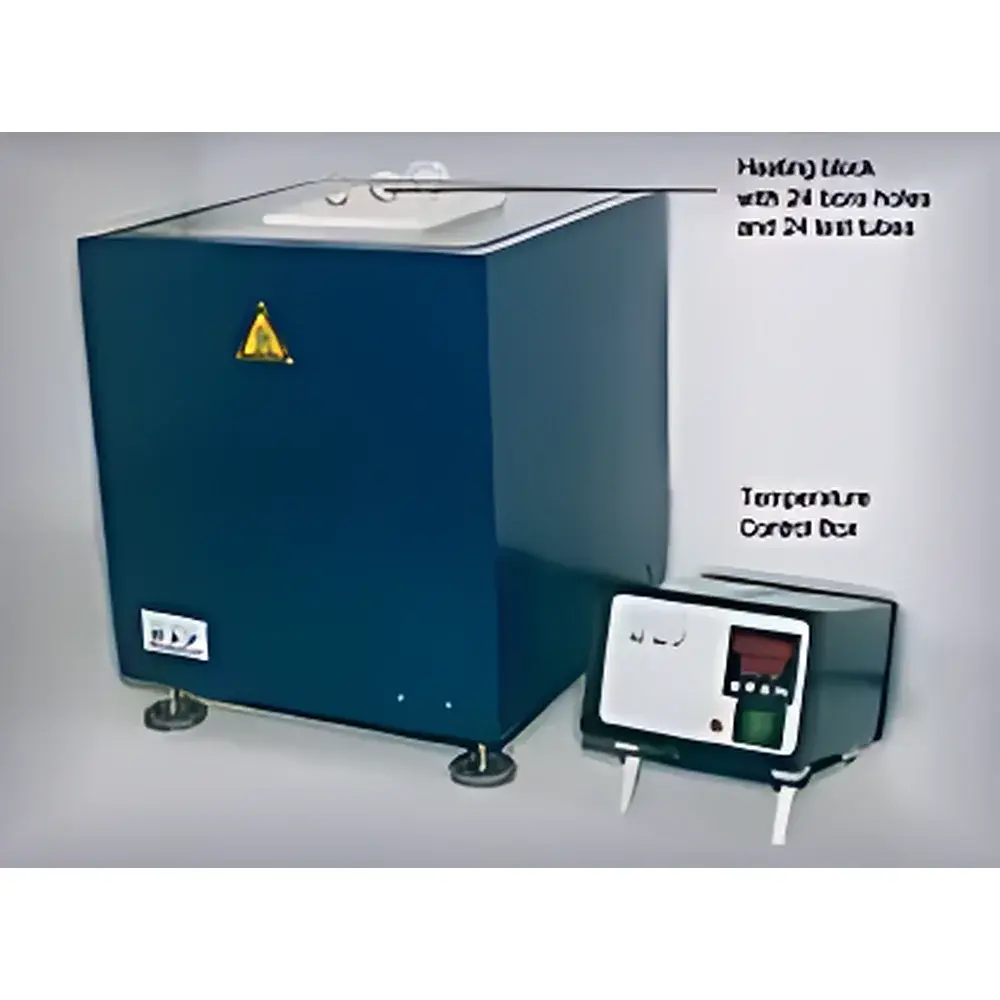
R&P Methyl Violet Thermal Stability Tester (MIL-STD-286C Compliant)
| Brand | R&P |
|---|---|
| Origin | Germany |
| Manufacturer Type | Authorized Distributor |
| Product Category | Imported Instrument |
| Model Designation | MV-TS 24-135 |
| Temperature Range | 60–140 °C |
| Control Accuracy | ±0.1 °C |
| Heating Block | 24-position anodized aluminum, 20.5 mm bore (19 mm per MIL-STD-286C), 280 mm depth |
| Sample Tubes | 24 × stainless steel cylindrical tubes, OD 20 mm (18 mm per MIL-STD-286C), ID 17 mm (15 mm per MIL-STD-286C), L 290 mm, with vented retaining clamps and stainless steel suspension hooks |
| Detection Medium | 200 pcs methyl violet impregnated indicator papers (N₂O-sensitive) |
| Temperature Sensor | PT100 Class A |
| Safety | Independent overtemperature cut-off device |
| Controller | Dedicated PID-based programmable temperature controller with isolated ISO-compliant housing |
| Display | Dual digital LED (setpoint & real-time temperature) |
| Power Supply | 230 V AC, 50–60 Hz |
| Power Consumption | 1500 VA |
| Cable Length | ~2 m |
Overview
The R&P Methyl Violet Thermal Stability Tester (Model MV-TS 24-135) is a precision-engineered thermal aging apparatus designed specifically for the standardized assessment of thermal stability in nitrocellulose-based propellants and insensitive munitions compounds. It implements the methyl violet test method as defined in U.S. Department of Defense standard MIL-STD-286C (Sections 120 and 134.5), which quantifies decomposition onset by detecting nitrogen dioxide (NO₂) — a primary gaseous decomposition product — via colorimetric reaction with methyl violet-impregnated paper. The instrument operates on the principle of controlled isothermal exposure: samples are heated at precisely maintained temperatures (commonly 120 °C or 135 °C) within sealed, vented stainless steel tubes; evolved NO₂ diffuses through calibrated apertures and reacts with the indicator paper, producing a measurable purple-to-blue color transition. This endpoint serves as a reproducible, operator-independent metric for relative thermal lability and shelf-life prediction under accelerated aging conditions.
Key Features
- 24-position high-mass anodized aluminum heating block with optimized thermal uniformity (±0.3 °C across all positions at 135 °C), engineered to minimize thermal gradients during extended isothermal holds.
- PT100 Class A resistance thermometer integrated directly into the block core, providing traceable, NIST-compatible temperature feedback to the dedicated PID controller.
- Independent safety architecture: redundant overtemperature protection circuitry with mechanical cut-off independent of the main control loop ensures fail-safe shutdown if setpoint exceeds 142 °C.
- ISO 17025-aligned thermal isolation design: heating block mounted on certified thermal insulation board to reduce ambient heat loss and improve energy efficiency and repeatability.
- Stainless steel sample tubes feature precision-machined venting slots in retention clamps and corrosion-resistant suspension hooks — enabling consistent gas diffusion kinetics and eliminating tube-to-tube variability in detection response.
- Dual digital LED display shows both user-defined setpoint and real-time block temperature simultaneously, with resolution of 0.1 °C and long-term drift <0.05 °C/month.
Sample Compatibility & Compliance
The MV-TS 24-135 supports standardized sample forms per MIL-STD-286C, including pressed pellets, extruded grains, and solvent-cast films of nitrocellulose, double-base propellants (NC/NG), and modern insensitive formulations such as DNAN-, NTO-, or FOX-7-based compositions. Tube dimensions (OD 20 mm, ID 17 mm, L 290 mm) accommodate typical specimen masses of 0.5–2.0 g while maintaining defined headspace-to-sample volume ratios critical for quantitative gas evolution modeling. All structural materials comply with ASTM E2018 for laboratory thermal equipment and meet EU RoHS Directive 2011/65/EU. The system is routinely validated per ISO/IEC 17025:2017 Annex A.2 for method-specific equipment qualification and supports full audit trails required under GLP and DoD QA Program Directive 5010.12.
Software & Data Management
While the MV-TS 24-135 operates as a stand-alone analog-controlled instrument, it integrates seamlessly with external data acquisition systems via its 0–10 V analog output port (temperature signal) and discrete TTL-level status outputs (heating active, alarm triggered). Optional R&P DAQ-Link interface module enables time-stamped logging of temperature profiles, event markers (e.g., paper color change detection via external optical sensor), and operator inputs into compliant LIMS or ELN platforms. All calibration records, maintenance logs, and performance verification reports (including daily thermocouple verification and quarterly uniformity mapping) are structured to satisfy FDA 21 CFR Part 11 requirements when paired with validated electronic signature workflows.
Applications
- Qualification testing of new propellant batches prior to field deployment in artillery, small arms, or rocket motor applications.
- Comparative thermal stability screening during formulation development of low-vulnerability energetic materials.
- Accelerated aging studies supporting life extension programs for legacy munitions stockpiles.
- Root cause analysis of field failures linked to premature decomposition or binder degradation.
- Supporting compliance documentation for NATO AEP-97 (STANAG 4147) and UN Manual of Tests and Criteria, Part I, Series 5 tests.
FAQ
Does this instrument comply with MIL-STD-286C Section 134.5?
Yes — the heating block geometry, tube dimensions, temperature control tolerance (±0.1 °C), and indicator paper specification are fully aligned with the physical and procedural requirements of MIL-STD-286C, including the mandatory 135 °C test condition.
Can the unit be operated at temperatures other than 120 °C or 135 °C?
Yes — the programmable PID controller supports any setpoint between 60 °C and 140 °C in 0.1 °C increments, enabling custom stability protocols beyond the standard military methods.
Is calibration certification included with shipment?
Each unit ships with a factory-issued calibration certificate traceable to PTB (Physikalisch-Technische Bundesanstalt), covering temperature uniformity, accuracy, and controller linearity — valid for 12 months from date of issue.
What maintenance is required to sustain measurement integrity?
Quarterly verification of thermal uniformity across all 24 positions and annual recalibration of the PT100 sensor and controller are recommended; R&P provides certified service technicians and NIST-traceable reference standards.
Are replacement methyl violet papers supplied with ongoing consumables support?
Yes — R&P supplies OEM-grade methyl violet indicator papers in certified lots (batch-tested for sensitivity and shelf life), available in packs of 100 or 500, with full CoA and expiration tracking.





