
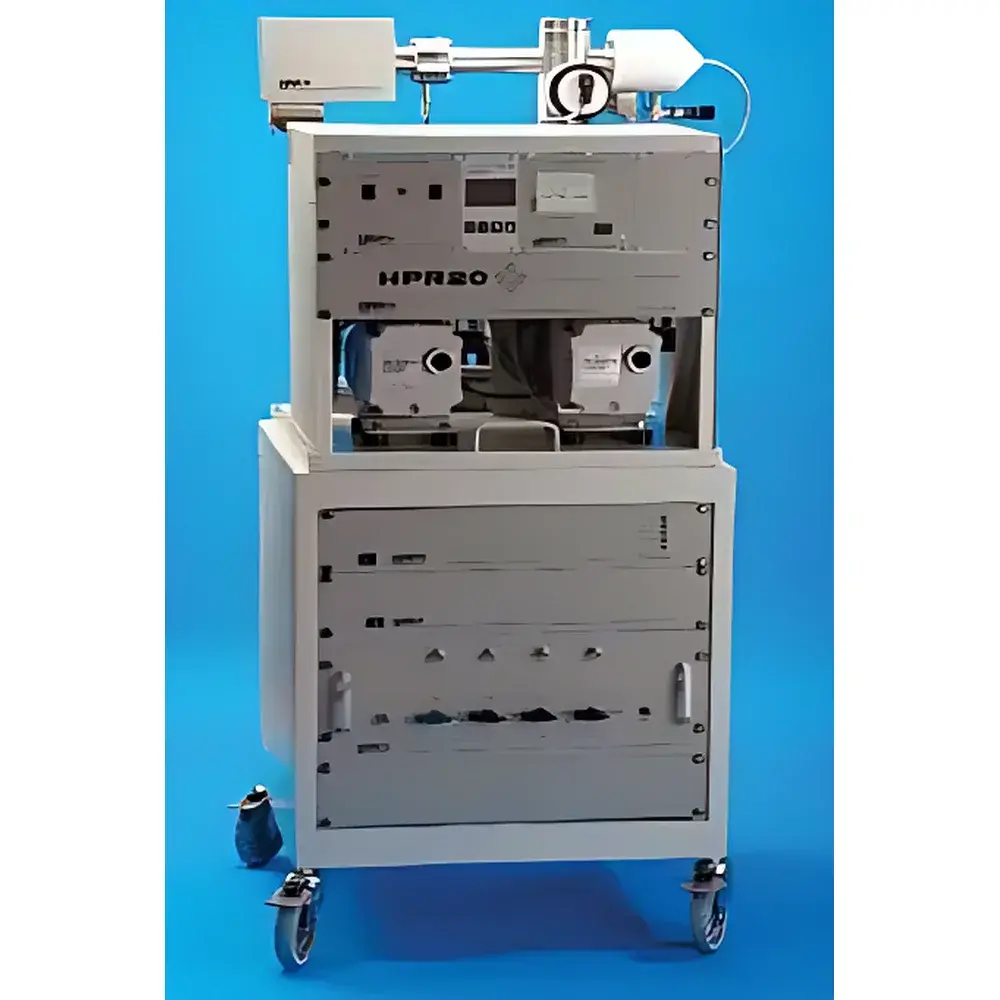
Hiden Analytical HPR20 QICPlus Automated Quantitative Online Mass Spectrometer
| Origin | UK |
|---|---|
| Manufacturer Type | Authorized Distributor |
| Origin Category | Imported |
| Model | HPR20 QICPlus |
| Quotation | Upon Request |
| Mass Range | 1–50 / 1–200 / 1–300 / 1–500 / 1–1000 amu |
| Quadrupole Type | Residual Gas Analyzer (RGA) or Triple-Filter (3F) Configuration |
| Capillary Inlet | Integrated quartz capillary (2 m length), stainless-steel sheathed, heated to 200 °C |
| Gas Flow Rate | 1–20 sccm (adjustable) |
| Inlet Pressure Range | 100 mbar–2 bar (standard) |
| Mounting Options | Benchtop or vehicle-mounted (optional) |
| Detection Limit | 0.1–1 ppm (RGA HAL series, standard) |
| Mass Resolution Step | 0.01 amu (minimum scan increment) |
| Multi-Channel Inlet Valve | Up to 80 channels (heated or unheated, optional) |
| Calibration Gas Panel | Four-component gas delivery and pre-mixing manifold |
| Sample/Calibration Switching | Dual-gas-path inlet with low-dead-volume valves, auto/manual toggle between zero gas, calibration gas, and process sample |
| Inlet Filter | 5 µm sintered metal, high transmission, low dead volume, field-serviceable |
| Quantification Software | Automated calibration using certified reference gases |
| output units | %, ppm, ppb |
Overview
The Hiden Analytical HPR20 QICPlus is an engineered solution for real-time, quantitative gas-phase composition monitoring in industrial process environments. Built upon the proven HPR20 QIC platform, this system integrates a high-stability quadrupole mass spectrometer with fully automated gas handling, dynamic calibration capability, and trace-level detection performance. Its operational principle relies on electron ionization (EI) of sampled gas molecules followed by mass-selective filtering via a radio-frequency (RF)/direct-current (DC) quadrupole mass analyzer—enabling precise identification and quantification of gaseous species across a broad mass range (1–1000 amu). Designed specifically for continuous online deployment, the HPR20 QICPlus maintains analytical integrity under fluctuating pressure and compositional conditions typical of chemical reactors, fermentation vessels, catalytic beds, semiconductor etch chambers, and vacuum coating systems.
Key Features
- Modular quadrupole configurations: Standard RGA HAL-series quadrupole (0.1–1 ppm LOD) or high-sensitivity 3F triple-filter option (5 ppb LOD) for demanding trace analysis.
- Thermally stabilized quartz capillary inlet (2 m, heated to 200 °C), housed within a corrosion-resistant stainless-steel sheath—minimizing condensation, adsorption, and memory effects for reactive or condensable species.
- Dual-path, low-dead-volume gas switching manifold with automatic/manual selection between process sample, zero gas, and multi-component calibration standards—ensuring measurement continuity and metrological traceability.
- Integrated four-gas mixing panel supporting precise preparation of custom calibration blends directly at the instrument interface, reducing external cylinder dependency and cross-contamination risk.
- Programmable multi-channel inlet valve supporting up to 80 independent sampling points; configurable for ambient or heated operation to prevent condensation in long-line applications.
- FCI (Flow Control Interface) module available for active pressure compensation during variable-process-pressure operation—maintaining constant ion current and signal stability across dynamic pressure ranges (100 mbar–2 bar).
Sample Compatibility & Compliance
The HPR20 QICPlus accommodates a wide spectrum of process gases—including corrosive (e.g., Cl₂, HCl, HF), reactive (e.g., NH₃, H₂S, silanes), and condensable vapors (e.g., alcohols, esters, monomers)—via its chemically inert quartz/stainless-steel inlet architecture and optional heated valve train. All wetted materials comply with ASTM F519 and ISO 15156 for sour service compatibility where applicable. The system supports audit-ready operation per GLP and GMP requirements: full electronic record retention, user-access logging, and calibration history tracking. While not inherently 21 CFR Part 11 compliant out-of-the-box, the QICPlus software architecture permits integration with validated LIMS or MES platforms supporting electronic signatures and audit trails when deployed in regulated pharmaceutical or biomanufacturing settings.
Software & Data Management
Quantitative analysis is executed via Hiden’s QGA (Quantitative Gas Analysis) software suite, which implements a constrained matrix inversion algorithm to resolve overlapping peaks and compute absolute concentrations from partial pressure measurements. Calibration is fully automated using certified reference gas mixtures—eliminating manual response factor entry and reducing operator-induced error. Real-time data output includes time-stamped concentration traces (% v/v, ppm, ppb), spectral snapshots, and diagnostic parameters (ion gauge pressure, filament emission current, detector gain). Data export conforms to ASTM E1382-compliant CSV and XML formats; OPC UA and Modbus TCP interfaces are supported for seamless DCS/SCADA integration. All calibration events, method changes, and maintenance logs are timestamped and user-attributed—facilitating compliance with ISO/IEC 17025 documentation requirements.
Applications
- Real-time catalyst deactivation monitoring via CO, CO₂, H₂, CH₄, and hydrocarbon speciation in Fischer–Tropsch or methanol synthesis loops.
- In-situ fermentation off-gas analysis for O₂ uptake rate (OUR), CO₂ evolution rate (CER), and ethanol/acetate profiling in bioreactor process control.
- Etch endpoint detection and chamber cleanliness verification in plasma-enhanced CVD/PVD tools through real-time F, Cl, and Si-containing fragment tracking.
- Leak detection and residual gas analysis (RGA) in high-vacuum systems (e.g., particle accelerators, fusion diagnostics) with sub-ppm sensitivity.
- Flue gas and syngas compositional trending for combustion efficiency optimization and emissions compliance reporting (e.g., NOₓ, SO₂ precursors).
FAQ
What mass resolution and scan speed does the HPR20 QICPlus support?
The system achieves a minimum mass step of 0.01 amu with programmable dwell times per mass channel; typical full-spectrum scans (e.g., 1–100 amu) complete in under 2 seconds at unit mass resolution.
Can the instrument operate under varying process pressures without manual intervention?
Yes—when equipped with the optional FCI flow control interface, the system dynamically adjusts inlet conductance to maintain constant molecular flow into the analyzer, enabling stable quantification across pressure excursions from 100 mbar to 2 bar.
Is remote configuration and diagnostics supported?
Standard Ethernet connectivity enables secure remote access via VNC or SSH for firmware updates, method editing, and real-time spectral viewing; TLS-encrypted API endpoints are available for custom integration.
How is calibration traceability maintained?
Certified NIST-traceable gas standards are used for initial calibration; subsequent recalibrations are logged with gas lot numbers, expiration dates, and operator credentials—satisfying ISO 17025 clause 5.6.2 requirements.
What safety certifications apply to the HPR20 QICPlus for hazardous area installation?
The base unit carries CE marking per ATEX Directive 2014/34/EU (Category 3G, Zone 2) and IECEx certification; explosion-proof enclosures and purge systems are available as factory-installed options for Zone 1 deployment.
Related Products






