
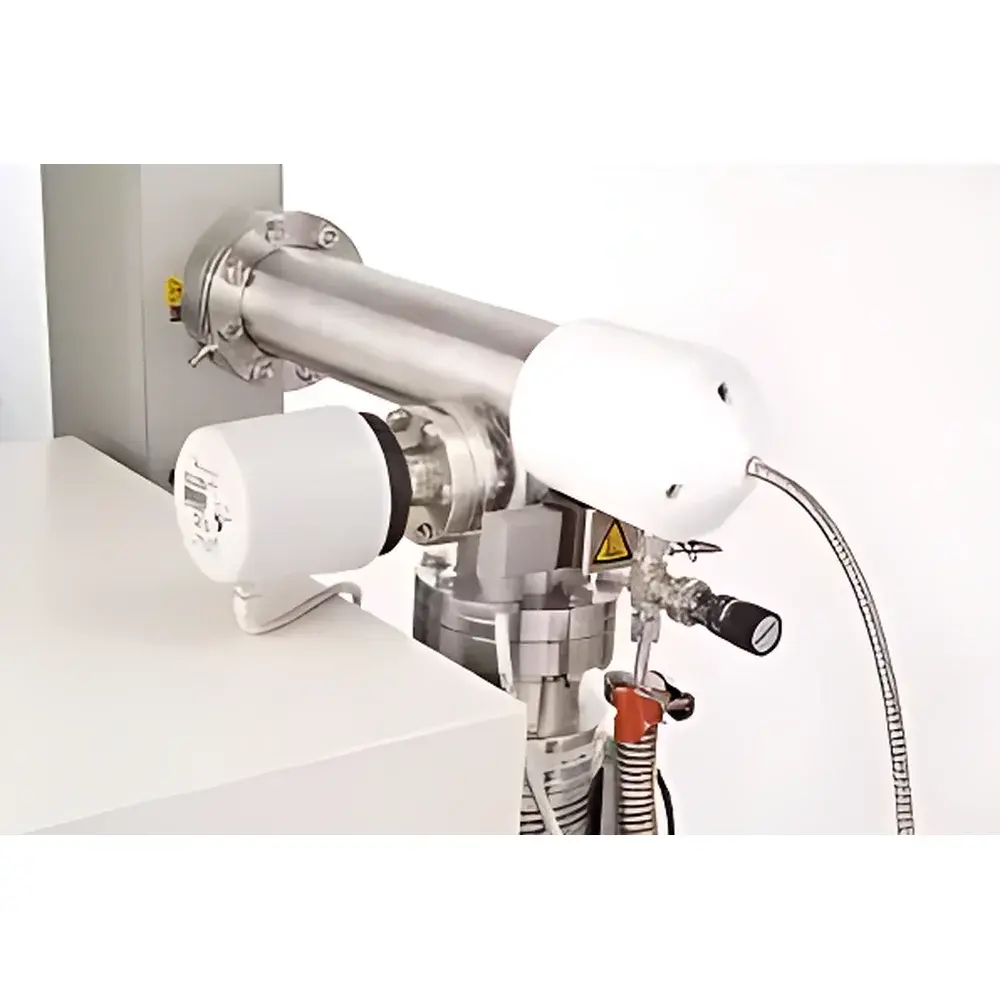
Hiden HPR20 QIC TMS Transient Process Gas Analysis Mass Spectrometer
| Brand | Hiden |
|---|---|
| Origin | Austria |
| Model | HPR20 QIC TMS |
| Mass Range | 1–50 / 100 / 200 / 300 / 500 / 1000 amu |
| Sampling Pressure | 100 mbar–2 bar (standard) |
| Response Time | <150 ms |
| Dynamic Range | 7 decades (pulse-counting detector) |
| Detection Limit | 5 ppb |
| Quantification Range | ppm to 100% |
| Stability | ±0.5% peak height over 24 h |
| Scan Speed | 100 amu/s |
| Measurement Rate | 500 data points/sec |
| Capillary | 0.9 m heated quartz inert capillary (up to 200 °C) |
| Ionization | APSI-MS soft ionization |
| External Analog Outputs | 2 standard, up to 16 optional |
Overview
The Hiden HPR20 QIC TMS is a high-speed, quadrupole-based process mass spectrometer engineered for real-time, quantitative analysis of transient gas-phase reactions occurring near ambient pressure. Unlike laboratory benchtop MS systems optimized for static or slow-varying samples, the HPR20 QIC TMS employs a dedicated hardware and vacuum architecture to maintain stable ion transmission under dynamic pressure gradients and rapidly evolving composition profiles. Its core measurement principle relies on electron ionization (EI) augmented by Hiden’s proprietary Atmospheric Pressure Sampling Interface – Mass Spectrometry (APSI-MS), enabling selective, low-fragmentation ionization of complex volatile organic compounds (VOCs), inorganic gases, and condensable vapors without prior chromatographic separation. The system is designed for integration into catalytic reactors, plasma discharge chambers, fermentation off-gas streams, and chemical vapor deposition (CVD) exhaust lines where sub-second compositional shifts must be resolved with metrological traceability.
Key Features
- 0.9 m heated quartz inert capillary (QIC) with precise temperature control up to 200 °C — minimizes surface adsorption, prevents condensation, and ensures representative sampling of thermally labile species;
- APSI-MS soft ionization module — reduces fragmentation, enhances molecular ion signal intensity, and improves selectivity for isobaric and structurally similar analytes;
- Multi-source compatibility — supports interchangeable ion sources including standard EI, filament-heated CI, and optional laser-assisted desorption configurations;
- Pulse-counting detector with 7-decade linear dynamic range — delivers robust quantification across concentration spans from 5 ppb to 100% without gain switching or detector saturation;
- Optimized differential pumping architecture — maintains stable 10−6 mbar analyzer chamber pressure while accepting sample gas at 100 mbar–2 bar (standard), extendable to 30 bar with optional high-pressure interface;
- Sub-150 ms system response time — defined as time from inlet perturbation to full spectral acquisition; validated for >5-decade step changes in gas composition within 200 ms;
- Real-time spectral acquisition at 500 data points per second — enables time-resolved tracking of reaction intermediates, transient radicals, and short-lived adsorbed species;
- Mass resolution sufficient for unit-mass separation across full operating range (1–1000 amu), with selectable mass ranges (1–50, 1–100, 1–200, etc.) to optimize dwell time and signal-to-noise ratio.
Sample Compatibility & Compliance
The HPR20 QIC TMS accommodates a broad spectrum of process gases, including corrosive (e.g., HCl, Cl2, HF), reactive (e.g., NH3, NOx, O3), and condensable species (e.g., alcohols, ketones, silanes). Quartz capillary construction and gold-plated ion optics ensure long-term resistance to chemical attack and minimize memory effects. The system meets mechanical and electrical safety requirements per IEC 61010-1 and CE marking directives. For regulated environments, firmware supports audit-trail-enabled operation compliant with FDA 21 CFR Part 11 when paired with Hiden’s QGA software suite. Data integrity protocols align with GLP/GMP documentation standards, and calibration traceability follows ISO/IEC 17025 principles via NIST-traceable gas standards.
Software & Data Management
Control, acquisition, and quantitative analysis are performed using Hiden’s QGA (Quantitative Gas Analysis) software — a Windows-based platform supporting real-time spectral visualization, multi-component calibration curve generation, and stoichiometric reaction modeling. QGA implements automated background subtraction, peak deconvolution for overlapping signals (e.g., CO2/N2O at m/z 44), and drift-compensated quantification using internal reference masses. Raw data are stored in HDF5 format with embedded metadata (timestamp, pressure, temperature, calibration ID). Two analog voltage outputs (±10 V, 16-bit) provide real-time concentration channels for PLC interfacing; up to 16 additional outputs are available via optional DAC expansion. OPC UA and Modbus TCP drivers enable seamless integration into DCS and SCADA systems.
Applications
- Catalytic reaction monitoring: in situ observation of surface intermediates during Fischer–Tropsch synthesis, methanol steam reforming, or ammonia oxidation;
- Plasma chemistry diagnostics: time-resolved detection of excited species (e.g., N2+, O+), metastables, and radical densities in atmospheric-pressure plasma jets;
- Fermentation and bioreactor off-gas analysis: continuous tracking of O2, CO2, ethanol, acetate, and volatile fatty acids for metabolic flux estimation;
- CVD/PVD process endpoint detection: real-time identification of precursor depletion and by-product formation during thin-film growth;
- Leak detection and residual gas analysis (RGA) in ultra-high vacuum systems with fast-response capability;
- Environmental emission monitoring: compliance-grade quantification of VOCs, greenhouse gases, and hazardous air pollutants (HAPs) in stack testing scenarios.
FAQ
What is the minimum detectable concentration for hydrogen sulfide (H2S) using the HPR20 QIC TMS?
The system achieves a typical limit of detection of 5 ppb for H2S under standard operating conditions (100 mbar sampling pressure, 1 s dwell per mass, pulse-counting mode).
Can the instrument operate continuously for 72 hours without recalibration?
Yes — the HPR20 QIC TMS demonstrates ≤±0.5% peak height drift over 24 h; extended stability beyond 48 h is achievable with active temperature stabilization and periodic zero-gas verification.
Is the quartz capillary compatible with chlorine-containing process streams?
Yes — fused quartz exhibits excellent resistance to dry Cl2 and HCl up to 200 °C; for wet or oxidizing halogen environments, optional passivated stainless-steel capillaries are available.
How is mass calibration maintained during rapid pressure transients?
The system employs an internal reference gas (e.g., perfluorotributylamine, PFTBA) introduced via a precision leak valve; automated mass lock routines correct for thermal and pressure-induced peak shift in real time.
Does the HPR20 QIC TMS support isotopic ratio measurements?
It provides unit-mass resolution suitable for routine isotopic abundance determination (e.g., 13C/12C in CO2, D/H in H2O); high-precision isotope ratio analysis requires additional signal averaging and correction for instrumental mass fractionation.





