
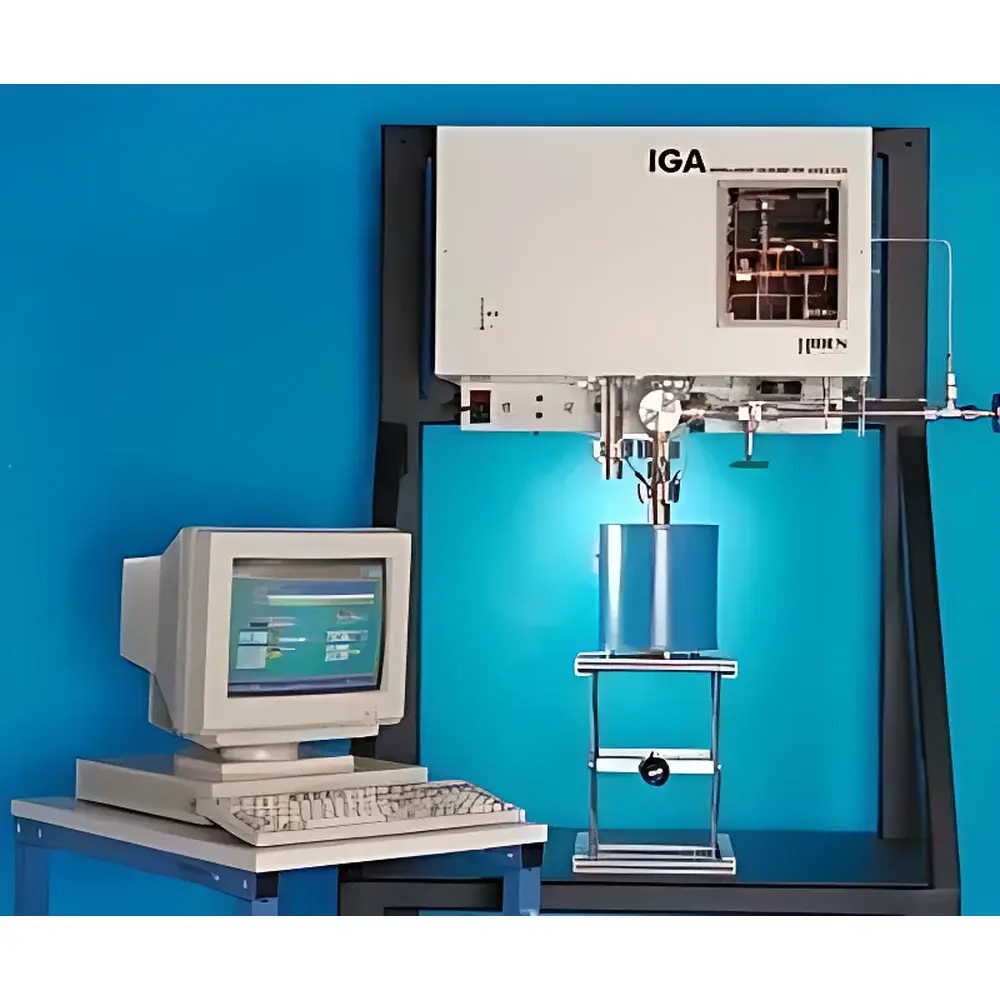
Hiden IGA100 Dynamic Gas Sorption Analyzer
| Origin | UK |
|---|---|
| Manufacturer Type | Authorized Distributor |
| Origin Category | Imported |
| Model | IGA100 |
| Pricing | Upon Request |
Overview
The Hiden IGA100 Dynamic Gas Sorption Analyzer is a high-precision, fully automated gravimetric sorption measurement system engineered for quantitative characterization of gas–solid interactions under controlled temperature and pressure conditions. Operating on the fundamental principle of microgravimetric detection—where mass changes induced by adsorption/desorption are measured in real time using an ultra-sensitive electronic microbalance—the IGA100 delivers exceptional resolution and long-term stability essential for kinetic and thermodynamic analysis. Unlike volumetric or manometric systems, gravimetric instrumentation eliminates assumptions related to gas compressibility, dead volume calibration, or buoyancy corrections, enabling direct, model-independent quantification of uptake across wide pressure (10−6 mbar to 10 bar) and temperature (−270 °C to 1000 °C) ranges. The system is widely deployed in advanced materials research—including hydrogen storage, catalysis, MOF/COF development, and battery electrode interface studies—where accurate determination of sorption isotherms, hysteresis behavior, diffusion coefficients, and activation energies is critical for structure–property correlation.
Key Features
- High-resolution microbalance with standard 1 g capacity (5 g optional), achieving 0.1 μg mass resolution and ±0.1 μg short-term stability at ambient conditions
- Ultra-high vacuum capability (<10−6 mbar) coupled with programmable pressure control up to 10 bar (20 bar optional), featuring <0.02% full-scale accuracy and 1/16,000 pressure resolution
- Wide thermal operating range from cryogenic (liquid helium-compatible) to high-temperature (1000 °C) environments, supported by dual-sensor options: Type K thermocouples (±1 °C) or Platinum Resistance Thermometers (PRTs) with ±0.01–0.1 °C precision
- Dynamic multi-step dosing protocol support for sequential or simultaneous exposure to multiple gases/vapors, enabling isothermal, isobaric, and transient sorption profiling
- Integrated sample pre-treatment module with programmable heating, cooling, and purge cycles under inert or reactive atmospheres
- Rugged ASME Category III / BS5500–compliant pressure vessel construction ensuring operational safety during high-pressure hydrogen or reactive gas experiments
Sample Compatibility & Compliance
The IGA100 accommodates powdered, pelletized, fibrous, or monolithic samples within the 0–100 mg standard mass range (extendable to 200 mg with 5 g balance option). Its design supports heterogeneous catalysts, metal–organic frameworks (MOFs), covalent organic frameworks (COFs), activated carbons, zeolites, hydride-forming alloys, and ionic liquid–based sorbents. All hardware and software modules comply with GLP/GMP-aligned data integrity requirements: audit trails, user access controls, electronic signatures, and 21 CFR Part 11–ready configuration are available via optional software licensing. Experimental protocols align with ASTM D3663 (surface area), ISO 15901 (pore size distribution), and ISO 11540 (hydrogen storage capacity) standards where applicable.
Software & Data Management
Control and analysis are executed via Hiden’s proprietary IGASorp™ software suite, offering intuitive workflow-driven experiment setup, real-time visualization of mass vs. time/pressure/temperature curves, and automated generation of isotherms, isobars, and kinetic models (e.g., Langmuir, BET, Dubinin–Astakhov, Fickian diffusion). Raw data are stored in timestamped, immutable binary files with embedded metadata (instrument ID, operator, calibration history, environmental logs). Export formats include CSV, Excel, and HDF5 for third-party modeling (e.g., MATLAB, Python SciPy, DFT simulation packages). Data archiving supports networked storage with version-controlled backups and configurable retention policies compliant with institutional research data management (RDM) frameworks.
Applications
- Hydrogen storage capacity and reversibility assessment in nanoporous frameworks and complex hydrides
- Transient adsorption kinetics and diffusion barrier quantification in catalytic supports
- In situ thermal desorption (TPD), reduction (TPR), and oxidation (TPO) profiling coupled with mass tracking
- Water vapor sorption hysteresis analysis for pharmaceutical excipients and food-grade packaging materials
- Competitive multi-component gas uptake studies (e.g., CO2/N2, H2/CH4) under dynamic flow conditions
- Surface functionalization monitoring via controlled vapor-phase probe molecule dosing (e.g., NH3, H2O, SO2)
- Decomposition thermodynamics of coordination polymers and precursor-derived ceramics
FAQ
What distinguishes gravimetric sorption analysis from volumetric methods?
Gravimetric measurement directly records mass change without reliance on gas law assumptions, eliminating systematic errors from dead volume uncertainty, non-ideal gas behavior, or buoyancy effects—particularly critical at low pressures or with condensable vapors.
Can the IGA100 be interfaced with mass spectrometry?
Yes; the system features a dedicated effluent port compatible with quadrupole mass spectrometers (QMS) for evolved gas analysis (EGA), enabling simultaneous mass gain/loss and species-specific desorption profiling.
Is remote operation supported?
Full remote control and monitoring are enabled via secure TCP/IP connection; instrument status, live data streams, and alarm notifications can be accessed through enterprise-level network infrastructure.
How is calibration traceability maintained?
Mass calibration uses NIST-traceable weights; pressure transducers are factory-calibrated against primary standards and optionally re-certified annually; temperature sensors are validated per ISO/IEC 17025 procedures.
What safety provisions exist for high-pressure hydrogen experiments?
The system integrates redundant pressure relief valves, burst discs rated to ASME Section VIII, real-time overpressure interlocks, and leak-tested stainless-steel fluid paths conforming to PED 2014/68/EU directives.



