
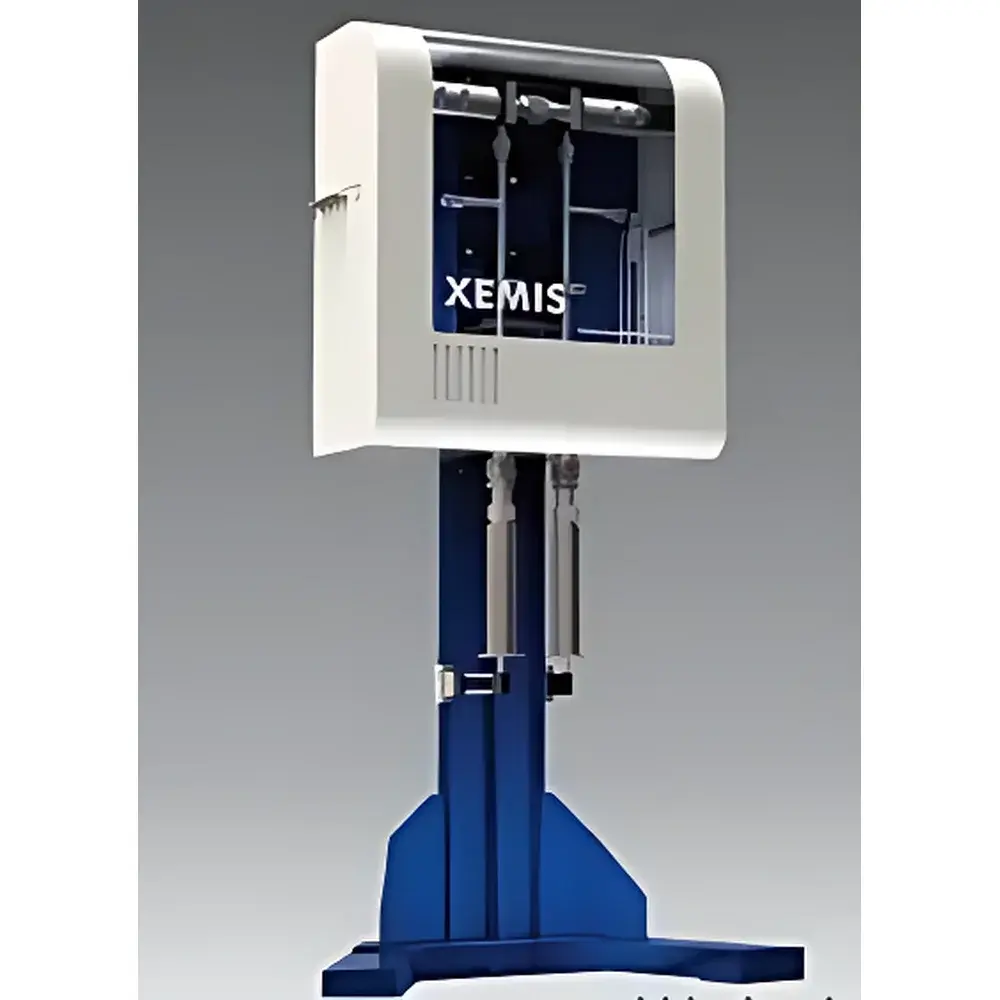
Hiden XEMIS Magnetic Suspension Adsorption and Desorption Analyzer
| Brand | Hiden |
|---|---|
| Origin | United Kingdom |
| Model | XEMIS |
| Instrument Type | Specific Surface Area and Pore Size Analyzer |
| Number of Analysis Stations | 1 |
| Pore Size Measurement Range | < 50 nm |
| Temperature Range | 77 K to 773 K (–196 °C to 500 °C) |
| Pressure Range | Up to 200 bar |
| Analysis Theory | BJH, Langmuir, DFT, t-plot, α<sub>s</sub>-method |
| Balance Capacity | 5 g |
| Balance Resolution | 0.2 µg |
| Long-term Stability | ±5 µg |
| Dynamic Weighing Range | 0–200 mg |
| Construction | All-metal VCR-fitted architecture |
| Compliance | Designed for GLP/GMP environments with audit-trail-capable software |
Overview
The Hiden XEMIS Magnetic Suspension Adsorption and Desorption Analyzer is a high-precision gravimetric microbalance system engineered for quantitative gas adsorption, desorption, and reaction studies under extreme thermodynamic conditions. Unlike conventional quartz spring or electromagnetic compensation balances, the XEMIS employs a proprietary external sensing technology—where the critical transduction elements are physically isolated from the sample chamber. This architecture eliminates thermal drift, mechanical hysteresis, and contamination-induced signal degradation, enabling stable, reproducible mass measurements across cryogenic to high-temperature regimes (77 K to 773 K) and pressures up to 200 bar. The instrument operates on the fundamental principle of magnetic suspension force compensation: a precisely controlled magnetic field counterbalances the gravitational force acting on the sample holder, with displacement feedback translated into mass change via optical interferometry. This method delivers intrinsic immunity to corrosive, pyrophoric, or reactive gases—including H2, CH4, CO2, NH3, Cl2, and supercritical fluids—without compromising balance integrity or calibration fidelity.
Key Features
- External sensing architecture: Transducers located outside the balance chamber ensure zero thermal coupling and full compatibility with aggressive chemical environments.
- Geometrically symmetric microbalance design minimizes torque-induced errors and enhances linearity over the full 0–200 mg dynamic range.
- Ultra-low internal volume chamber reduces dead volume effects and improves response time during rapid pressure transients.
- 5 g maximum load capacity with 0.2 µg resolution and long-term stability of ±5 µg—validated over continuous 72-hour operation at 500 °C.
- Integrated high-temperature reactor with independent temperature control (±0.1 °C) and optional cooling trap for cryogenic isotherms at 77 K.
- No in-situ re-zeroing or recalibration required; baseline integrity maintained across thermal cycling and multi-gas sequences.
- IGA-exclusive endpoint prediction algorithm dynamically identifies adsorption/desorption equilibrium, reducing measurement time by up to 40% without sacrificing data fidelity.
- Full-metal construction using electropolished stainless steel and VCR fittings ensures ultra-high vacuum integrity (<1×10⁻⁹ mbar base pressure) and leak-tight performance under high-pressure gas service.
- Modular platform supports seamless integration with mass spectrometry (QMS), FTIR, or Raman modules for evolved gas analysis or in situ spectroscopic validation.
Sample Compatibility & Compliance
The XEMIS accommodates a broad spectrum of solid and porous materials—including MOFs, zeolites, activated carbons, carbon molecular sieves, templated carbons, porous polymers, metal oxides, and ionic liquid-supported sorbents. Its inert, all-metal flow path meets ASTM D3663 and ISO 9277 requirements for specific surface area determination, while its pressure/temperature control accuracy satisfies USP and ICH Q5C guidelines for stability-indicating adsorption characterization. When operated with Hiden’s IGAware software, the system complies with FDA 21 CFR Part 11 for electronic records and signatures, providing full audit trails, user access controls, and electronic signature enforcement—essential for regulated QC/QA laboratories conducting GLP or GMP-compliant material release testing.
Software & Data Management
IGAware v5.x provides a unified interface for instrument control, real-time data acquisition, and advanced isotherm modeling. It supports automated generation of BET, Langmuir, BJH, DFT (NLDFT and QSDFT), t-plot, and αs-method analyses—with built-in uncertainty propagation for derived parameters (e.g., pore volume, micropore surface area). Raw mass vs. time/pressure datasets are stored in HDF5 format with embedded metadata (temperature setpoint, pressure ramp rate, gas purity, calibration certificate ID). Export options include ASTM E2979-compliant CSV, NIST-traceable PDF reports, and direct import into MATLAB, Python (via h5py), or commercial modeling platforms such as COMSOL Multiphysics for coupled transport simulations.
Applications
- High-fidelity hydrogen and methane storage capacity assessment for onboard vehicular systems (SAE J2718, ISO 16111).
- CO2 capture screening under post-combustion (0.1–0.15 bar CO2) and pre-combustion (20–30 bar) conditions per ISO 27886.
- Kinetic analysis of gas uptake/diffusion in shale matrix and coal seam samples—aligned with API RP 14B and ISO 13703 protocols.
- Thermodynamic parameter derivation (isosteric heat of adsorption, entropy changes) via Clausius–Clapeyron analysis across ≥3 isotherms.
- In situ chemisorption studies of catalysts under reactive atmospheres (e.g., O2 oxidation, NOx reduction, NH3 SCR), with simultaneous mass and temperature monitoring.
- Supercritical adsorption behavior of CO2, CHF3, and SF6 in functionalized porous frameworks—supporting IPCC AR6 methodology for geological sequestration modeling.
- Solubility and phase-equilibrium measurements of gases in ionic liquids, with gravimetric detection limits below 10−5 mol fraction.
FAQ
What distinguishes the XEMIS magnetic suspension balance from conventional electrodynamic microbalances?
The XEMIS eliminates internal sensing components—such as voice coils or strain gauges—that degrade under thermal stress or react with process gases. Its external force transduction enables true long-term stability and corrosion resistance unattainable with integrated designs.
Can the XEMIS perform both physisorption and chemisorption measurements in a single run?
Yes—by programming multi-step temperature–pressure sequences (e.g., evacuation at 150 °C, dosing at 25 °C, then heating to 400 °C under H2), the system captures reversible physisorption, irreversible chemisorption, and decomposition events within one experiment.
Is calibration traceable to national standards?
All XEMIS systems ship with NPL-traceable calibration certificates for mass, temperature, and pressure sensors, with optional annual recalibration services accredited to ISO/IEC 17025.
Does the instrument support automated sample changing?
While the standard configuration features a single analysis station, the modular reactor interface allows integration with third-party autosamplers compliant with ASTM E2887, subject to custom engineering review.
How is data integrity ensured during extended high-temperature runs?
IGAware implements cyclic checksum verification of raw sensor streams, redundant non-volatile memory buffering, and automatic recovery from power interruption—retaining full measurement continuity without data loss.
Related Products



