
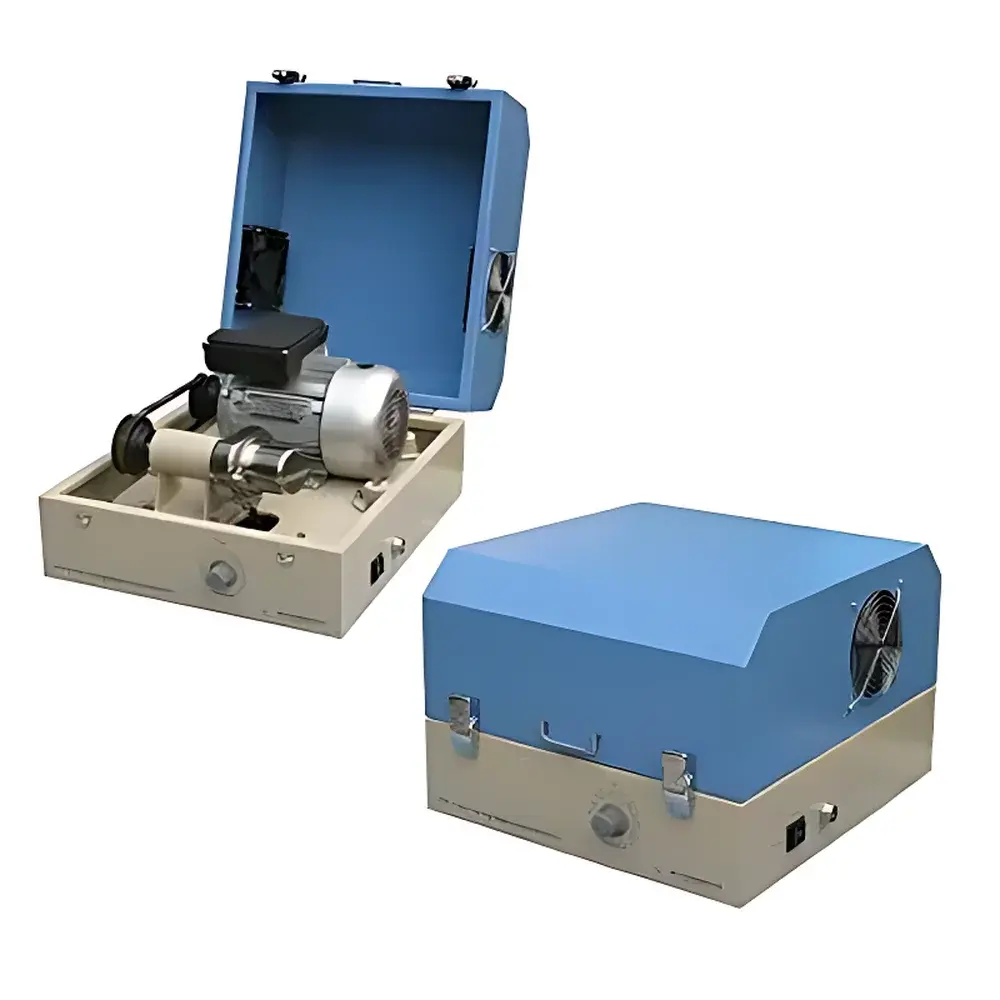
High-Speed Vibratory Ball Mill SFM-3 by Hefei Kejing
| Brand | Hefei Kejing |
|---|---|
| Model | SFM-3 |
| Type | High-Speed Vibratory Ball Mill |
| Drive Principle | Eccentric Oscillation with Vertical Vibration |
| Rated Power | 300 W |
| Input Voltage | AC 220 V, Single Phase |
| Oscillation Frequency | 1200 rpm |
| Adjustable Oscillation Time | 0–120 min |
| Standard Jar Capacity | 80 mL (Stainless Steel & Nylon) |
| Optional Jars | Alumina (Al₂O₃), Agate, Vacuum-Sealed Stainless Steel |
| Compatible Grinding Media | Stainless Steel, Zirconia, Alumina, Agate Balls |
| Max Feed Size | ≤ 1 mm |
| Typical Final Particle Size (e.g., Ceramic Powders) | ~0.1 µm |
| Dimensions (L×W×H) | 405 × 365 × 260 mm |
| Net Weight | 40 kg |
| Safety Certification | CE |
| Warranty | 2 Years (excl. jars & grinding media) |
| Operating Environment | Ambient air only — not suitable for inert gas (e.g., Ar) atmospheres |
Overview
The SFM-3 High-Speed Vibratory Ball Mill is an engineered laboratory-scale comminution system designed for rapid, reproducible size reduction and homogenization of solid materials via three-dimensional eccentric oscillation. Unlike planetary or horizontal rotary mills, the SFM-3 employs a vertically oriented eccentric drive shaft that induces high-frequency, low-amplitude oscillatory motion—1200 rpm—transmitted simultaneously to the grinding jar and its contents. This kinematic profile generates intense impact, shear, and friction forces between grinding media and sample particles in all spatial axes, enabling efficient mechanical activation, alloying, amorphization, and dispersion of powders, suspensions, and slurries. The device operates exclusively under ambient atmospheric conditions and is not rated for use in inert or reducing gas environments due to motor insulation limitations.
Key Features
- Robust eccentric oscillation mechanism delivering consistent 1200 rpm frequency with ±5 rpm stability over full operational range
- Dual-standard jar configuration: one 80 mL stainless steel jar and one 80 mL nylon jar, both fitted with fluoropolymer-sealed lids for wet grinding compatibility
- Modular jar interchangeability supporting optional high-purity media: alumina (99.5% Al₂O₃), agate, and vacuum-rated stainless steel jars (80 mL); additional 50 mL agate jar available
- Adjustable oscillation duration (0–120 minutes) with digital timer and automatic shutdown
- Integrated safety interlock: operation halts immediately upon lid removal or jar misalignment
- CE-certified electrical architecture compliant with IEC 61000-6-2 (immunity) and IEC 61000-6-4 (emission) standards
- Compact footprint (405 × 365 × 260 mm) and reinforced cast-aluminum base for vibration damping and long-term mechanical stability
Sample Compatibility & Compliance
The SFM-3 accommodates diverse material classes including metals, oxides, carbides, polymers, and brittle ceramics—provided appropriate jar–media pairing is selected to avoid cross-contamination or mechanical failure. Stainless steel jars are recommended for metallic alloys and hard intermetallics; alumina and agate jars are preferred for oxide-based ceramics (e.g., TiO₂, ZnO, BaTiO₃) and pH-sensitive compounds. Use of stainless steel media in alumina or agate jars is strictly prohibited to prevent cold welding and irreversible jar damage. All standard jars conform to ISO 8502-3 for surface cleanliness and are compatible with GLP-aligned sample tracking protocols. The unit itself meets CE marking requirements for laboratory equipment safety (2014/35/EU Low Voltage Directive and 2014/30/EU EMC Directive).
Software & Data Management
The SFM-3 operates via hardware-integrated digital control—no external software or PC interface is required. All operational parameters (time, speed, start/stop) are managed through a front-panel membrane keypad with LED status feedback. While the base model does not support data logging or audit trails, optional OEM firmware upgrades (available under contract) can enable RS-232 output for integration into LIMS environments compliant with FDA 21 CFR Part 11 when paired with validated third-party acquisition software. Routine maintenance logs, calibration records, and jar usage history must be manually documented per ISO/IEC 17025 Clause 7.6 to ensure metrological traceability.
Applications
- Mechanochemical synthesis of nanocomposites and solid-state battery cathode precursors (e.g., LiCoO₂–graphene hybrids)
- Particle size reduction of ceramic raw materials prior to sintering (achieving D₉₀ ≤ 0.1 µm for submicron densification)
- Homogenization of heterogeneous catalyst formulations (e.g., Pt/CeO₂–Al₂O₃ mixtures)
- Preparation of colloidal suspensions for rheological or zeta potential analysis
- Amorphization of crystalline APIs in pharmaceutical development (subject to GMP-compliant jar cleaning validation)
- Dispersion of carbon nanotubes and graphene nanoplatelets in polymer matrices
FAQ
Can the SFM-3 operate under argon or nitrogen atmosphere?
No. The motor housing and internal electronics are not sealed against inert gases. Operation in Ar or N₂ may cause condensation-induced short circuits or insulation breakdown. For inert milling, consider glovebox-integrated planetary ball mills with hermetic feedthroughs.
What is the maximum recommended ball diameter for 50 mL agate jars?
Do not exceed 8 mm. Larger balls increase localized stress beyond agate’s fracture toughness (~1.2 MPa·m⁰·⁵), risking catastrophic jar failure.
Is speed regulation available as a factory option?
Yes. An optional 0–1200 rpm variable-frequency drive (VFD) module can be installed pre-shipment. This requires recalibration of torque compensation and is supplied with NIST-traceable speed verification certificate.
How often should the eccentric bearing assembly be lubricated?
Every 500 operating hours or biannually—whichever occurs first—using ISO VG 68 synthetic gear oil. Over-lubrication causes heat retention and premature seal degradation.
Does the CE mark indicate compliance with RoHS or REACH?
The CE marking on this unit attests solely to electromagnetic compatibility and low-voltage safety. RoHS/REACH conformity documentation is available upon request and covers all plastic housings, wiring insulation, and PCB substrates.



