
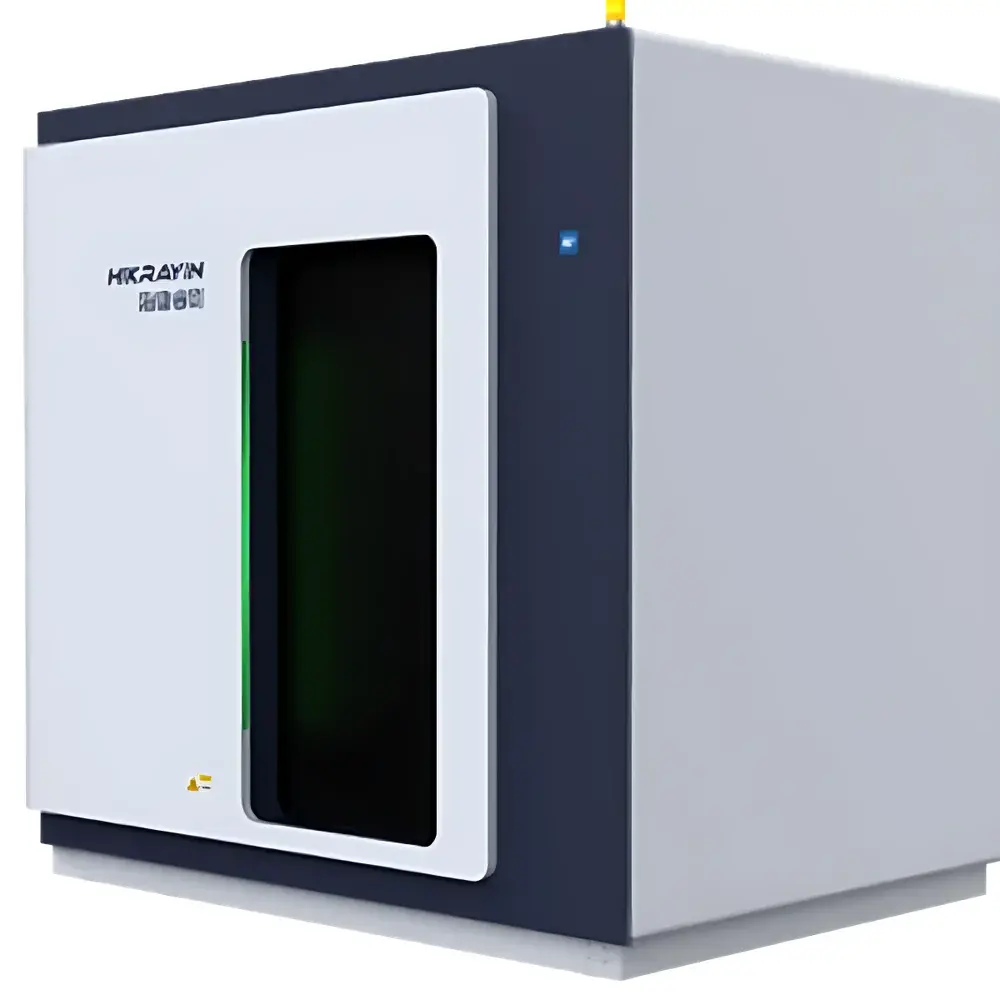
HIKMICRO ISD-NIX58-E16 Digital Radiography Imaging System
| Brand | HIKMICRO |
|---|---|
| Origin | Zhejiang, China |
| Manufacturer Type | Authorized Distributor |
| Country of Origin | China |
| Model | ISD-NIX58-E16 |
| Pricing | Available Upon Request |
Overview
The HIKMICRO ISD-NIX58-E16 Digital Radiography Imaging System is a high-integration industrial X-ray non-destructive testing (NDT) platform engineered for precision internal inspection of castings, weldments, composite components, and additive-manufactured parts. It operates on the fundamental principle of differential X-ray attenuation: materials with varying atomic number, density, or thickness absorb incident X-ray photons to differing degrees, generating contrast in the transmitted radiation field. This spatially resolved attenuation pattern is captured by a high-sensitivity digital detector array and reconstructed into a quantitative grayscale radiograph. Unlike film-based or basic fluoroscopic systems, the ISD-NIX58-E16 employs advanced Automatic Defect Recognition (ADR) algorithms—trained on metallurgical defect morphology datasets—to perform real-time segmentation, contrast enhancement, and dimensional annotation of voids, porosity, inclusions, and shrinkage cavities. Its architecture conforms to the functional hierarchy defined in ASTM E2737–21 (Standard Practice for Digital Radiographic Testing) and supports compliance pathways for ISO 17025-accredited laboratories.
Key Features
- Modular X-ray generator with adjustable tube voltage (40–160 kV) and focal spot size ≤1.0 mm, optimized for resolution–penetration trade-off across aluminum, steel, and titanium alloys.
- Digital flat-panel detector (FPD) featuring CsI scintillator coupled to amorphous silicon (a-Si) photodiode array, offering 12-bit dynamic range, <150 µm effective pixel pitch, and frame rates up to 15 fps for real-time motion analysis.
- Integrated mechanical manipulator system with 5-axis programmable motion (X/Y/Z translation + tilt/rotation), enabling full volumetric coverage without manual repositioning.
- Hardware-synchronized safety interlock network compliant with IEC 61508 SIL2 and EN 62471 for optical radiation safety, including door-mounted microswitches, beam-on indicator LEDs, and audible alarm activation.
- Embedded real-time image processing engine supporting ROI-based histogram equalization, noise suppression via adaptive median filtering, and edge-preserving sharpening using unsharp masking kernels.
- Conformal shielding enclosure constructed from lead-equivalent (≥2.0 mm Pb) steel–polymer composite panels, certified per ISO 4037-3 for scattered radiation containment under continuous operation.
Sample Compatibility & Compliance
The ISD-NIX58-E16 accommodates specimens up to Ø580 mm × 160 mm height (max. weight: 25 kg), with programmable collimation to minimize scatter-induced contrast loss. It supports both ferrous and non-ferrous metallic castings (e.g., A380 die-cast, ASTM A27 carbon steel), fiber-reinforced polymer laminates, and ceramic matrix composites. All imaging protocols adhere to ASTM E94/E94M (Standard Guide for Radiographic Examination), ASTM E1411 (Standard Practice for Qualification of Radiographic Film Systems), and ISO 5579 (Non-destructive testing — Radiographic testing of metallic materials using film and X- or gamma rays). The system’s audit trail functionality—including operator ID, acquisition timestamp, exposure parameters, and post-processing history—meets documentation requirements for ASME BPVC Section V, API RP 1104, and FAA AC 43.13-1B traceability frameworks.
Software & Data Management
The proprietary HIKMICRO NDT Studio software provides a validated, FDA 21 CFR Part 11–ready environment for acquisition, analysis, reporting, and archival. It features role-based user authentication, electronic signature capture, and immutable audit logs with SHA-256 hashing of all DICOM SR (Structured Reporting) objects. Image data is stored in vendor-neutral DICOM 3.0 format, ensuring interoperability with PACS, LIMS, and enterprise PLM systems. Advanced analysis modules include thickness mapping via dual-energy subtraction, porosity quantification per ASTM E505, and comparative overlay against CAD reference models (STEP/IGES import supported). All software updates undergo regression testing per ISO/IEC 17025 Clause 5.9.2 and are delivered with validation documentation packages.
Applications
- Automotive powertrain component verification: cylinder heads, transmission housings, turbocharger casings.
- Aerospace structural integrity assessment: turbine blades, landing gear forgings, honeycomb sandwich panels.
- Medical device manufacturing: validation of hermetic seals in implantable electronics enclosures and weld integrity in stainless-steel surgical instruments.
- Energy sector QA/QC: inspection of pipeline girth welds, valve body castings, and nuclear-grade control rod drive mechanisms.
- Academic and R&D use: in-situ monitoring of solidification dynamics, additive manufacturing defect evolution studies, and multi-modal correlation with ultrasonic C-scan or CT datasets.
FAQ
What regulatory standards does the ISD-NIX58-E16 comply with for industrial radiography?
It meets ASTM E2737, ISO 5579, EN 462 series, and incorporates hardware-level safeguards aligned with IEC 61508 and EN 62471.
Can the system integrate with existing factory MES or QMS platforms?
Yes—via DICOM 3.0 export, RESTful API for metadata exchange, and optional OPC UA server module for real-time status telemetry.
Is ADR algorithm training data customizable for proprietary defect classes?
HIKMICRO offers on-site algorithm fine-tuning services using customer-supplied ground-truth defect libraries, subject to NDA and model validation per ISO/IEC 17025 Annex A.3.
What is the typical calibration interval and traceability chain?
Annual metrological verification is recommended; traceability is maintained to NIST-traceable X-ray dosimetry standards and PTB-certified detector response curves.
Does the system support automated report generation compliant with ISO 10012 or ASNT SNT-TC-1A?
Yes—predefined templates align with ISO 9712 Level II reporting requirements and include configurable pass/fail thresholds, statistical process control charts, and PDF/A-2b archival output.
Related Products



