
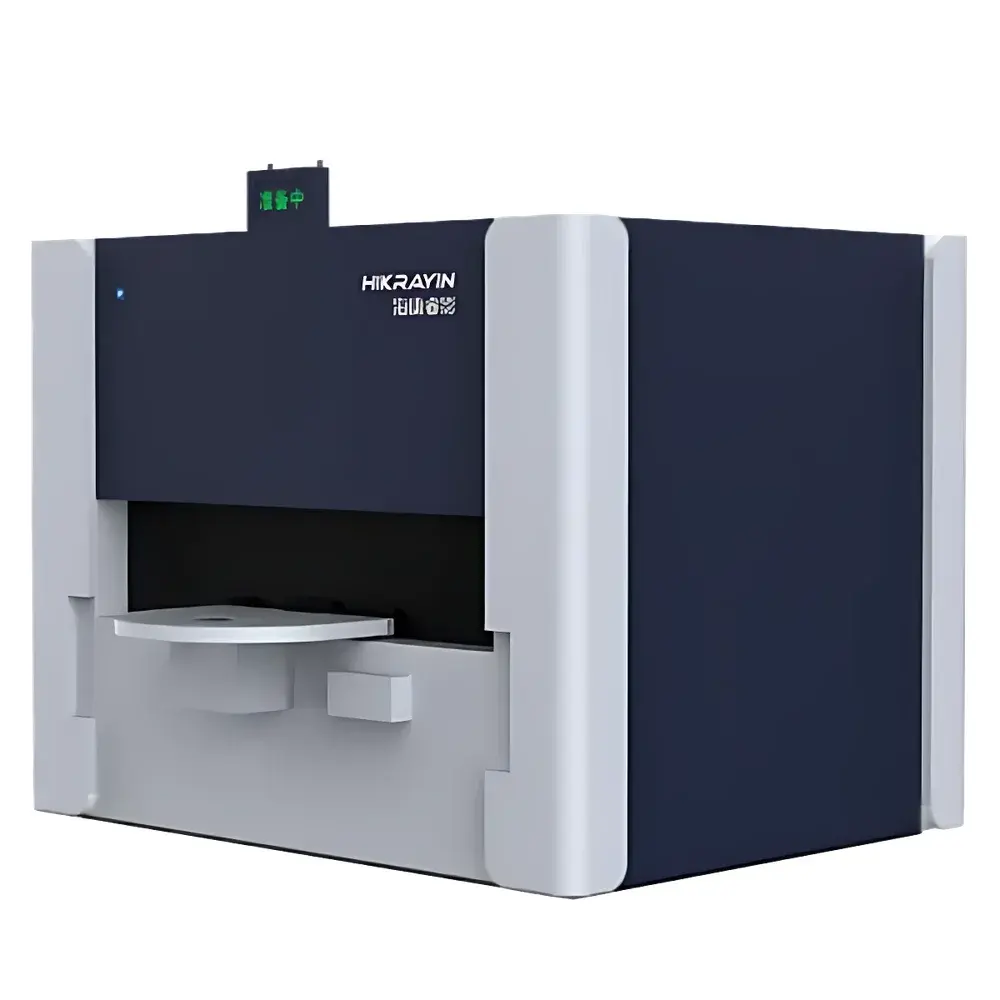
HIKMICRO ISD-NIX59-A16 Dual-Station Industrial X-ray Flaw Detection System
| Brand | HIKMICRO |
|---|---|
| Origin | Zhejiang, China |
| Manufacturer Type | Authorized Distributor |
| Country of Origin | China |
| Model | ISD-NIX59-A16 |
| Pricing | Available Upon Request |
Overview
The HIKMICRO ISD-NIX59-A16 Dual-Station Industrial X-ray Flaw Detection System is a high-integration non-destructive testing (NDT) platform engineered for automated, high-throughput inspection of castings, weldments, and structural components in foundry, aerospace, automotive, and heavy machinery manufacturing environments. It operates on the principle of differential X-ray attenuation: materials with varying density, atomic number, or thickness absorb incident X-ray photons to differing degrees, generating contrast in the transmitted radiation field. This spatially resolved intensity variation is captured by a high-sensitivity digital flat-panel detector (FPD), then reconstructed into grayscale radiographic images. The system incorporates an advanced Automated Defect Recognition (ADR) algorithm suite—trained on metallurgical defect signatures including porosity, shrinkage cavities, inclusions, and incomplete fusion—to enable objective, repeatable flaw classification without operator-dependent interpretation bias.
Key Features
- Dual-station architecture enables concurrent sample loading/unloading and imaging—reducing cycle time by up to 40% compared to single-station systems and supporting continuous production line integration.
- Integrated safety-certified X-ray generator with adjustable kVp (80–300 kV) and mA output, compliant with IEC 61331-1 and GBZ 137-2018 shielding requirements; includes interlocked access doors, real-time radiation monitoring sensors, and audible/visual warning systems.
- High-resolution amorphous silicon (a-Si) flat-panel detector with 14-bit dynamic range, 127 µm pixel pitch, and <1.5% spatial distortion across full active area—optimized for fine detail resolution in aluminum, magnesium, and steel castings up to 150 mm equivalent steel thickness.
- Modular mechanical handling system featuring programmable manipulator arms and precision rotary stages (±0.02° repeatability), supporting complex multi-angle acquisition for 2D radiography and limited-angle tomographic reconstruction.
- Embedded real-time image processing engine performing on-the-fly flat-field correction, noise suppression (non-local means filtering), edge enhancement (unsharp masking), and ADR-driven defect segmentation with configurable sensitivity thresholds.
Sample Compatibility & Compliance
The ISD-NIX59-A16 accommodates parts ranging from small precision investment castings (minimum dimension: 50 × 50 × 30 mm) to large structural weldments (maximum envelope: 800 × 600 × 400 mm). It supports ferrous and non-ferrous alloys—including gray iron, ductile iron, aluminum A380/A390, titanium Ti-6Al-4V, and stainless steels—with consistent contrast sensitivity per ASTM E94/E1742 for radiographic quality assessment. System validation adheres to ISO 17025-accredited procedures; operational documentation satisfies GLP and GMP traceability requirements, including audit trails for exposure parameters, image metadata, and ADR decision logs. Radiation safety protocols align with national regulatory frameworks (e.g., China’s Regulation on Safety and Protection of Radioactive Isotopes and Radiation Devices) and international best practices (IAEA Safety Standards Series No. SSG-11).
Software & Data Management
The proprietary HIKNDT Suite v4.2 provides unified control of acquisition, analysis, reporting, and archival functions via a Windows-based GUI. Key capabilities include DICOM-compliant image export, customizable report templates (PDF/HTML) with embedded pass/fail criteria per customer-defined acceptance standards (e.g., ASTM E2869 Level 2), and secure role-based user access (admin/operator/auditor). All image datasets are timestamped and cryptographically hashed to ensure data integrity; software supports FDA 21 CFR Part 11 compliance through electronic signatures, audit trail logging (user actions, parameter changes, result modifications), and immutable record retention policies. Integration with MES/ERP platforms is enabled via OPC UA and RESTful API interfaces.
Applications
- Automated in-line inspection of cylinder heads, transmission housings, and brake calipers in Tier-1 automotive casting plants.
- Weld integrity verification for pressure vessels and piping systems under ASME BPVC Section V requirements.
- Porosity mapping and volumetric quantification in aerospace investment castings per AMS 2644 and NADCAP AC7114.
- Failure analysis support—correlating internal discontinuities with mechanical test results (tensile, fatigue) to refine process parameters.
- Supplier qualification audits requiring objective, documented evidence of internal soundness per ISO 9001 Clause 8.6.
FAQ
Does the ISD-NIX59-A16 require external radiation shielding beyond the built-in cabinet?
No—the integrated lead-lined enclosure meets Class I radiation safety classification per national regulations when operated within specified kV/mA limits and with all interlocks engaged.
Can ADR algorithms be retrained for custom defect types not included in the default library?
Yes—HIKMICRO provides SDK access and annotation tools for supervised model refinement using customer-specific ground-truth datasets, subject to contractual agreement and validation protocol approval.
Is remote diagnostics and firmware update supported?
Yes—the system includes embedded telemetry and TLS-secured remote access capability for HIKMICRO-certified service engineers, enabling predictive maintenance alerts and over-the-air updates without on-site intervention.
What is the minimum detectable defect size under standard operating conditions?
Detection limit is material- and geometry-dependent; typical performance achieves ≥95% probability of detection (POD) for 0.3 mm diameter gas pores in 30 mm thick aluminum castings at 160 kV, per ASTM E2737 resolution verification methodology.
How is measurement traceability maintained for calibration and performance verification?
Annual calibration is performed using NIST-traceable step wedges (e.g., ASTM E1025 duplex wire IQI sets) and beam quality phantoms; certificates include uncertainty budgets compliant with ISO/IEC 17025 Clause 6.5.



