
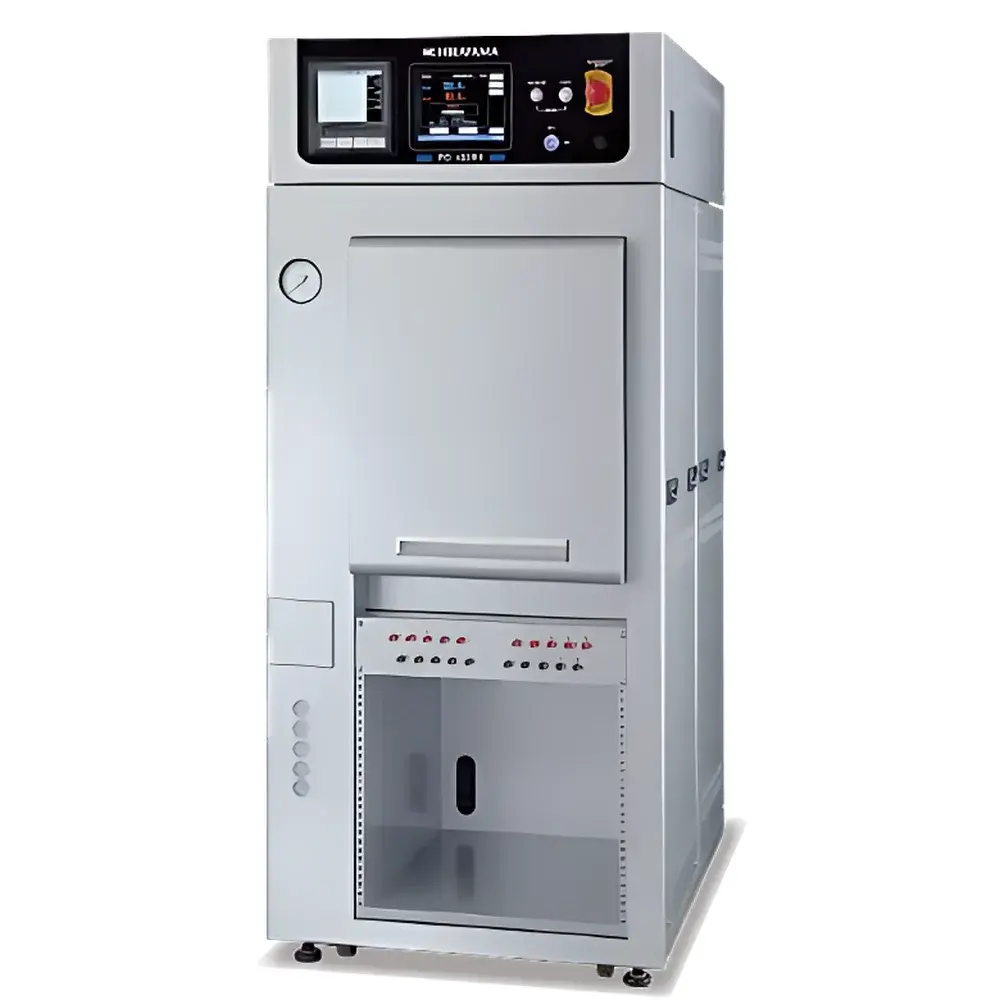
HIRAYAMA PC-R9 Series High-Accelerated Stress Test (HAST) Chamber
| Brand | HIRAYAMA |
|---|---|
| Origin | Japan |
| Model | PC-304R9 / PC-422R9 / PC-304R9D / PC-422R9D |
| Chamber Capacity | 304 L / 422 L |
| Dual-Chamber Configuration | Standard (PC-R9D models) |
| Pressure Range | Up to 300 kPa (gauge) |
| Temperature Range | +105 °C to +130 °C |
| Humidity Control | 85–100 % RH |
| Remote Operation | Ethernet & USB interface |
| Data Logging | Internal memory + external USB storage |
| Compliance | JEDEC JESD22-A110, JESD22-A118, IEC 60068-2-66, MIL-STD-883 Method 1007 |
| Cooling System | Integrated chilled water reservoir with automatic drain function |
| Electrochemical Migration (ECM) Evaluation Mode | Built-in electrolyte residue monitoring and purge cycle |
Overview
The HIRAYAMA PC-R9 Series High-Accelerated Stress Test (HAST) Chamber is an engineered environmental stress screening system designed for rapid reliability assessment of electronic components, printed circuit boards (PCBs), and automotive electronics under highly accelerated humidity and temperature conditions. Unlike conventional temperature-humidity bias (THB) testing, the PC-R9 series operates above atmospheric pressure—typically at 105–130 °C and 85–100 % relative humidity at pressures up to 300 kPa (gauge)—to significantly accelerate moisture diffusion into encapsulants, conformal coatings, and interfacial boundaries. This enables detection of latent failure mechanisms—including conductive anodic filament (CAF) formation, solder joint degradation, dielectric breakdown, and electrochemical migration (ECM)—within hours or days rather than weeks. The system complies with internationally recognized qualification standards including JEDEC JESD22-A110 (Unbiased HAST), JESD22-A118 (Biased HAST), IEC 60068-2-66, and MIL-STD-883 Method 1007, making it suitable for AEC-Q200-compliant component validation and IPC-A-610/IPC-J-STD-001 process qualification workflows.
Key Features
- Dual-chamber architecture (standard on PC-R9D models) enables simultaneous execution of independent test profiles—ideal for comparative reliability studies or parallel qualification of multiple sample batches.
- Programmable operation modes: Unbiased HAST, Biased HAST (with integrated DC voltage sourcing up to ±50 V), and ECM-specific acceleration mode with timed electrolyte residue purge and controlled condensate drainage.
- Full-color 7-inch capacitive touchscreen HMI with intuitive navigation, real-time parameter visualization, and on-device program editing; supports multi-language UI (English, Japanese, Korean, Chinese).
- Integrated chilled water reservoir with automatic cooling water circulation and drain sequencing—eliminates dependency on facility-supplied chilled water while maintaining thermal stability during extended high-pressure cycles.
- Automated air purge and external pressurization function ensures reproducible chamber atmosphere conditioning prior to test initiation, minimizing residual oxygen content and enhancing test repeatability.
- Comprehensive communication suite: Ethernet (TCP/IP), USB host/device, and RS-485 interfaces enable seamless integration into centralized lab management systems and support remote monitoring via secure web-based client or third-party SCADA platforms.
Sample Compatibility & Compliance
The PC-R9 series accommodates standard JEDEC trays (JEDEC MS-013, MO-153), 24 × 18 inch PCB pallets, and custom fixtures for automotive ECUs, power modules, and sensor assemblies. Chamber interior volume (304 L or 422 L) allows uniform exposure of up to 48 large-format PCBs per cycle without compromising humidity homogeneity (< ±2 % RH spatial variation per IEC 60068-3-5). All models meet ISO/IEC 17025 calibration traceability requirements when operated with optional NIST-traceable hygrothermal sensors. Full audit trail capability—including operator ID, parameter changes, alarm events, and cycle completion timestamps—is maintained in accordance with FDA 21 CFR Part 11 and GLP/GMP data integrity principles when used with validated software configurations.
Software & Data Management
HIRAYAMA’s proprietary PC-R9 Control Suite (v4.2+) provides full lifecycle test management: from method creation and version-controlled protocol deployment to raw data export in CSV/Excel-compatible formats. Each test run automatically generates a timestamped .log file containing all setpoints, actual readings (temperature, pressure, RH, voltage), and event markers (e.g., door open, purge start, pressure ramp completion). USB storage support allows offline archiving of >10,000 hours of continuous logging data. Optional IQ/OQ documentation packages are available for regulated environments requiring formal installation and operational qualification against U.S. Pharmacopeia and ISO 13485 Annex A requirements.
Applications
- Accelerated moisture sensitivity level (MSL) grading per J-STD-020 for plastic-encapsulated microcircuits.
- Qualification of underfill materials, no-clean flux residues, and conformal coating adhesion under combined thermal-hygric stress.
- Failure analysis correlation between HAST-induced defects and field return root causes in ADAS sensors, infotainment modules, and battery management systems.
- Process robustness validation for reflow soldering, plasma cleaning, and selective coating deposition steps in high-reliability PCB assembly lines.
- Material compatibility screening of laminates, prepregs, and embedded passives under aggressive hygrothermal aging conditions.
FAQ
What standards does the PC-R9 series support for HAST testing?
The system is pre-configured to execute JEDEC JESD22-A110, JESD22-A118, IEC 60068-2-66, and MIL-STD-883 Method 1007 protocols, with programmable ramp rates, dwell times, and recovery sequences aligned to each standard’s annexes.
Can the PC-R9 operate without external chilled water supply?
Yes—the integrated chilled water reservoir and recirculating pump eliminate reliance on facility cooling infrastructure; users only require standard tap water for initial fill and periodic top-up.
Is remote programming and real-time monitoring supported?
All models include Ethernet and USB interfaces; the HIRAYAMA Control Suite supports remote desktop access, scheduled firmware updates, and live telemetry streaming via secure HTTPS or Modbus TCP.
How is electrochemical migration (ECM) evaluated in this system?
The ECM mode applies controlled DC bias across test patterns while monitoring leakage current; integrated condensate drainage and nitrogen-assisted purge cycles minimize false positives from surface contamination.
Are dual-chamber models compatible with independent temperature/humidity setpoints?
No—both chambers share a common steam generation and pressure control manifold, ensuring identical environmental conditions; independence is limited to program scheduling and data logging domains.



