
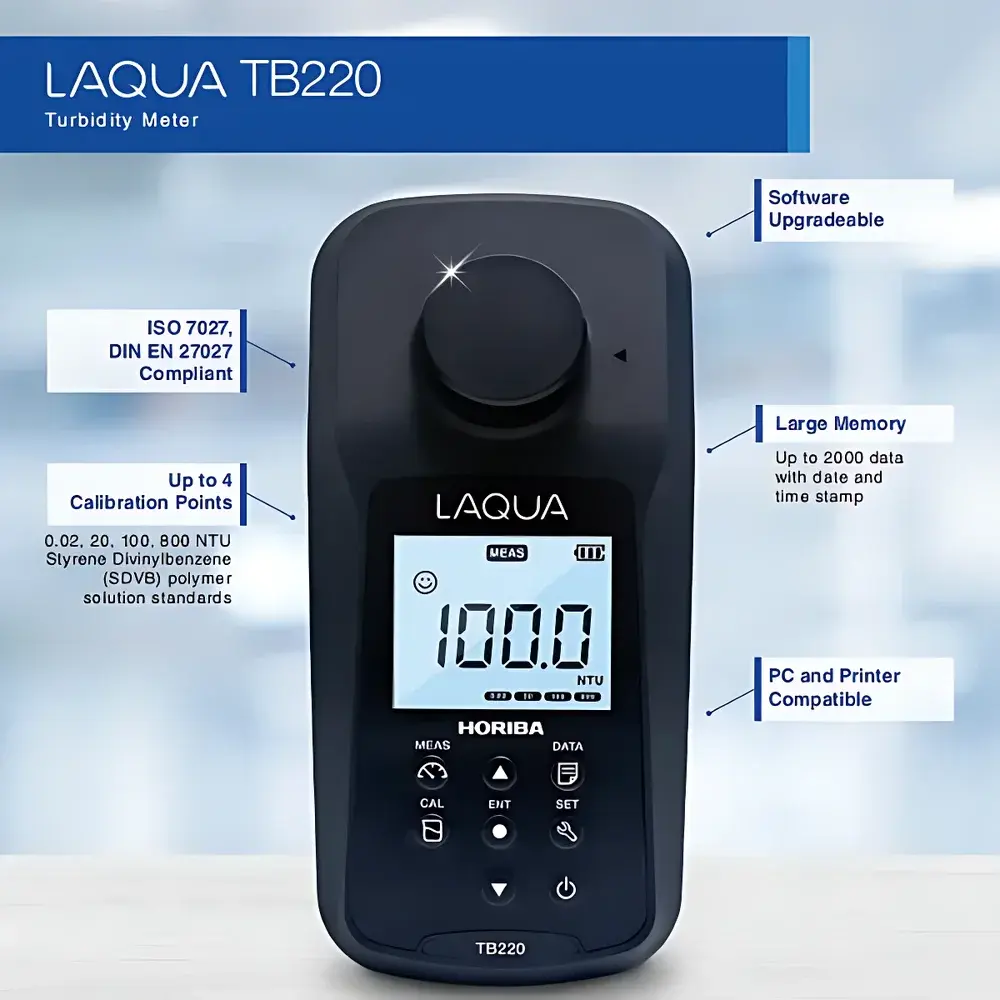
HORIBA LAQUA TB220 Portable Turbidimeter
| Brand | HORIBA |
|---|---|
| Origin | Japan |
| Product Type | Portable |
| Measurement Range | 0–2000 NTU |
| Resolution | 0.01 NTU (0.00–19.99 NTU), 0.1 NTU (20.0–199.9 NTU), 1 NTU (200–2000 NTU) |
| Operating Temperature | 0–50 °C |
| Accuracy | ±0.02 NTU or ±2% (0.00–1000 NTU) |
| Calibration Points | Up to 4 (0.02, 20, 100, 800 NTU) |
| IP Rating | IP67 |
| Display | Backlit monochrome LCD |
| Data Storage | 2000 measurements with timestamp |
| Light Source | 860 nm infrared LED |
| Detector | Silicon photodiode |
| Sample Volume | 10 mL |
| Power | 4×AA batteries |
| Dimensions | 210 × 110 × 55 mm |
| Weight | 510 g (with batteries), 410 g (without) |
Overview
The HORIBA LAQUA TB220 Portable Turbidimeter is a field-deployable, ratio-based optical instrument engineered for high-reliability turbidity measurement in compliance with ISO 7027 and DIN EN 27027 standards. It employs dual-signal detection—simultaneous measurement of scattered light (at 90°) and transmitted light—to compute a normalized turbidity value, minimizing errors caused by coloration, particle absorption, or lamp intensity drift. This ratiometric methodology ensures long-term stability and metrological traceability without requiring frequent recalibration. Designed for rigorous use in variable environmental conditions, the TB220 delivers consistent performance across its full 0–2000 NTU range, supporting both low-level clarity verification (e.g., potable water distribution) and high-turbidity process monitoring (e.g., wastewater effluent or aquaculture recirculation systems). Its compact, ruggedized form factor and battery-powered operation make it suitable for unattended spot checks, mobile lab deployments, and routine QA/QC field surveys.
Key Features
- IP67-rated enclosure for dust-tight and immersion-resistant operation (1 m for 30 min), validated per IEC 60529
- Ratiometric optical design using an 860 nm infrared LED source and dual silicon photodiodes—eliminates interference from sample color and reduces sensitivity to air bubbles or window fouling
- Four-point calibration capability with NIST-traceable SDVB (styrene divinylbenzene) polymer standards (0.02, 20, 100, and 800 NTU)
- Intuitive user interface featuring a backlit monochrome LCD, tactile keypad, and visual stability indicator (“smiley face” icon) confirming measurement readiness
- Onboard real-time clock with automatic timestamping; stores up to 2000 measurement records including date, time, NTU value, and calibration status
- Configurable auto-power-off (1–30 minutes) and built-in self-diagnostic routines for sensor integrity, battery voltage, and optical path validation
- Robust mechanical construction: shock-absorbing elastomer overmold, scratch-resistant display cover, and non-slip ergonomic grip
Sample Compatibility & Compliance
The TB220 accepts standard 10 mL cylindrical glass vials (16 mm OD), compatible with common laboratory-grade turbidity standards and field sampling protocols. Its optical path length and detector geometry are optimized for reproducible readings across diverse particulate matrices—including clay suspensions, algal cultures, activated sludge, and coagulated surface waters. The instrument meets ISO 7027:2016 requirements for formazin-equivalent turbidity measurement using near-infrared illumination, ensuring comparability with reference laboratories and regulatory reporting frameworks. It supports GLP-compliant workflows through audit-ready data export (via RS-232 serial interface) and tamper-evident timestamped storage. While not FDA 21 CFR Part 11 certified out-of-the-box, its data logging architecture enables integration into validated systems when paired with compliant software and procedural controls.
Software & Data Management
Data retrieval is performed via RS-232 serial connection using standard terminal emulation or HORIBA-provided PC utilities (Windows-compatible). Exported files include ASCII-formatted .CSV logs containing measurement ID, date/time stamp (YYYY-MM-DD HH:MM:SS), NTU reading, measurement mode (auto/manual), calibration reference used, and instrument serial number. No proprietary drivers are required—standard COM port configuration suffices. All stored records retain immutable timestamps generated by the internal real-time clock, synchronized at power-on. Memory management includes overwrite protection for flagged entries and sequential readout with scroll navigation directly on-device. Firmware updates (when available) are delivered via serial download and require no external programming hardware.
Applications
- Drinking water treatment: Verification of filtration efficiency, post-chlorination clarity, and distribution system integrity per WHO and EPA guidelines
- Aquaculture & fisheries: Monitoring suspended solids in recirculating aquaculture systems (RAS), hatchery intake water, and pond sediment resuspension events
- Wastewater operations: Effluent compliance testing (e.g., NPDES permits), clarifier performance assessment, and sludge blanket depth estimation
- Environmental field studies: River, lake, and estuarine turbidity profiling; stormwater runoff characterization; sediment transport modeling inputs
- Industrial process control: Monitoring coolant clarity in machining lines, quality assurance of pharmaceutical rinse water, and beverage filtration validation
- Academic research: Calibration transfer experiments, optical property modeling of colloidal dispersions, and method comparison studies against benchtop nephelometers
FAQ
Does the TB220 require annual recalibration?
No mandatory annual recalibration is specified by HORIBA; however, users operating under ISO/IEC 17025 or similar accreditation schemes should establish interval-based verification using traceable standards—typically every 3–6 months depending on usage frequency and criticality of measurements.
Can the TB220 measure samples with high absorbance or color?
Yes—the 860 nm infrared source minimizes interference from yellow-to-brown chromophores (e.g., humic substances), and the ratiometric algorithm compensates for wavelength-specific attenuation, improving accuracy in colored natural waters compared to visible-light turbidimeters.
Is the TB220 compatible with third-party data acquisition software?
Yes—its RS-232 output conforms to standard ASCII command/response protocols; integration with LabVIEW, Python (pySerial), or custom SCADA systems is achievable using documented control codes provided in the technical manual.
What is the recommended cleaning procedure for the optical cell?
Wipe the cuvette window gently with lint-free lens tissue moistened with deionized water or isopropyl alcohol; avoid abrasive cloths or solvents that may degrade the anti-reflective coating. Perform blank verification after each cleaning cycle.
How does the “smiley face” stability indicator function?
It activates only when signal variance across five consecutive 100-ms sampling intervals falls below a predefined threshold—indicating optical equilibrium and sufficient particle suspension homogeneity for a valid reading.




