
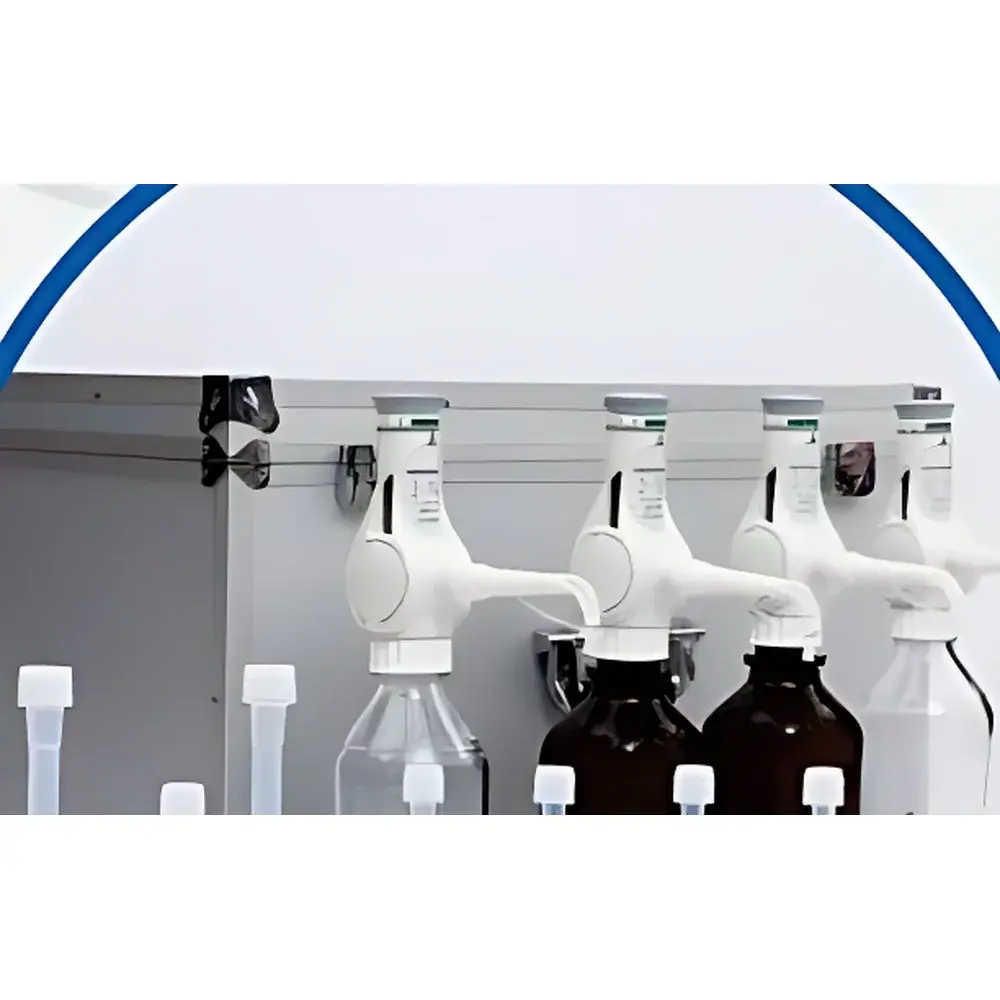
Hirschmann Metal Trace Analysis Preparatory System
| Brand | Hirschmann |
|---|---|
| Origin | Germany |
| Model | 98310001 |
| Dispensing Accuracy | ±0.1 mL |
| Dispensing Range | 1–10 mL |
| Sample Throughput | 4 samples per run |
| Dimensions | 50 × 50 × 30 cm |
| Material Compatibility | HF-resistant ceramic piston, PTFE/ETFE/FEP-wetted components |
| Calibration | Factory-calibrated for lifetime accuracy (no field recalibration required) |
Overview
The Hirschmann Metal Trace Analysis Preparatory System (Model 98310001) is a purpose-engineered liquid handling platform designed to meet the stringent requirements of trace metal analysis in environmental, food safety, pharmaceutical, and regulatory laboratories. Unlike general-purpose liquid handlers, this system integrates chemically inert, HF-compatible dispensing technology with gravimetrically validated precision—enabling reproducible sample preparation for ICP-MS, ICP-OES, and AAS workflows where sub-ppq contamination control and volumetric fidelity are non-negotiable. The core principle centers on positive-displacement metering via high-purity ceramic pistons housed in fluoropolymer-coated bodies, eliminating reliance on air displacement or glassware that degrades under hydrofluoric acid exposure. This architecture ensures long-term dimensional stability, zero drift over time, and compliance with ISO 8655-3 (volumetric accuracy of piston-operated devices) without periodic recalibration—a critical advantage in GLP and ISO/IEC 17025-accredited environments.
Key Features
- HF- and aggressive solvent-resistant construction: Ceramic piston (Al2O3-based, >99.8% purity), PTFE-sealed valve body, ETFE/FEP fluid path—all certified for continuous use with ≥48% HF, concentrated HNO3, HClO4, and organic solvents including acetonitrile and chloroform.
- Staged-volume dispensing mechanism: Fixed-volume increments (1, 2, 5, and 10 mL) implemented via mechanical detent positioning—eliminating electronic drift, software dependency, or operator-induced parallax error.
- Integrated reagent recovery manifold: Closed-loop solvent return path with integrated pressure-relief safety valve prevents drips, aerosol generation, and cross-contamination during repetitive dispensing cycles.
- Modular benchtop footprint: Compact 50 × 50 × 30 cm chassis supports up to four parallel sample vessels (e.g., 50 mL PFA vials or quartz digestion tubes), enabling batched trace-metal digestion prep without robotic arm complexity.
- Traceability-ready design: Each unit ships with factory-issued calibration certificate referencing NIST-traceable mass standards; no user-performed calibration required per ISO/IEC 17025 Clause 6.5.2.
Sample Compatibility & Compliance
The system accommodates solid and semi-solid matrices requiring acid digestion—including soils, sediments, biological tissues, food composites, and pharmaceutical excipients—prior to elemental quantification. It is explicitly validated for EPA Method 3050B (acid digestion of sediments and soils), ASTM D5688 (trace metals in drinking water), and ISO 17294-2 (water quality — ICP-MS determination). All wetted materials comply with USP Class VI biocompatibility testing and pass DIN EN ISO 10993-5 cytotoxicity screening. The absence of glass or silicone components eliminates leachable borosilicate or siloxane interference—critical for low-background Cr, Al, Ti, and Si measurements.
Software & Data Management
This is a hardware-only, calibration-free preparatory system—no embedded firmware, touchscreen interface, or proprietary software is included or required. All operation is manual and tactile, ensuring full audit trail transparency: users record dispense volumes, lot numbers, and digestion parameters directly in laboratory notebooks or LIMS-compatible electronic records. For labs operating under FDA 21 CFR Part 11, the system’s deterministic mechanical action supports ALCOA+ principles (Attributable, Legible, Contemporaneous, Original, Accurate) without electronic signature dependencies. Full documentation package includes ISO 9001-certified manufacturing records, material declarations (REACH/ROHS), and compatibility matrices for >60 common analytical reagents.
Applications
- Pre-digestion standard addition for ICP-MS multi-element calibration curves (e.g., As, Cd, Pb, Hg, U).
- Controlled HF-mediated dissolution of silicate-rich environmental samples (clays, fly ash, geological cores).
- Reagent-limited dilution series preparation for spike-recovery validation per ISO 11843-7.
- Acid matrix matching in reference material analysis (e.g., NIST SRM 1643e, ERM-CA713).
- Automated rinse-and-refill cycles in closed-vessel microwave digestion workflows using PFA vessels.
FAQ
Does this system require periodic recalibration?
No. The ceramic piston and mechanical volume indexing are factory calibrated to ISO 8655-3 specifications and retain accuracy for the product’s service life—no user intervention or external calibration is necessary.
Can it be used with hydrofluoric acid concentrations above 40%?
Yes. All fluid-contact surfaces—including piston, valve seat, and dispensing tip—are qualified for continuous exposure to 48% HF at ambient temperature per DIN 51393 corrosion resistance testing.
Is the system compatible with automated LIMS integration?
While the device itself has no digital interface, its deterministic operation enables unambiguous manual entry into LIMS or ELN systems; all dispense events are fully attributable, contemporaneous, and auditable per GLP and ISO/IEC 17025 requirements.
What maintenance is required?
Annual visual inspection of piston smoothness and valve seal integrity is recommended; cleaning is performed with deionized water followed by acetone rinse—no lubrication or part replacement is needed under normal use.
How does it differ from conventional bottle-top dispensers?
Unlike air-displacement or spring-loaded dispensers, this system uses true positive displacement with zero dead volume, eliminating bubble formation, evaporation bias, and viscosity-dependent error—particularly critical for high-density nitric/hydrofluoric acid mixtures.



