
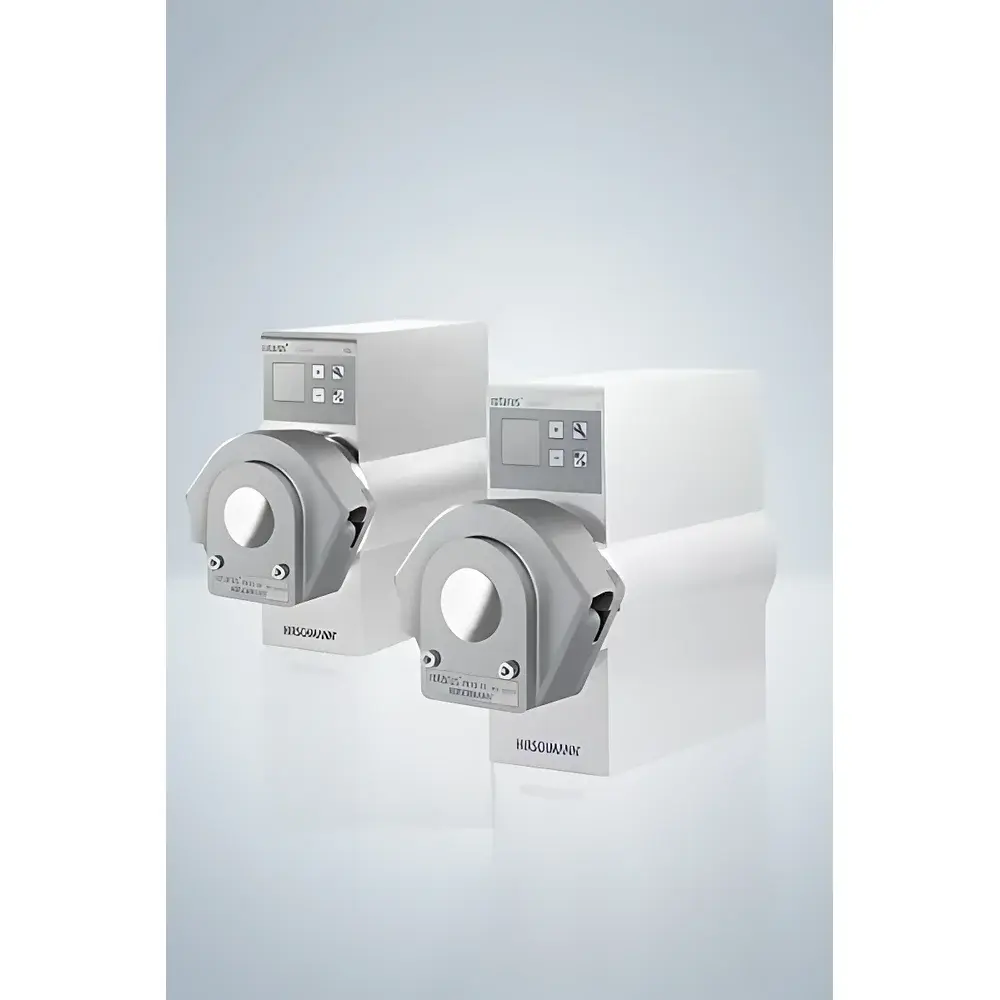
Hirschmann rotarus® Standard 50 Peristaltic Pump (Model 9501322)
| Brand | Hirschmann |
|---|---|
| Origin | Germany |
| Model | 9501322 |
| Flow Rate Range | 0.0001–1380 mL/min |
| Speed Range | 0.2–100 rpm |
| Motor Power | 50 W |
| Enclosure Rating | IP54 (lab version), IP65 (stainless steel version) |
| Control Interface | Integrated keypad, RS232, USB |
| Power Supply | 24 V DC |
| Pump Head Mounting | Tool-free, modular |
| Compatibility | Interchangeable pump heads (single- or multi-channel), third-party pump head support |
Overview
The Hirschmann rotarus® Standard 50 Peristaltic Pump (Model 9501322) is an engineered solution for precise, contamination-free liquid handling in regulated laboratory and light industrial environments. Operating on the principle of peristaltic displacement—where rollers compress flexible tubing to generate positive displacement—the pump ensures complete fluid isolation from drive components, eliminating risk of cross-contamination, seal leakage, or sample degradation. Designed for continuous or intermittent dosing applications, it delivers reproducible volumetric flow across a broad dynamic range—from ultra-low dispensing at 0.0001 mL/min (e.g., reagent addition in microfluidic assays) to high-throughput transfer at 1380 mL/min (e.g., buffer circulation in bioprocessing workflows). Its 50 W brushless DC motor provides stable torque output across the full 0.2–100 rpm speed range, enabling fine-grained control over shear-sensitive media such as cell suspensions, protein solutions, or polymer melts.
Key Features
- Tool-free, modular pump head system: Supports rapid interchange of single-channel and multi-channel pump heads without disassembly tools—enabling quick adaptation between low-volume precision dispensing and parallel multi-stream distribution.
- Integrated user interface: Front-panel keypad with LED display allows direct setting and monitoring of speed, direction, and run time; no external controller required for standalone operation.
- Dual enclosure options: White epoxy-coated housing rated to IP54 (dust-protected, splash-resistant) for general laboratory use; optional stainless-steel enclosure certified to IP65 (dust-tight, low-pressure water jet resistant) for wet-process or cleanroom-adjacent environments.
- Standardized 24 V DC power architecture: Enables safe integration into automated lab platforms and reduces electrical safety compliance overhead in multi-instrument setups.
- Industrial-grade communication interfaces: RS232 and USB ports support bidirectional command protocols (e.g., ASCII-based SCPI subsets), facilitating integration with LIMS, PLCs, or custom Python/Matlab control scripts.
- Third-party pump head compatibility: Mechanical and mounting dimensions conform to ISO 8536-4 and DIN 12550 standards, permitting use of validated pump heads from alternative manufacturers where application-specific tubing performance or regulatory traceability is required.
Sample Compatibility & Compliance
The rotarus® Standard 50 is compatible with a wide spectrum of elastomeric tubing materials—including silicone, Viton®, Tygon®, and PharmPure™—each selected for chemical resistance, extractables profile, and USP Class VI or FDA 21 CFR 177.2600 compliance. Its peristaltic mechanism inherently avoids contact between fluid and pump internals, making it suitable for handling aggressive solvents, biological buffers, sterile media, and viscous suspensions up to ~50,000 cP (dependent on tubing ID and wall thickness). The device meets IEC 61010-1:2010 for electrical safety in laboratory equipment and carries CE marking under the EU Machinery Directive 2006/42/EC. For GLP/GMP environments, audit trails can be generated via external logging software using timestamped serial commands; firmware supports configurable start/stop triggers and error-code reporting (e.g., “tubing occlusion”, “motor stall”) for process documentation.
Software & Data Management
No proprietary software is bundled, ensuring long-term interoperability and avoiding vendor lock-in. Communication follows open ASCII command syntax over RS232 or USB virtual COM port, allowing seamless integration with common lab automation frameworks. Example commands include SPD=42.5 (set speed to 42.5 rpm), DIR=F (forward rotation), and STA? (query status). All commands return machine-readable responses (e.g., SPD=42.5rn), enabling real-time data synchronization with electronic lab notebooks (ELNs) or MES systems. Firmware supports non-volatile memory for up to 16 user-defined presets, each storing speed, direction, duration, and ramp profiles—critical for SOP-driven workflows requiring repeatable parameter recall.
Applications
- Automated reagent dispensing in ELISA, PCR setup, and NGS library preparation
- Continuous feed of culture media or harvest streams in benchtop bioreactors
- Calibration standard delivery in ICP-MS and HPLC autosampler interfaces
- In-line pH or conductivity probe flushing in process analytical technology (PAT) systems
- Controlled solvent addition during crystallization studies or reaction calorimetry
- Low-shear transfer of stem cell suspensions or liposomal formulations
FAQ
Is the rotarus® Standard 50 compliant with FDA 21 CFR Part 11 for electronic records?
The pump itself does not provide built-in audit trail functionality, but its deterministic command-response protocol enables full traceability when paired with validated third-party logging software that captures timestamps, operator IDs, and command history.
Can I use this pump for sterile filtration line priming?
Yes—when equipped with USP Class VI-certified silicone tubing and operated within validated speed/tubing combinations, it is routinely deployed for pre-filter and post-filter line priming in aseptic filling suites.
What is the maximum recommended backpressure for continuous operation?
At 100 rpm and with standard 3.2 mm ID silicone tubing, sustained backpressure should not exceed 1.5 bar to maintain tubing service life and flow accuracy; higher pressures require reinforced tubing or pressure-relief design considerations.
Does Hirschmann supply tubing validation reports?
Yes—certificates of conformance, extractables test data (per USP and ), and lot-specific dimensional verification are available upon request for all factory-supplied tubing kits.
How often does the pump require recalibration?
Speed calibration is factory-set and remains stable over time; however, volumetric accuracy verification is recommended before critical experiments using gravimetric or timed-collection methods per ISO 8655-4 guidelines.



