
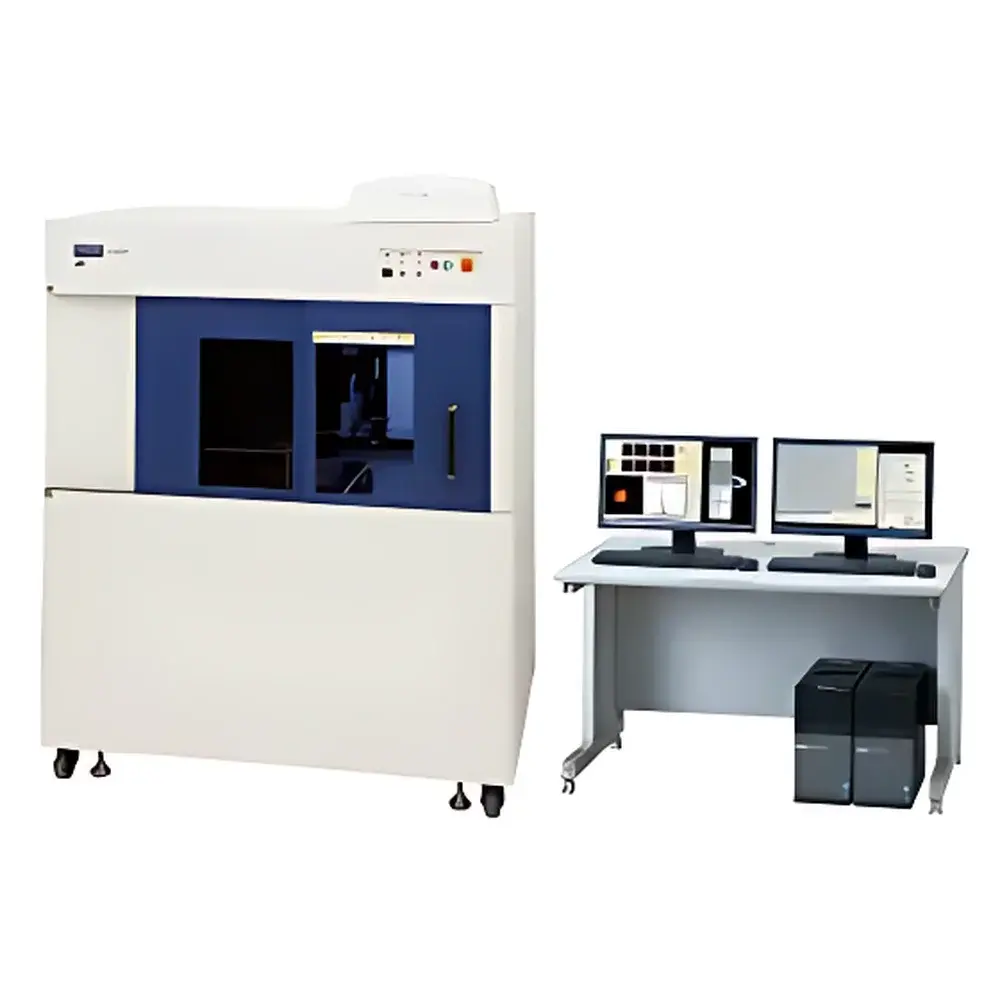
Hitachi EA8000 X-ray Foreign Particle Analyzer for Lithium-ion Batteries and Fuel Cells
| Brand | Hitachi |
|---|---|
| Origin | Japan |
| Model | EA8000 |
| Detection Limit | ≥20 µm metallic particles |
| Imaging Mode | Transmission + Energy-Dispersive X-ray Fluorescence (ED-XRF) Mapping |
| Sample Format | Powder, Foil, Separator, Electrode Sheet (up to 250 × 200 mm) |
| Automation | Full workflow automation (acquisition → detection → elemental mapping → report generation) |
| Compliance | Designed for ISO/IEC 17025-aligned QA/QC labs |
Overview
The Hitachi EA8000 X-ray Foreign Particle Analyzer is a purpose-built, dual-mode analytical system engineered for rigorous foreign material control in lithium-ion battery (LIB) and fuel cell manufacturing. It integrates high-resolution transmission X-ray imaging with spatially resolved energy-dispersive X-ray fluorescence (ED-XRF) spectroscopy to detect, locate, and chemically identify metallic contaminants as small as 20 µm within heterogeneous battery components. Unlike conventional XRD or standalone XRF systems, the EA8000 operates on a hybrid principle: first, it acquires a high-contrast transmission radiograph to localize density anomalies—such as metal particles embedded in carbon-based anodes, LiCoO₂ cathodes, polyolefin separators, or conductive carbon black slurries; second, it performs automated, motorized stage-driven micro-XRF scanning at each anomaly site to generate quantitative elemental distribution maps. This dual-signal correlation ensures unambiguous identification of Fe, Cu, Ni, Zn, Cr, or Al particles—even when embedded in low-Z matrices where absorption contrast alone is insufficient. The system is deployed at critical process gates: raw material incoming inspection (e.g., cathode powder batches), electrode coating uniformity verification, separator roll QC, and post-lamination defect screening—directly supporting IATF 16949 and ISO 26262 functional safety requirements for automotive-grade batteries.
Key Features
- Sub-20 µm metallic particle detection capability enabled by a custom-developed high-DQE (Detective Quantum Efficiency) flat-panel detector and optimized microfocus X-ray source (≤5 µm focal spot)
- Simultaneous dual-mode operation: real-time transmission imaging (250 × 200 mm field-of-view) followed by automated ED-XRF raster scanning with <10 µm spatial resolution
- Fully automated workflow—from sample loading and image acquisition to AI-assisted anomaly segmentation, targeted XRF point analysis, and ISO-compliant reporting
- Direct analysis of unprepared, bag-contained powders (e.g., conductive additives in polyethylene bags), eliminating digestion, pressing, or vacuum requirements
- Embedded metrology engine generating particle size histograms, positional heatmaps, count-per-area statistics, and elemental composition tables per detected inclusion
- Robust mechanical architecture with vibration-damped optical table, temperature-stabilized detector housing, and redundant hardware interlocks for 24/7 production-line integration
Sample Compatibility & Compliance
The EA8000 accommodates a broad spectrum of battery-relevant materials without destructive preparation: dry powders (cathode active materials, graphite anodes, carbon black), thin films (Cu/Al foils ≤20 µm, ceramic-coated separators), laminated electrodes, and slurry-coated jigs. Its low-energy X-ray configuration (5–30 kV) maximizes contrast for light-element matrices while minimizing beam hardening artifacts. The system meets electromagnetic compatibility (EMC) Class B requirements per CISPR 11 and is designed for use in ISO Class 7 cleanrooms. Data integrity aligns with FDA 21 CFR Part 11 principles: all images, spectra, and reports are time-stamped, digitally signed, and stored with immutable audit trails. Instrument qualification documentation supports GLP and GMP environments, and method validation protocols conform to ASTM E2923-22 (Standard Guide for XRF Elemental Mapping).
Software & Data Management
Hitachi’s proprietary EA-Analyzer Suite provides a validated, role-based interface with three operational modes: Quick Scan (for incoming inspection), Deep Map (for root-cause failure analysis), and Trend Dashboard (for SPC-based contamination monitoring). All X-ray images and XRF spectra are stored in vendor-neutral HDF5 format with embedded metadata (sample ID, operator, timestamp, instrument parameters). Batch processing enables retrospective re-analysis across hundreds of samples using consistent thresholding and calibration models. Reporting modules auto-generate PDF/Excel outputs compliant with customer-specific FA/8D templates, including annotated radiographs, element overlay maps, particle size distribution charts, and full spectral deconvolution results (peak fitting via fundamental parameter method). Data export supports LIMS integration via ASTM E1482-compliant XML schema.
Applications
- Root-cause analysis of internal short circuits in LIB cells by identifying Fe/Cu fragments from electrode cutting or slitting processes
- Quantitative assessment of metal contamination in NMC/NCA cathode precursors prior to calcination
- Verification of coating uniformity and absence of agglomerates in SiOx-C composite anodes
- Non-destructive release testing of separator rolls for stainless-steel or Al debris introduced during extrusion
- Process capability studies linking particle count/size distribution to cell formation yield and cycle life degradation
- Supplier qualification audits requiring traceable, reproducible foreign material thresholds per JIS Z 8901 or IPC-6012
FAQ
Does the EA8000 require vacuum or sample coating for analysis?
No. It operates in ambient air and accepts samples in standard polyethylene or Mylar bags—ideal for hygroscopic or oxygen-sensitive battery powders.
Can it distinguish between stainless steel and pure iron particles?
Yes. ED-XRF quantifies Cr, Ni, and Mn signatures simultaneously, enabling alloy classification (e.g., SUS304 vs. Fe2O3) with detection limits below 100 ppm per pixel.
Is the system compatible with automated factory data infrastructure?
Yes. It supports OPC UA server integration, MQTT telemetry, and RESTful API endpoints for real-time data ingestion into MES or digital twin platforms.
What calibration standards are supplied with the instrument?
NIST-traceable multi-element thin-film standards (Ni/Cu/Zn/Fe) and certified reference materials for LIB-specific matrices (e.g., graphite + Fe powder blends) are included.
How is measurement reproducibility verified across operators and shifts?
Built-in daily performance checks include drift-corrected detector gain calibration, beam stability monitoring, and automated reference sample scans—generating ISO/IEC 17025-compliant QC logs.






