
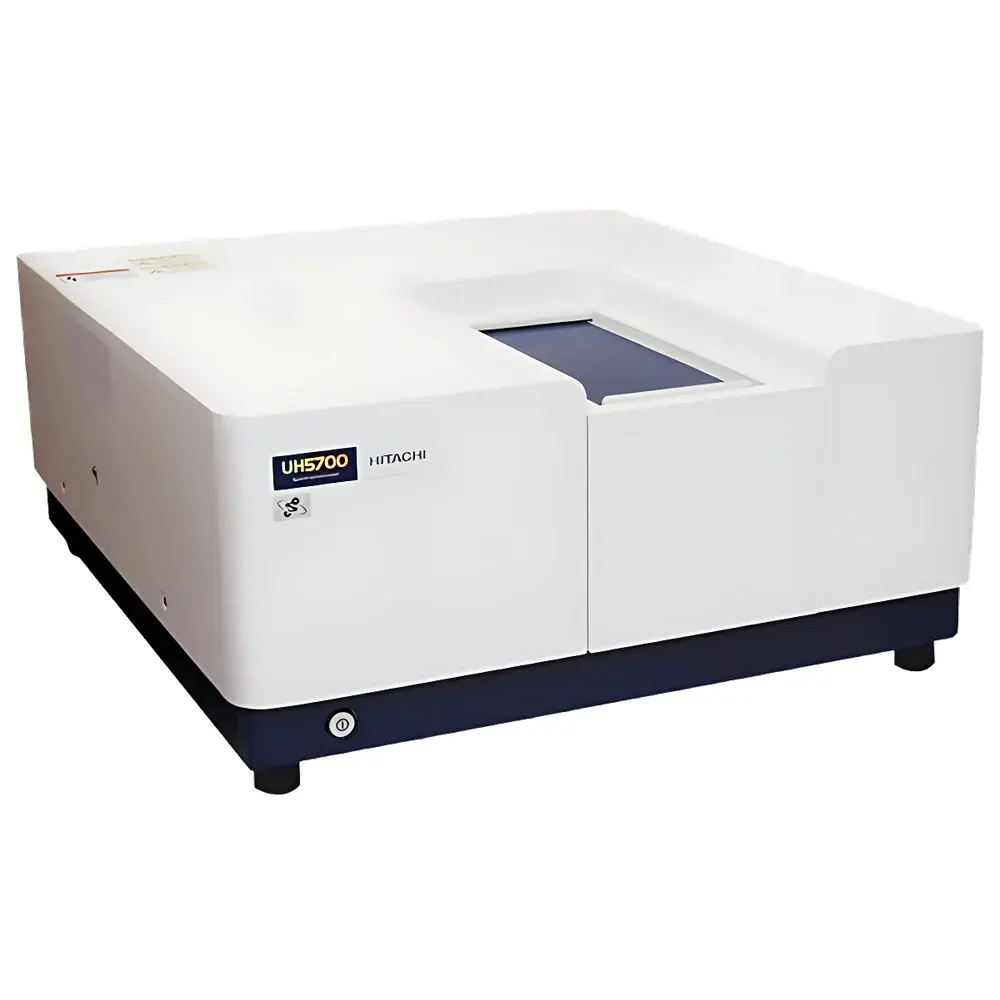
Hitachi UH5700 Dual-Beam UV-Vis-NIR Spectrophotometer
| Brand | Hitachi |
|---|---|
| Origin | Japan |
| Manufacturer | Hitachi High-Tech Corporation |
| Instrument Type | Dual-beam |
| Detector | Photomultiplier Tube (PMT) |
| Wavelength Range | 190–3300 nm |
| Wavelength Accuracy | ±0.05 nm (UV-Vis), ±0.2 nm (NIR) |
| Spectral Bandwidth | UV-Vis: 0.1, 0.2, 0.5, 1, 2, 5, 10 nm |
| NIR | 0.25, 0.5 nm |
| Wavelength Scanning Mode | Automatic |
| Slit Control | Motorized continuous variable slit |
| Optical System | Etched holographic diffraction grating, high-flux monochromator |
| Software | UV Solutions Plus with customizable reporting, data table view, instrument performance verification module |
Overview
The Hitachi UH5700 is a high-performance dual-beam UV-Vis-NIR spectrophotometer engineered for precision quantitative and qualitative analysis across an exceptionally broad spectral domain—from deep ultraviolet (190 nm) through visible light to extended near-infrared (3300 nm). Its optical architecture leverages a newly developed etched holographic diffraction grating and a thermally stabilized high-flux monochromator, enabling low stray light (<0.00005% at 220 nm), high photometric linearity (±0.002 A over 0–3.5 A), and exceptional wavelength reproducibility. Designed for laboratory environments requiring regulatory compliance and long-term measurement stability, the UH5700 supports both transmission and reflectance measurements on liquid, solid, and thin-film samples—making it suitable for materials science, pharmaceutical development, polymer characterization, and environmental monitoring applications where spectral fidelity across three decades of wavelength is critical.
Key Features
- Dual-beam optical path with real-time reference compensation, minimizing drift due to lamp intensity fluctuations or environmental temperature variation.
- Motorized continuous variable slit mechanism: automatically adjusts slit width during scanning—widening in NIR regions to maintain signal-to-noise ratio under low photon flux, narrowing in UV-Vis for optimal resolution.
- Gear-driven high-speed scanning system: achieves full 190–3300 nm scans in under 240 seconds with sub-nanometer step resolution and repeatable positioning accuracy.
- Low-stray-light optical design validated per ASTM E275 and ISO 9001-compliant manufacturing protocols; certified for use in GLP and GMP-regulated laboratories.
- Photomultiplier tube (PMT) detector optimized for UV-Vis sensitivity and extended InGaAs array compatibility for NIR detection (optional configuration).
Sample Compatibility & Compliance
The UH5700 accommodates diverse sample formats via interchangeable accessories—including 1–10 mm pathlength cuvettes, integrating spheres (60 mm, 150 mm), specular reflectance stands, film holders, and micro-volume adapters for as little as 2 µL of analyte. It meets key international standards for spectrophotometric validation: ASTM E1421 (for reflectance measurement), USP (for pharmaceutical absorbance testing), and ISO/IEC 17025 requirements for instrument calibration traceability to NIST SRM standards. All hardware and firmware are designed to support audit-ready operation under FDA 21 CFR Part 11 when paired with UV Solutions Plus software configured for electronic signatures and secure data archiving.
Software & Data Management
UV Solutions Plus is a Windows-based control and analysis platform offering full instrument automation, spectral database management, and regulatory-compliant data handling. It provides customizable report templates with embedded metadata (operator ID, timestamp, instrument serial number, calibration status), batch processing for multi-sample workflows, and built-in instrument performance verification routines—including wavelength accuracy checks using holmium oxide and didymium filters, photometric linearity assessment, and baseline stability monitoring. Raw spectral data are stored in vendor-neutral CSV and JCAMP-DX formats; audit trails record all parameter changes, measurement events, and user logins with immutable timestamps.
Applications
- Pharmaceutical QC/QA: Quantitative assay of active pharmaceutical ingredients (APIs), excipient identification, dissolution profile analysis per USP , and stability-indicating method development.
- Materials science: Bandgap determination of semiconductors, thin-film thickness calculation via interference fringe analysis, and optical constant derivation (n, k) using Kramers–Kronig transforms.
- Environmental chemistry: Multi-wavelength quantification of nitrate, nitrite, phosphate, and heavy metal complexes in aqueous matrices without derivatization.
- Polymers & coatings: Degradation kinetics monitoring via carbonyl index tracking (1710 cm⁻¹ equivalent in NIR), haze/transparency evaluation, and pigment dispersion uniformity assessment.
- Academic research: Time-resolved absorption kinetics, photochemical reaction monitoring, and multivariate calibration model development (e.g., PLS regression) for complex mixtures.
FAQ
What is the wavelength accuracy specification across the full 190–3300 nm range?
Wavelength accuracy is ±0.05 nm from 190–900 nm and ±0.2 nm from 900–3300 nm, verified using NIST-traceable holmium oxide and water vapor absorption standards.
Does the UH5700 support GLP/GMP-compliant data integrity requirements?
Yes—when configured with UV Solutions Plus in Audit Trail mode, it enforces role-based access control, electronic signatures, and tamper-evident data storage compliant with FDA 21 CFR Part 11 and EU Annex 11.
Can solid samples be measured without accessory modification?
No—solid sample measurement requires optional accessories such as the 60 mm integrating sphere or specular reflectance stage; these are not included in the base configuration but are fully supported by the optical design and software.
Is the instrument compatible with third-party chemometrics software?
Yes—spectral export in JCAMP-DX format ensures interoperability with Unscrambler, MATLAB, Python (SciPy/NumPy), and other analytical platforms supporting open spectral data standards.
What maintenance is required to sustain photometric accuracy over time?
Annual recalibration against NIST SRMs is recommended; the built-in performance verification module allows daily operational qualification using factory-installed reference filters and lamp intensity diagnostics.





