
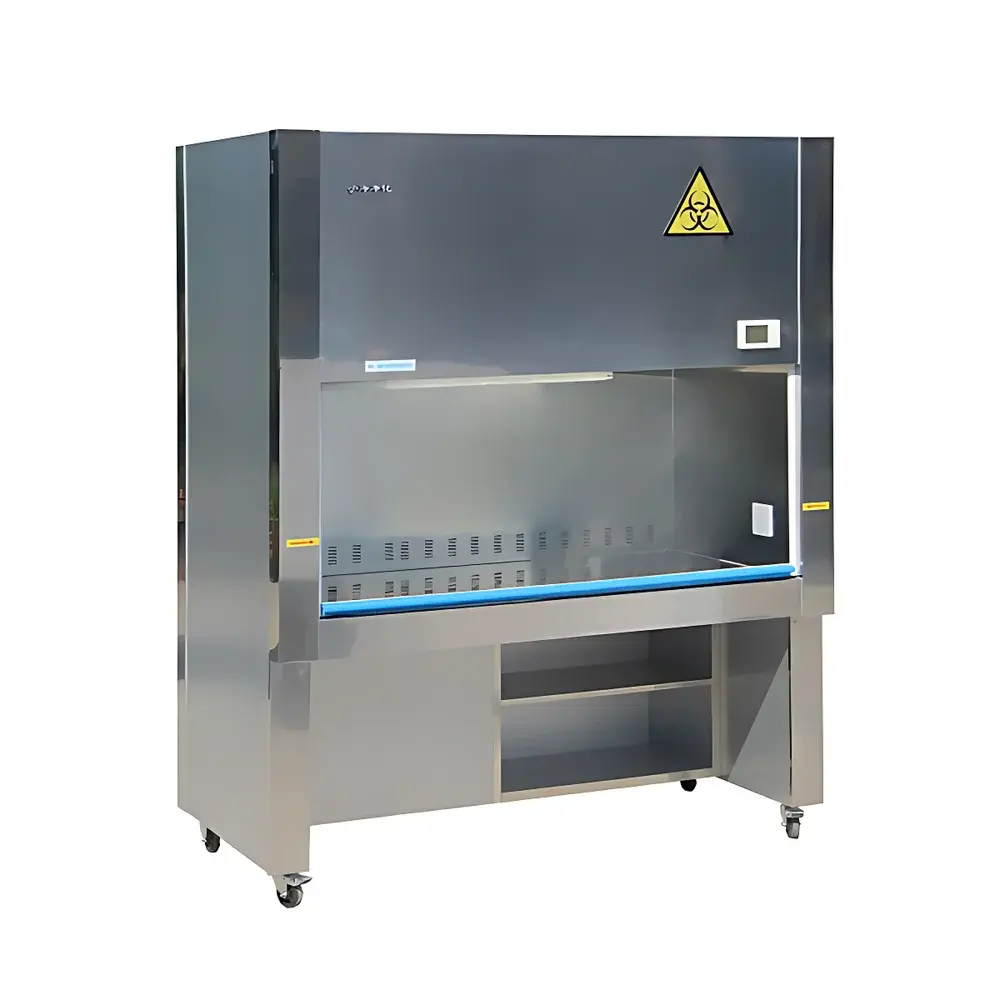
HJ BHC-1300IIA/B3 Class II A2 Biological Safety Cabinet
| Brand | HJ Purification |
|---|---|
| Origin | Shanghai, China |
| Manufacturer Type | Direct Manufacturer |
| Product Origin | Domestic (China) |
| Model | BHC-1300IIA/B3 |
| Price | ¥16,800 |
| External Dimensions (L×W×H) | 1540 × 800 × 1950 mm |
| Internal Work Area Dimensions (L×W×H) | 1340 × 650 × 600 mm |
| HEPA Filter Efficiency | ≥99.99% @ 0.3 µm particles |
Overview
The HJ BHC-1300IIA/B3 is a certified Class II Type A2 biological safety cabinet engineered for containment of low-to-moderate risk biological agents (BSL-2) in research, clinical diagnostics, and pharmaceutical quality control laboratories. It operates on the principle of laminar airflow combined with dual-stage filtration—vertical downflow across the work surface and inward-facing front intake—ensuring personnel, product, and environmental protection simultaneously. Air entering the cabinet passes through a pre-filter and then a certified HEPA filter (≥99.99% efficiency at 0.3 µm), while approximately 70% of total airflow is exhausted externally via ducted connection or recirculated after filtration (30% recirculation). The unit complies fully with YY 0569–2011 (Chinese SFDA standard) and NSF/ANSI 49–2022 (U.S. standard), supporting GLP-compliant workflows and routine validation per ISO 14644-1 (cleanroom classification) and ISO 14698-1 (biocontamination control).
Key Features
- Structural integrity: Steel-and-wood hybrid chassis with full SUS304 brushed stainless steel work chamber—corrosion-resistant, non-porous, and compliant with ISO 15223-1 cleaning validation requirements.
- Ergonomic design: 10° forward-sloped sash and optimized work height reduce operator fatigue during extended procedures; integrated leveling feet and swivel casters enable precise positioning and mobility without disassembly.
- Airflow assurance: Independently verified inflow velocity of 0.55 ± 0.025 m/s (at 100% exhaust mode); uniform downflow velocities across three zones (front/mid/rear) maintained within ±0.025 m/s tolerance to prevent turbulence-induced cross-contamination.
- Safety interlocks: Automatic UV lamp deactivation upon sash movement and lighting circuit cutoff when UV is active—meeting IEC 61000-6-3 EMC and IEC 62471 photobiological safety standards.
- Intuitive control: Digital LCD interface with three-speed fan control (low/medium/high), real-time airflow monitoring, and audible/visual alarms for filter saturation, sash mispositioning, or airflow deviation.
- Integrated utilities: One 5-outlet 220 V AC power strip (IEC 60320 C13) mounted inside the work area; standard 160 mm diameter × 1 m flexible exhaust duct with 90° elbow included for rapid installation.
Sample Compatibility & Compliance
The BHC-1300IIA/B3 accommodates standard microbiological tools—including Petri dishes, test tubes, pipettes, centrifuge tubes, and small benchtop instruments—within its 1340 × 650 × 600 mm work volume. Its Class II A2 configuration supports open-vessel manipulations involving low-volatility chemical agents (e.g., ethanol, diluted acids/bases) when used in conjunction with appropriate chemical compatibility assessments. Certification documentation includes full test reports for containment integrity (smoke pattern verification), filter leak testing (DOP/PAO scan per ISO 14644-3), and microbial challenge (settling plate assay per ISO 14698-1 showing ≤0.5 CFU/plate·hour). Units are supplied with factory-issued Certificate of Conformance traceable to CNAS-accredited calibration labs.
Software & Data Management
While the cabinet operates as a standalone hardware system without embedded network connectivity, its digital controller logs operational parameters—including cumulative runtime, alarm events, and fan speed settings—for local review via LCD menu navigation. All alarm states (e.g., airflow failure, UV exposure breach) trigger timestamped visual indicators and sustained audible alerts, satisfying basic audit trail requirements under GLP Annex 11 and FDA 21 CFR Part 11 for non-electronic record systems. Optional external data loggers (RS-485 or 4–20 mA output compatible) may be interfaced for centralized facility monitoring in regulated environments.
Applications
This safety cabinet is routinely deployed in applications requiring simultaneous personnel and product protection: microbial culture handling (bacterial/fungal isolation, antibiotic susceptibility testing), tissue culture passaging (adherent and suspension lines), PCR setup and plasmid transfection, vaccine formulation QC, and sterility testing per USP . Its validated 100-level clean environment (Fed. Std. 209E equivalent) makes it suitable for aseptic filling of parenteral preparations under ISO 13408-1 guidance, provided ancillary engineering controls (e.g., HVAC, gowning protocols) are aligned with EU GMP Annex 1.
FAQ
Does this cabinet meet international regulatory requirements for BSL-2 laboratories?
Yes—it is independently certified to both YY 0569–2011 and NSF/ANSI 49–2022, ensuring compliance with global BSL-2 containment expectations.
Can the unit operate in recirculation-only mode without external ducting?
No. As a Type A2 cabinet, it requires either hard-ducted exhaust or connection to a dedicated thimble canopy system; recirculation-only operation is prohibited per NSF 49.
What maintenance intervals are recommended for HEPA filter replacement?
Filter service life depends on usage intensity and ambient particulate load; annual integrity testing (via DOP/PAO scan) is mandatory, with replacement typically required every 3–5 years or following documented performance drift.
Is the stainless steel work surface electropolished?
No—the chamber uses mechanically polished SUS304 grade stainless steel with Ra ≤ 0.8 µm surface roughness, validated for effective disinfectant contact and residue removal per ASTM E2614.
Are electrical components rated for continuous duty in laboratory environments?
Yes—fan motor, ballasts, and control electronics are IP20-rated and thermally protected for 24/7 operation at ambient temperatures up to 35°C and relative humidity ≤80% non-condensing.
Related Products




