
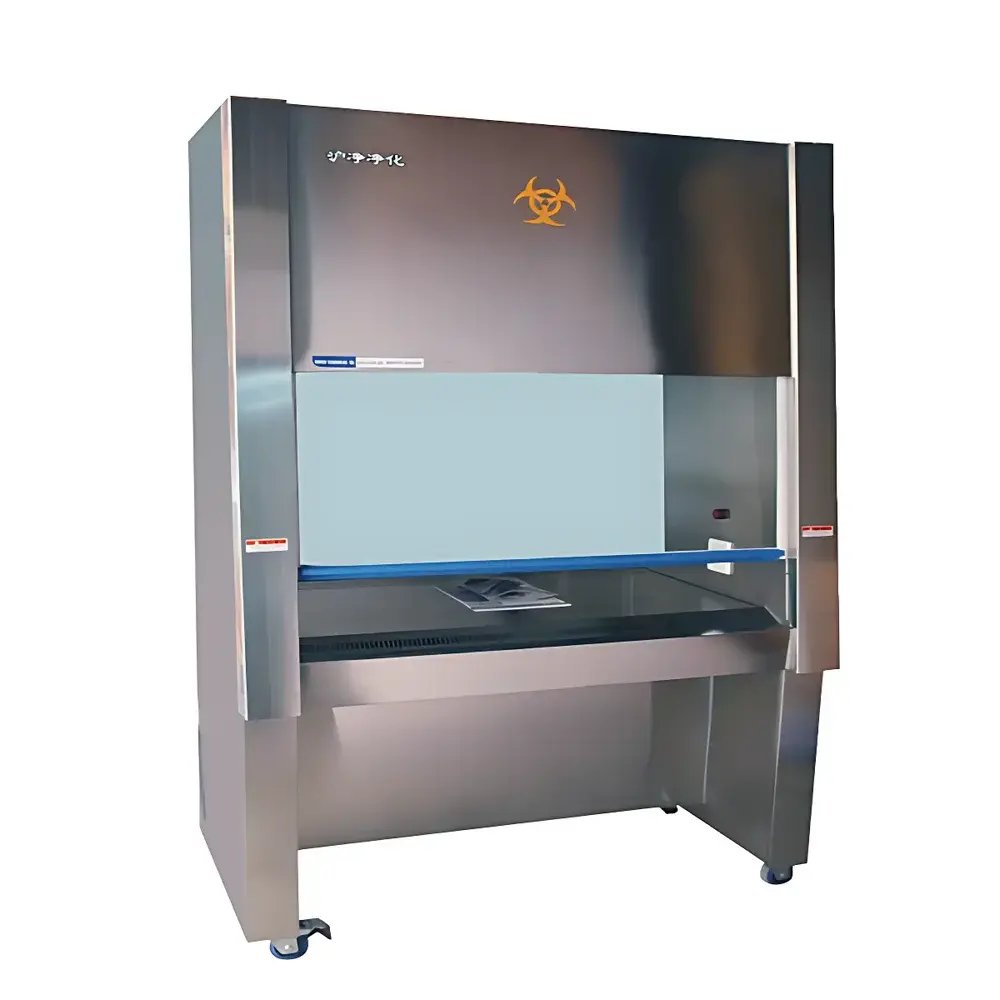
HJ BSC-1000IIB2 Class II Type B2 Biological Safety Cabinet
| Brand | HJ |
|---|---|
| Origin | Shanghai, China |
| Manufacturer | HJ Purification |
| Type | Class II, Type B2 (Total Exhaust) |
| Model | BSC-1000IIB2 |
| External Dimensions (L×W×H) | 1200 × 750 × 1950 mm |
| Internal Work Area Dimensions (L×W×H) | 1000 × 650 × 580 mm |
| Filter Efficiency | ≥99.999% @ 0.3 µm (HEPA), compliant with US Federal Standard 209E Class 100 (ISO Class 5) |
| Average Inflow Velocity | 0.55 ± 0.025 m/s |
| Downflow Velocity (Center) | 0.26 ± 0.025 m/s |
| Noise Level | ≤62 dB(A) |
| Power Supply | AC 220 V, 50 Hz |
| Max. Power Consumption | 1000 W |
| Net Weight | 150 kg |
| Lighting | 20 W fluorescent lamp × 1 |
| UV Lamp | 20 W × 1 |
| Work Surface Material | 304 stainless steel |
| Control Interface | LED-based digital panel with real-time monitoring and alarm functions |
Overview
The HJ BSC-1000IIB2 is a certified Class II, Type B2 biological safety cabinet engineered for maximum personnel, product, and environmental protection in microbiological and biomedical laboratories. As a total-exhaust (100% external venting) system, it operates under negative pressure with unidirectional downward laminar airflow—generated by a dedicated blower—and inward-facing inflow at the work opening. This dual-airflow architecture ensures complete containment of aerosols generated during open handling of Risk Group 2 and 3 agents, while eliminating recirculation to prevent cross-contamination. The cabinet complies with NSF/ANSI 49–2022 and EN 12469:2000 standards for biosafety performance, and its HEPA filtration system meets ISO 14644-1 Class 5 (equivalent to US FED STD 209E Class 100) for particulate removal efficiency ≥99.999% at 0.3 µm. Designed for integration into dedicated ducted exhaust systems, the BSC-1000IIB2 is suitable for applications requiring strict chemical compatibility—including volatile organic solvents—due to its non-recirculating airflow path.
Key Features
- Vertical laminar downflow and front inflow maintained by a precision-controlled dual-blower system, delivering consistent velocity profiles across the work surface (0.26–0.27 m/s downflow; 0.55 m/s inflow) per NSF/ANSI 49 requirements.
- Motorized or manually operated sash window with positional memory and audible/visual height-limit alarm to ensure operator safety and maintain aerodynamic integrity during operation.
- Seamless 304 stainless steel work surface and interior chamber—electropolished and welded without crevices—to resist corrosion from disinfectants (e.g., 70% ethanol, sodium hypochlorite, hydrogen peroxide vapor) and enable validated decontamination protocols.
- Dedicated exhaust HEPA filter (955 × 554 × 550 mm, single unit) with integrated filter life monitoring and real-time failure alert via LED control panel.
- Integrated UV germicidal lamp (20 W) with interlocked safety cutoff when sash is raised above operational threshold; independently controllable from main interface.
- Ergonomic 10° forward tilt of the work surface and optimized depth-to-height ratio (650 mm depth × 580 mm height) reduce operator fatigue during extended procedures.
- Onboard power outlets (IPX4-rated waterproof sockets) and liquid waste port located within the work area for seamless integration of centrifuges, pipette controllers, and vacuum aspirators.
- Real-time airflow anomaly detection: simultaneous visual and acoustic alarms for inflow velocity deviation, HEPA saturation, and unintended air leakage at the sash perimeter.
Sample Compatibility & Compliance
The BSC-1000IIB2 supports safe manipulation of a broad spectrum of biological materials, including bacterial cultures (e.g., Escherichia coli, Bacillus subtilis), viral vectors (lentiviral, AAV), primary human cells, and low-volatility chemical reagents used in molecular cloning and cell therapy workflows. Its Type B2 configuration prohibits use with high-vapor-pressure solvents such as ether or carbon disulfide but accommodates acetone, methanol, and isopropanol under controlled volumetric limits. All structural and performance claims are verified through third-party certification per NSF/ANSI 49–2022 Annex D (smoke pattern visualization), Annex E (air velocity mapping), and Annex F (microbial containment challenge testing using Bacillus atrophaeus). The cabinet’s construction materials and electrical design conform to IEC 61010-1 for laboratory equipment safety, and its control firmware supports audit-ready event logging compatible with GLP/GMP documentation frameworks.
Software & Data Management
The LED-based digital control interface provides continuous display of critical parameters: inflow velocity, downflow velocity, UV exposure time, filter usage hours, and alarm history. While the base model does not include networked data export, the controller stores up to 1,000 chronological events—including sash position changes, alarm triggers, and lamp activation—with timestamp and duration. Optional RS-485 serial output enables integration into centralized facility monitoring systems (e.g., LabVantage, Siemens Desigo). For regulated environments, the system supports manual calibration verification logs aligned with FDA 21 CFR Part 11 principles—requiring operator ID entry for all configuration changes and enabling printed audit trails via optional thermal printer module.
Applications
This cabinet is routinely deployed in academic core facilities, pharmaceutical QC labs, and contract development and manufacturing organizations (CDMOs) for: sterile cell culture passaging and transfection; preparation of clinical-grade CAR-T products under ISO 13485-aligned workflows; mycological isolation and identification; recombinant protein expression using BL2-compatible strains; and biosafety-level 2 (BSL-2) diagnostics involving SARS-CoV-2 RNA extraction and RT-qPCR setup. Its total-exhaust architecture makes it especially appropriate for laboratories lacking recirculation infrastructure or those performing combined microbiological and low-concentration cytotoxic drug handling where solvent compatibility is essential.
FAQ
What type of exhaust system is required for the BSC-1000IIB2?
A hard-ducted, dedicated exhaust system with stable static pressure compensation and minimum 150 Pa differential is mandatory. Flexible ducting is prohibited.
Can this cabinet be installed in a room without a central HVAC system?
Yes, provided the room maintains positive pressure relative to adjacent spaces and ambient temperature remains between 15–30°C with humidity ≤70% RH.
Is the HEPA filter certified to EN 1822 H14 standard?
Yes—the supplied filter is independently tested and certified to EN 1822-1:2019 H14 classification (≥99.995% @ MPPS), with full test report available upon request.
Does the unit support validation per ISO 14644-3 for cleanroom classification?
While the cabinet itself is classified as ISO Class 5 (100), full cleanroom qualification requires additional room-level particle counting per ISO 14644-3; the BSC serves as a localized ISO 5 microenvironment.
How often must the HEPA filter be replaced?
Under typical BSL-2 usage (8 hrs/day, 5 days/week), replacement is recommended every 3–5 years—subject to annual performance verification and pressure drop monitoring per manufacturer guidelines.




