
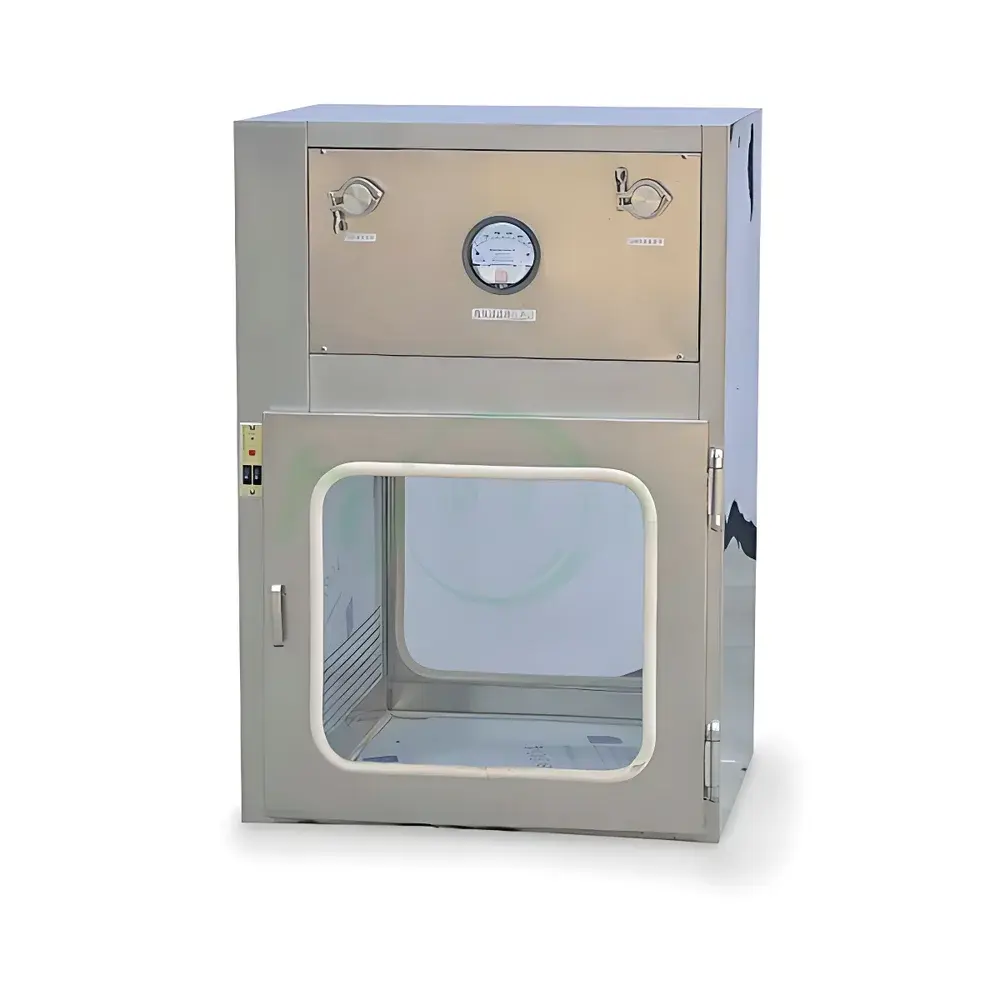
HJ DOP-Tested Laminar Flow Pass-Through Chamber
| Brand | HJ Purification (HJ) |
|---|---|
| Origin | Shanghai, China |
| Manufacturer Type | Direct Manufacturer |
| Product Origin | Domestic (China) |
| Model | DOP-Tested Laminar Flow Pass-Through Chamber |
| Price | USD 2,500 (approx.) |
Overview
The HJ DOP-Tested Laminar Flow Pass-Through Chamber is an engineered solution for controlled material transfer between cleanroom zones of differing ISO classifications—particularly between ISO Class 5 (Class 100) or higher洁净 areas and adjacent non-classified or lower-grade environments. Designed in strict alignment with Good Manufacturing Practice (GMP) Annex 1 requirements, this pass-through chamber integrates laminar airflow technology with certified DOP (Di-Octyl Phthalate) aerosol challenge testing capability to verify filter integrity and airflow uniformity. Its core function is to minimize cross-contamination risk by eliminating direct door-opening events between critical zones. Airflow is generated by a high-efficiency FFU (Fan Filter Unit) system, delivering unidirectional, vertically downward laminar flow across the transfer cavity at ≥0.45 m/s (≥1.62 km/h), ensuring particle-laden surfaces are continuously swept and recirculated through dual-stage filtration (pre-filter + HEPA). The chamber’s structural design follows cleanroom fluid dynamics principles—featuring fully radiused internal corners (R ≥ 25 mm), seamless 304 stainless steel construction, and zero-stagnation-zone geometry—to prevent microbial harborage and support validated cleaning protocols.
Key Features
- Full-radius internal corner design (R ≥ 25 mm) compliant with ISO 14644-1 and EU GMP Annex 1 surface hygiene requirements
- 304 stainless steel exterior and interior surfaces (electropolished finish option available); corrosion-resistant, non-shedding, and compatible with IPA/water-based disinfectants
- Dual interlocked doors with mechanical or microprocessor-controlled electronic interlock—ensuring fail-safe operation where both doors cannot open simultaneously
- Integrated UV-C germicidal lamp (254 nm) with programmable delay timer (0–30 min) for post-transfer surface decontamination
- HEPA filter (H14 grade per EN 1822-1) with ≥99.995% efficiency at 0.3 µm; DOP-tested and certified with documented leak-tightness report (≤0.01% upstream penetration)
- EVA gasket sealing system providing >99.9% door-to-frame seal integrity under differential pressure conditions (±10–50 Pa typical)
- Adjustable laminar airflow nozzles with calibrated velocity output ≥0.45 m/s across full workplane area
- Optional FFU configuration with ultra-low particulate air (ULPA) filter upgrade (U15 grade, ≥99.9995% @ 0.12 µm)
Sample Compatibility & Compliance
The chamber accommodates standard pharmaceutical packaging formats—including nested trays, aluminum foil-wrapped components, glass vials, stainless steel tooling, and pre-sterilized component carriers—without compromising laminar flow profile or containment integrity. All materials comply with USP , ISO 10993-5 (cytotoxicity), and FDA-recommended extractables/leachables compatibility guidelines for cleanroom contact surfaces. Regulatory documentation includes full DOP test reports (per IEST-RP-CC034.3), HEPA filter certification (EN 1822), and interlock validation protocol templates aligned with 21 CFR Part 11 data integrity expectations. Units are supplied with IQ/OQ documentation packages suitable for GMP-compliant commissioning in sterile manufacturing facilities (e.g., aseptic fill-finish suites, API isolation rooms).
Software & Data Management
Microprocessor-based control panel supports time-stamped event logging (door open/close, UV activation, filter run-hours, alarm triggers) with optional RS-485 Modbus RTU interface for integration into SCADA or MES systems. Audit trail functionality complies with ALCOA+ principles: attributable, legible, contemporaneous, original, accurate, complete, consistent, enduring, and available. Data export is supported via USB flash drive in CSV format. Optional firmware upgrade enables remote diagnostics and predictive maintenance alerts based on cumulative fan runtime and pressure differential trends—supporting lifecycle management under ISO 13485 and ICH Q9 quality risk management frameworks.
Applications
- Aseptic processing support: transfer of sterilized stoppers, rubber closures, and isolator gloves between Grade A/B and Grade C/D zones
- Cell therapy manufacturing: handling of cryovials and bioreactor accessories under ISO Class 5 conditions
- Medical device assembly: ingress/egress of laser-cut stents and catheter components into laminar flow hoods
- QC laboratory workflows: controlled movement of reference standards, calibration weights, and microbiological culture plates
- Vaccine production: barrier-integrated transfer of single-use bioreactor bags and tubing assemblies
FAQ
What does “DOP-tested” mean for this pass-through chamber?
It confirms that the installed HEPA filter has undergone quantitative aerosol challenge testing using Di-Octyl Phthalate (DOP) or equivalent PAO (Polyalphaolefin) oil mist at 0.3 µm, verifying ≤0.01% leakage per EN 1822-4 and IEST-RP-CC034.3.
Can this unit be integrated into a Building Management System (BMS)?
Yes—via optional Modbus RTU communication interface, enabling real-time monitoring of door status, UV cycle completion, and differential pressure alarms.
Is the chamber suitable for use with hydrogen peroxide (VHP) decontamination cycles?
The standard 304 stainless steel construction is compatible with VHP; however, UV lamp assemblies and electronic controls require removal or shielding during extended VHP exposure (>1000 ppm, >2 hr). A VHP-rated variant with sealed electronics is available upon request.
Does the unit include validation support documentation?
Yes—factory-supplied IQ/OQ templates, DOP test reports, HEPA certification, and interlock functional test records are included. PQ support is provided as a consultancy service.
What is the recommended maintenance frequency for the HEPA filter?
Filter replacement interval is determined by differential pressure monitoring (typically 12–24 months under continuous operation); pre-filters should be inspected quarterly and replaced every 6 months or when ΔP exceeds 150 Pa.
Related Products



