
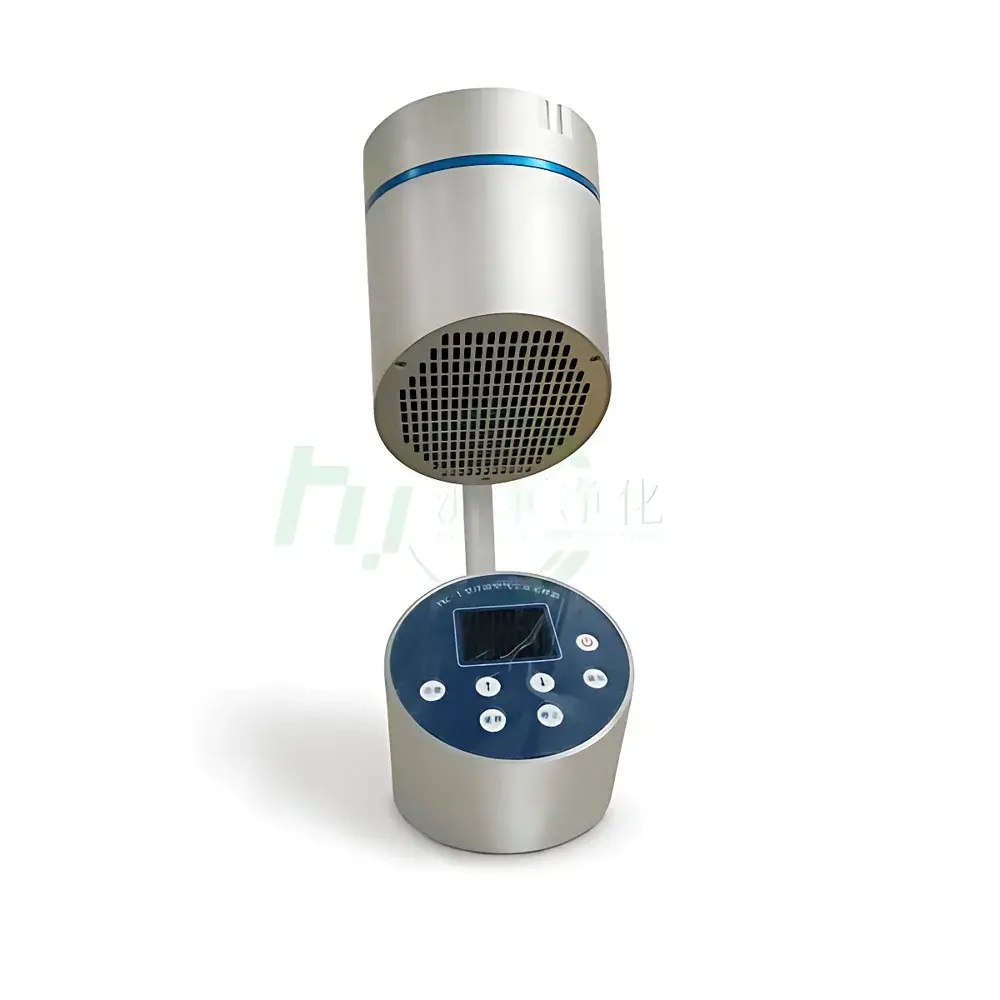
HJ FKC-1 Airborne Microbial Sampler
| Brand | HJ Purification |
|---|---|
| Origin | Shanghai, China |
| Manufacturer Type | OEM/ODM Manufacturer |
| Country of Origin | China |
| Model | FKC-1 |
| Sampling Principle | Andersen-style inertial impaction (5-stage cascade impactor principle) |
| Flow Rate | 100 L/min ±5% |
| Flow Measurement Accuracy | ±0.5% of reading |
| Adjustable Sampling Volume | 1–6000 L (programmable) |
| Operating Temperature Range | 25–35 °C |
| Operating Relative Humidity | 65–85 %RH |
| Impaction Velocity | 10.8 m/s |
| Display | 2.2-inch TFT LCD |
| Data Storage Capacity | 200 sampling records |
| Power Supply | AC 220 V / DC 14.8 V lithium battery (≥8 h runtime) |
| Dimensions (W×D×H) | 130 × 130 × 160 mm |
| Weight | 1.8 kg |
| Compliance | ISO 14698-1:2003, ISO 14698-2:2003, GB/T 16293–2010, Annex 1 to EU GMP (2022), USP <1116>, FDA Guidance for Aseptic Processing (2004) |
Overview
The HJ FKC-1 Airborne Microbial Sampler is a precision-engineered active air sampler designed for quantitative monitoring of viable airborne microorganisms in controlled environments—including cleanrooms, isolators, aseptic processing suites, and pharmaceutical manufacturing facilities. Unlike passive settle plates, the FKC-1 employs a validated 5-stage Andersen-type inertial impaction principle, delivering high collection efficiency across defined aerodynamic particle size ranges (0.65–20 µm). At an impaction velocity of 10.8 m/s, the sampler ensures reproducible deposition of viable particles onto standard 90 mm Petri dishes—enabling colony-forming unit (CFU) enumeration with minimal overlap and maximal recoverability. Its design aligns with international regulatory expectations for environmental monitoring programs under EU GMP Annex 1 (2022), ISO 14698-1/2, and USP , supporting risk-based contamination control strategies in Grade A–D classified spaces.
Key Features
- Programmable sampling volume (1–6000 L) with real-time flow compensation to maintain accuracy across variable ambient conditions
- High-flow capability (100 L/min ±5%) significantly reduces sampling duration without compromising microbial recovery fidelity
- 397-mesh stainless steel sampling head (0.7 mm aperture) minimizes particle bounce and re-entrainment while preventing colony coalescence on agar surfaces
- Dedicated ASIC-based flow control module ensures long-term stability and repeatability (<±0.5% flow measurement accuracy)
- 2.2-inch TFT display provides intuitive navigation and real-time visualization of cumulative volume, elapsed time, remaining battery, and error status
- Non-volatile memory stores up to 200 complete sampling sessions—including date/time stamp, set volume, actual flow, and duration—with automatic timestamping per record
- Tool-free Petri dish exchange: removal of the top impactor head grants immediate access to the agar plate—compatible with all standard 90 × 15 mm culture dishes
- Anodized aluminum impactor assembly resists corrosion and withstands routine disinfection protocols (e.g., 70% IPA, hydrogen peroxide vapor, sporicidal agents)
Sample Compatibility & Compliance
The FKC-1 is optimized for use with conventional microbiological growth media (TSA, SDA, Sabouraud Dextrose Agar) and supports both aerobic and fungal enumeration. Its physical configuration conforms to ISO 14698-2’s requirements for sampler calibration traceability and performance verification. Each unit undergoes factory flow calibration against NIST-traceable standards, with documented uncertainty budgets available upon request. The device meets mechanical and operational criteria specified in GB/T 16293–2010 (Chinese Pharmacopoeia), EU GMP Annex 1 Section 8.42 (sampling frequency and location rationale), and FDA Aseptic Processing Guidance (2004) regarding instrument qualification and environmental monitoring validation. It supports IQ/OQ documentation packages aligned with 21 CFR Part 11-compliant data integrity frameworks when integrated into validated laboratory information management systems (LIMS).
Software & Data Management
While the FKC-1 operates as a standalone field instrument, its embedded firmware supports USB-C data export in CSV format for post-acquisition analysis in Excel or statistical process control (SPC) platforms. All stored records include audit-ready metadata: operator ID (manually entered), sampling location code, environmental conditions (user-input temperature/humidity), and pass/fail status relative to preconfigured action/alert limits. Firmware versioning and parameter change logs are retained internally to satisfy GLP/GMP traceability requirements. Optional PC-based configuration utility enables batch setup of sampling templates, user-defined site libraries, and automated report generation compliant with ISO/IEC 17025 Clause 7.8.
Applications
- Environmental monitoring during aseptic drug product manufacturing (sterile fill-finish, lyophilization)
- Qualification and routine surveillance of ISO Class 5 (Grade A) laminar airflow workstations and RABS
- Investigation of microbial excursions and root cause analysis in cleanroom HVAC systems
- Validation of decontamination cycles (e.g., VHP, chlorine dioxide) via pre- and post-cycle bioburden assessment
- Monitoring of hospital pharmacy compounding areas and biosafety level 2 (BSL-2) laboratories
- Supporting ISO 14644-1 particulate testing with concurrent viable and non-viable monitoring campaigns
FAQ
What regulatory standards does the FKC-1 comply with?
The FKC-1 meets ISO 14698-1/2 (2003), GB/T 16293–2010, EU GMP Annex 1 (2022), and USP . It is suitable for use in FDA- and EMA-regulated facilities requiring validated environmental monitoring instrumentation.
Can the FKC-1 be used in high-humidity cleanrooms?
Yes—the operating RH range is 65–85 %RH. For sustained operation above 80 %RH, we recommend using low-moisture agar formulations (e.g., TSA with reduced water activity) and limiting exposure time to ≤30 minutes per sample to prevent condensation-induced colony spreading.
Is the impactor head autoclavable?
No—the anodized aluminum head is not autoclave-rated. Sterilization is performed via surface disinfection using 70% isopropyl alcohol or vapor-phase hydrogen peroxide (VPHP); thermal cycling may compromise dimensional tolerances critical to impaction velocity calibration.
How is flow accuracy maintained over time?
The proprietary ASIC flow controller continuously monitors pressure differentials across the calibrated orifice and adjusts fan speed in real time. Annual recalibration against a primary standard (e.g., dry calibrator or bubble meter) is recommended to retain ±0.5% measurement confidence.
Does the FKC-1 support remote operation or network integration?
Not natively—but its USB-C interface enables integration with industrial PLCs or SCADA systems via Modbus RTU emulation firmware (available as optional upgrade). Standalone wireless telemetry requires external Bluetooth/WiFi gateway hardware.
Related Products







