
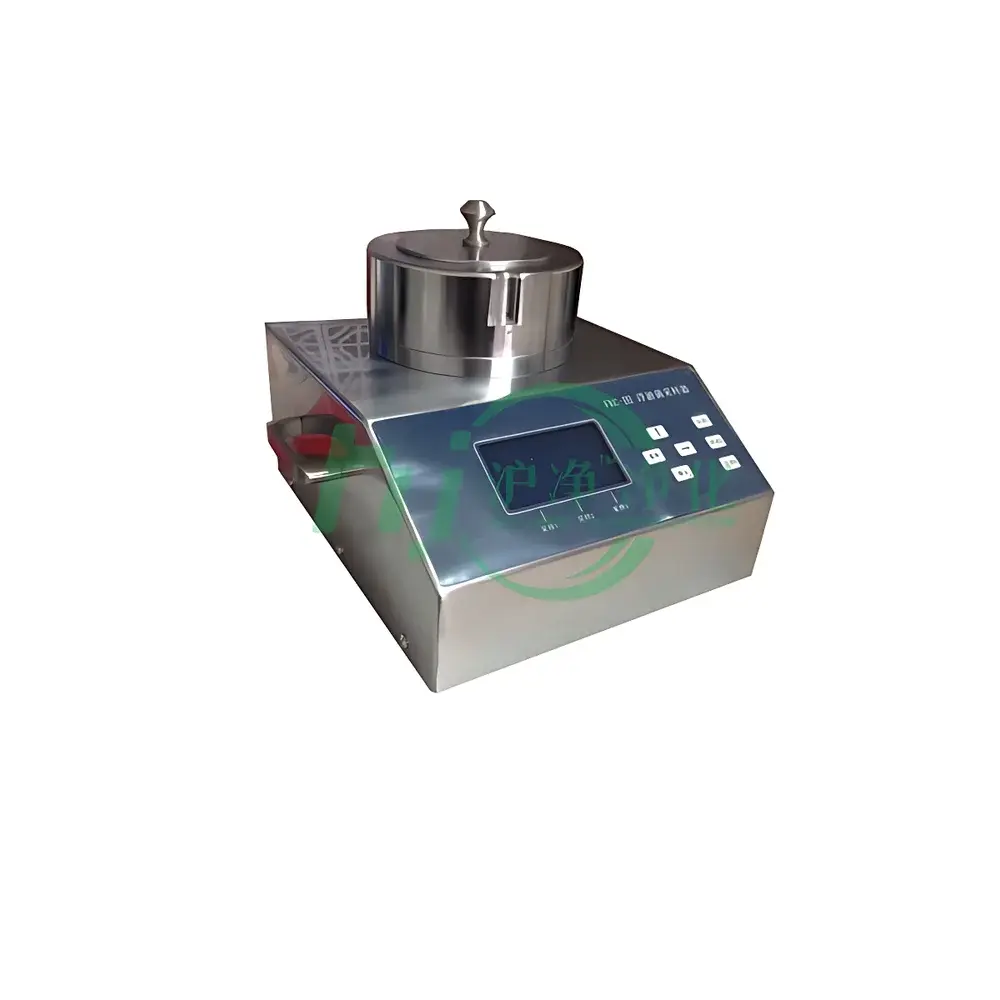
HJ FKC-III Airborne Microbial Sampler
| Brand | HJ |
|---|---|
| Origin | Zhejiang, China |
| Manufacturer Type | Manufacturer |
| Model | FKC-III |
| Sampling Principle | Isokinetic Impaction |
| Flow Rate | 100 L/min |
| Flow Accuracy | ±5% |
| Sampling Volume Range | 0.001–9.999 m³ |
| Operating Temperature | 10–35 °C |
| Operating Relative Humidity | 10–90 % RH |
| Atmospheric Pressure Range | 80–110 kPa |
| Maximum Ambient Particle Concentration | 1×10⁸ particles/m³ @ 0.5 µm or 0.2 mg/m³ |
| Power Supply | DC 12 V (center-positive) |
| Dimensions (Main Unit) | 200 × 240 × 150 mm (W × D × H) |
| Sampling Head Dimensions | Ø120 × 60 mm |
| Weight | 4 kg |
Overview
The HJ FKC-III Airborne Microbial Sampler is an isokinetic impactor-based active air sampler engineered for quantitative monitoring of viable airborne microorganisms in controlled environments. It operates on the principle of inertial impaction: air is drawn at a calibrated flow rate (100 L/min) through a precision-machined stainless-steel sampling head containing 400 uniform micro-orifices (Ø0.5 mm). The orifice geometry and flow velocity (0.38 m/s at the inlet) are designed to match typical unidirectional airflow velocities in ISO Class 5–8 cleanrooms—ensuring representative, bias-free collection per ISO 14698-1:2003 (“Biocontamination control — Part 1: General principles and methodology”). Upon impact, viable microorganisms retain metabolic activity and adhere to standard 90 mm Petri dishes filled with nutrient agar (e.g., Tryptic Soy Agar or Sabouraud Dextrose Agar), enabling subsequent colony-forming unit (CFU) enumeration under appropriate incubation conditions.
Key Features
- Isokinetic Sampling Design: Inlet velocity synchronized with ambient laminar or turbulent airflow profiles minimizes particle bounce and re-entrainment, improving biological collection efficiency for particles ≥0.6 µm.
- Stainless Steel Sampling Head: Constructed from electropolished 304 stainless steel for corrosion resistance and compatibility with autoclaving (121 °C, 20 min), ethanol wiping, and hydrogen peroxide vapor (HPV) decontamination protocols.
- Micro-Orifice Array: 400 precisely aligned orifices ensure uniform spatial distribution of impacted microorganisms across the agar surface, reducing colony overlap and enhancing count accuracy and statistical reproducibility.
- Digital Volume Control: Programmable sampling volume range from 0.001 to 9.999 m³ enables flexible protocol alignment with EU GMP Annex 1, ISO 14644-1, and USP sterility testing requirements.
- Low-Noise Vacuum System: Brushless DC pump with integrated thermal protection delivers stable 100 L/min flow within ±5% accuracy over the full operating temperature and humidity range (10–35 °C, 10–90 % RH).
- Compact & Portable Architecture: Lightweight (4 kg), benchtop-friendly form factor (200 × 240 × 150 mm) supports deployment in isolators, RABS, filling lines, and environmental monitoring (EM) rounds without requiring fixed utility connections.
Sample Compatibility & Compliance
The FKC-III is validated for use with standard 90 mm × 15 mm Petri dishes containing microbiological growth media compliant with pharmacopeial standards (USP, EP, JP). Its performance aligns with the physical sampling criteria specified in ISO 14698-1 and supports data integrity requirements under FDA 21 CFR Part 11 when paired with auditable manual logbooks or validated LIMS integration. While the instrument itself does not generate electronic records, its deterministic mechanical design ensures repeatable volumetric delivery—critical for GLP/GMP environmental monitoring programs requiring traceable, defensible microbial data. It is routinely deployed in pharmaceutical aseptic processing suites, biotech cleanrooms, hospital pharmacies, and medical device manufacturing facilities where routine airborne bioburden assessment is mandated.
Software & Data Management
The FKC-III operates via embedded microcontroller logic with LED display and tactile membrane keypad—no proprietary software or driver installation required. All operational parameters (set volume, elapsed time, real-time flow status) are displayed locally. For regulated environments, users maintain manual logs per ALCOA+ principles (Attributable, Legible, Contemporaneous, Original, Accurate, Complete, Consistent, Enduring, Available). Optional external data capture may be achieved using time-stamped video recording of the display during sampling or integration with facility-wide EM platforms via analog pulse output (available on custom firmware variants). No cloud connectivity or remote access capabilities are included, preserving network security in classified cleanroom IT infrastructures.
Applications
- Aseptic process simulation (media fill) environmental qualification
- ISO 14644-1 cleanroom classification and routine monitoring
- Pharmaceutical Grade A/B/C/D area microbial mapping
- Hospital cleanroom validation (e.g., laminar airflow hoods, ORs)
- Medical device packaging line bioburden verification
- Research laboratory biosafety cabinet (BSC) performance testing
- Validation of HVAC filtration efficiency and room recovery studies
FAQ
What regulatory standards does the FKC-III support?
It fulfills the physical sampling design requirements of ISO 14698-1 and supports compliance with EU GMP Annex 1 (2022), USP , and ISO 14644-1 for viable particle monitoring.
Can the sampling head be sterilized in an autoclave?
Yes—the 304 stainless steel sampling head is rated for repeated autoclaving at 121 °C for 20 minutes without dimensional or surface finish degradation.
Is calibration traceable to national standards?
Flow calibration is performed using a NIST-traceable primary standard (e.g., dry calibrator or mass flow meter) prior to shipment; users should perform periodic verification per internal SOPs or ISO/IEC 17025-accredited procedures.
Does it require compressed air or external vacuum sources?
No—it is self-contained with an integrated brushless DC vacuum pump powered by a 12 V DC supply.
How is sampling volume accuracy ensured across varying ambient conditions?
The flow control system compensates for minor pressure and temperature fluctuations within the specified operating range (80–110 kPa, 10–35 °C); however, users must apply gas law corrections for high-altitude or non-standard conditions per ISO 14644-3 Annex B.







