
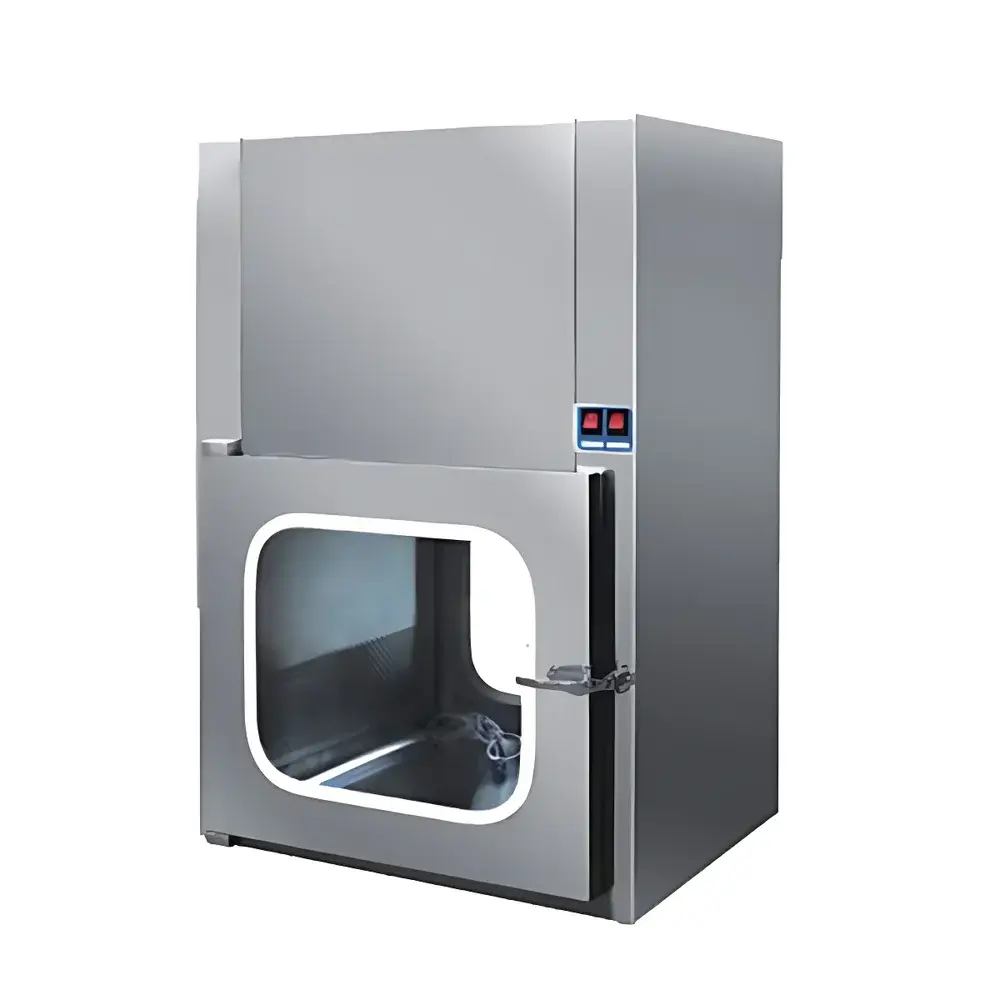
HJ Puritech 304 Stainless Steel Air Shower Pass-Through Chamber (Model: PT-600)
| Brand | HJ Puritech |
|---|---|
| Origin | Shanghai, China |
| Manufacturer Type | OEM/ODM Manufacturer |
| Country of Origin | China |
| Material | AISI 304 Stainless Steel |
| External Dimensions (W×H×D) | 720 × 680 × 660 mm |
| Internal Cavity Size (W×H×D) | 600 × 600 × 600 mm |
| Interlock Type | Mechanical Interlock (optional electronic interlock upgrade available) |
| UV Sterilization Lamp | Included (254 nm, GPH lamp) |
| Filtration System | HEPA H14 (≥99.995% @ 0.3 µm) integrated with centrifugal blower |
| Air Velocity at Nozzle | ≥22 m/s |
| Operating Noise Level | ≤65 dB(A) |
| Power Supply | 220 VAC ±10%, 50 Hz |
| IP Rating | IP54 |
Overview
The HJ Puritech 304 Stainless Steel Air Shower Pass-Through Chamber (Model PT-600) is an engineered solution for controlled material transfer between cleanroom zones of differing ISO classifications—such as ISO Class 5 (Class 100) and ISO Class 7 (Class 10,000)—or between classified and non-classified environments. Designed in strict accordance with cleanroom engineering principles, this pass-through chamber integrates laminar air shower functionality with dual-door mechanical interlocking to eliminate cross-contamination risk during item transfer. Its operation relies on a high-velocity, HEPA-filtered airstream directed vertically from the top plenum onto objects placed inside the chamber cavity. This air curtain serves two critical functions: physical particle removal via impaction and entrainment, and dynamic airlock isolation—preventing unfiltered ambient air from migrating into higher-grade clean zones when either door is opened. Constructed entirely from electropolished AISI 304 stainless steel (1.4301), the unit meets surface finish requirements for pharmaceutical and biotech cleanrooms (Ra ≤ 0.8 µm), ensuring corrosion resistance, non-shedding integrity, and compatibility with routine disinfectants including hydrogen peroxide vapor (HPV) and sporicidal agents.
Key Features
- Full-body 304 stainless steel construction—including inner walls, door frames, and work surface—with seamless welded corners and rounded internal edges to minimize particle trapping and facilitate cleaning.
- Integrated HEPA H14 filtration system (EN 1822-1 compliant) paired with a low-vibration centrifugal blower delivering ≥22 m/s air velocity at the nozzle outlet for effective surface decontamination of tools, glassware, sample containers, and small instruments.
- Fail-safe mechanical interlock mechanism preventing simultaneous opening of both doors; interlock status is visually indicated via LED indicators adjacent to each door handle.
- Dual-function UV-C germicidal lamp (254 nm, 15 W) mounted on the ceiling panel, programmable for timed activation (default 30 min) post-transfer to ensure microbial reduction on interior surfaces.
- Smooth, non-porous work surface with optional passive roller conveyor (available upon request) for ergonomic handling of heavier or elongated items without compromising airflow uniformity.
- IP54-rated electrical enclosure with sealed push-button controls, emergency stop switch, and CE-marked power supply meeting IEC 61000-6-3 EMC standards.
Sample Compatibility & Compliance
The PT-600 accommodates standard laboratory consumables including Petri dishes, vials (up to 100 mL), pipette tip boxes, weighing boats, and small-scale process components (e.g., filter housings, sensor probes). It is not intended for transfer of open biological cultures, hazardous chemicals, or heat-sensitive materials requiring environmental control. The unit complies with key regulatory expectations for cleanroom auxiliary equipment: it supports adherence to ISO 14644-1 (cleanroom classification), ISO 14644-3 (testing methods), and EU GMP Annex 1 (2022 revision) requirements for contamination control strategy. While not a medical device, its design facilitates alignment with FDA 21 CFR Part 11 data integrity expectations when integrated with facility-wide logging systems. All materials meet USP extractables profile thresholds for stainless steel contact surfaces.
Software & Data Management
This model operates as a standalone hardware unit with no embedded microprocessor or digital interface. Operational parameters—including UV cycle duration, interlock status, and blower runtime—are manually controlled via tactile switches. For facilities requiring audit trails, optional integration with Building Management Systems (BMS) or SCADA platforms is supported through dry-contact relay outputs (NO/NC) for door-open events, UV activation, and fault alarms. Calibration records, maintenance logs, and UV lamp replacement history must be maintained per site-specific SOPs aligned with ISO 9001:2015 and ISO/IEC 17025:2017 documentation practices.
Applications
- Pharmaceutical manufacturing: Transfer of sterilized components between Grade C and Grade A filling lines.
- Biotechnology labs: Introduction of pre-sterilized cell culture accessories into biosafety cabinets or isolators.
- Medical device assembly: Movement of cleaned subassemblies between ISO Class 7 assembly rooms and ISO Class 5 packaging suites.
- Research institutions: Controlled exchange of analytical standards and reference materials across differential-pressure barriers in core facilities.
- Microelectronics fabrication: Handling of wafers and metrology tools between tool-specific clean booths and general clean corridors.
FAQ
What is the recommended maintenance schedule for the HEPA filter?
HEPA filters should be replaced every 12–18 months under continuous operation, or sooner if pressure drop across the filter exceeds 250 Pa (measured via built-in manometer ports). Filter integrity testing (e.g., DOP/PAO scan) is required after each replacement.
Can the unit be installed in a wall with fire-rating requirements?
Yes—when mounted within a 2-hour fire-rated wall assembly using approved firestop collars and intumescent sealants compatible with stainless steel framing.
Is validation support provided for IQ/OQ protocols?
HJ Puritech supplies factory test reports (air velocity mapping, interlock verification, UV intensity measurement) and can provide template protocols aligned with ASTM E2500 and ISPE Baseline Guide Vol. 5.
Does the mechanical interlock require periodic lubrication?
No—the cam-and-lever interlock mechanism uses self-lubricating polymer bushings and requires only visual inspection during quarterly preventive maintenance.
What cleaning agents are compatible with the 304 stainless steel surface?
Validated agents include 70% isopropyl alcohol, diluted sodium hypochlorite (≤1000 ppm), and hydrogen peroxide (3–6%). Avoid chloride-based cleaners or abrasive pads to prevent pitting corrosion.



