
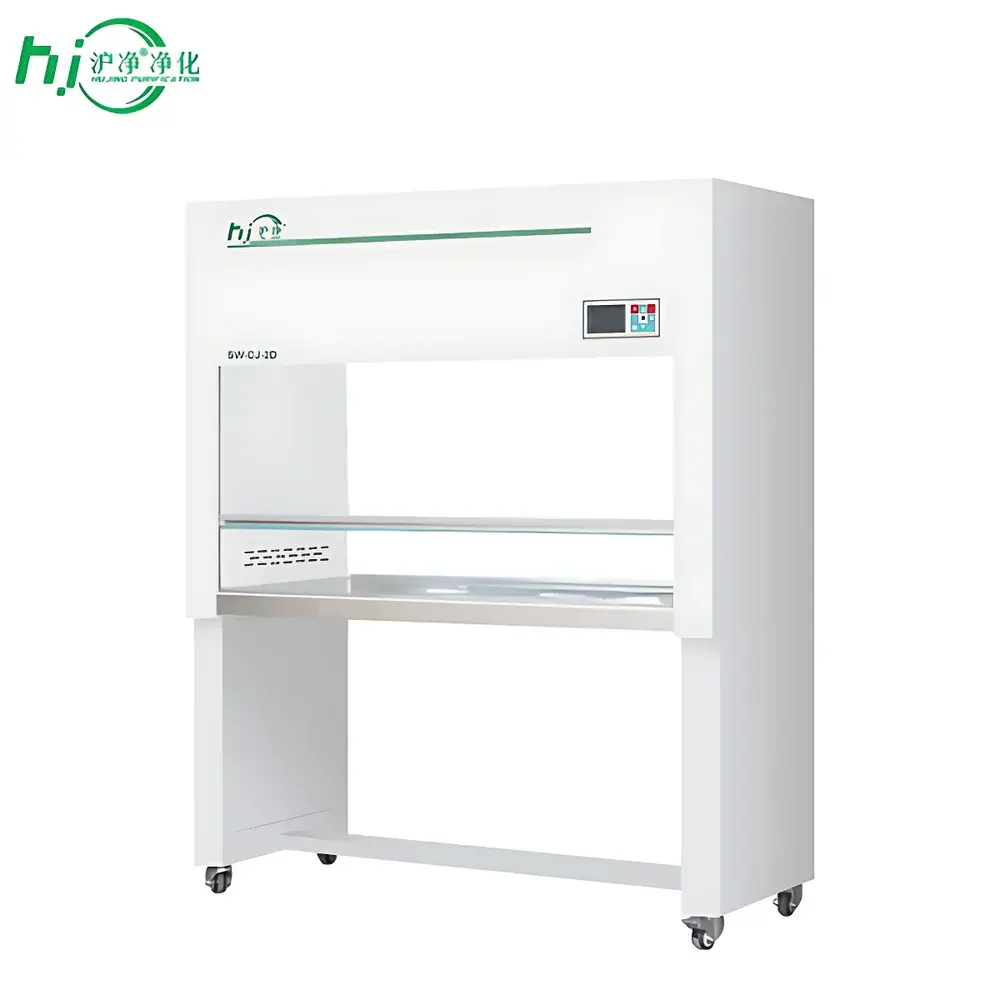
HJ SWCJ-2D Vertical Flow Clean Bench
| Brand | HJ Purification |
|---|---|
| Origin | Shanghai, China |
| Manufacturer Type | Direct Manufacturer |
| Product Category | Domestic |
| Model | SWCJ-2D |
| Instrument Type | Vertical Flow Clean Bench |
| Cleanliness Class | Class 100 @ ≥0.5 µm (US Federal Standard 209E) |
| Noise Level | ≤62 dB(A) |
| User Capacity | Dual-Operator, Single-Face |
| Airflow Pattern | Vertical Downflow |
| Working Area Dimensions (W×D×H) | 1150 × 550 × 580 mm |
| Overall Dimensions (W×D×H) | 1310 × 590 × 1600 mm |
| Average Air Velocity | 0.25–0.45 m/s |
| Microbial Count | ≤0.5 CFU/plate·hr (Φ90 mm Petri dish) |
| Vibration Peak-to-Peak | ≤5 µm (X/Y/Z axes) |
| Illumination | ≥300 lx |
| Power Supply | AC 220 V / 50 Hz |
| Max. Power Consumption | 500 W |
| Net Weight | 110 kg |
| HEPA Filter Spec | 1135 × 455 × 50 mm (1 unit) |
| Fluorescent Lamp | 12 W (1 unit) |
| UV Lamp | 30 W (1 unit) |
| Control Interface | Digital LCD Display |
| Safety Interlock | UV/illumination interlock with auto-shutoff |
| UV Timer Function | Yes |
| Work Surface Material | SUS304 brushed stainless steel |
| Cabinet Material | Cold-rolled steel with electrostatic powder coating |
| Air Curtain | Vertical quasi-closed downflow air curtain for operator and process protection |
| Pre-filter | Integrated coarse pre-filter to extend HEPA service life |
Overview
The HJ SWCJ-2D Vertical Flow Clean Bench is an ISO Class 5 (Federal Standard 209E Class 100) laminar flow workstation engineered for routine aseptic procedures in microbiology, cell culture, pharmaceutical quality control, and academic research laboratories. It operates on the principle of unidirectional vertical laminar airflow—filtered air is drawn through a pre-filter and then conditioned through a certified HEPA filter (≥99.995% efficiency at 0.3 µm), delivering uniform, particle-free downflow across the entire work surface. This airflow configuration establishes a sterile barrier between the external environment and the working area, minimizing cross-contamination risk while maintaining operator safety during non-hazardous applications. Unlike biosafety cabinets, the SWCJ-2D is not designed for handling biohazards or volatile chemicals; it is strictly intended for product protection in low-risk, non-toxic workflows requiring particulate-controlled environments.
Key Features
- Vertical quasi-closed downflow air curtain design ensures stable laminar flow and prevents ingress of ambient contaminants into the work zone.
- Dual-operator, single-face configuration with 1150 mm wide working area supports collaborative benchwork without compromising airflow integrity.
- SUS304 brushed stainless steel work surface offers superior corrosion resistance, non-porosity, and compatibility with common disinfectants (e.g., 70% ethanol, sodium hypochlorite).
- Cold-rolled steel cabinet with electrostatic powder coating provides structural rigidity, chemical resistance, and long-term durability under routine laboratory use.
- Integrated safety interlock system prevents simultaneous operation of UV germicidal lamps and fluorescent lighting—ensuring operator protection during sterilization cycles.
- Digital LCD control panel enables precise monitoring and adjustment of operational parameters, including UV exposure duration and lighting activation.
- Modular HEPA filtration system includes a replaceable coarse pre-filter upstream of the main HEPA unit, significantly extending filter service intervals and reducing lifecycle maintenance costs.
Sample Compatibility & Compliance
The SWCJ-2D is validated for use with non-hazardous biological samples, sterile media preparation, inoculation of agar plates, and aseptic transfer of mammalian or microbial cultures. It complies with US Federal Standard 209E Class 100 requirements for airborne particulate concentration (≤3,520 particles/m³ ≥0.5 µm). While not certified to NSF/ANSI 49 or EN 12469 (standards applicable to biosafety cabinets), its performance aligns with ISO 14644-1:2015 Class 5 for cleanroom-associated equipment. Routine validation per ASTM E2500-13 (Good Practice Guide for Verification of Pharmaceutical Equipment) is recommended, including airflow velocity mapping, particle counting (ISO 14644-1 Annex B), and microbial settling plate assays (USP Annex A guidance). The unit supports GLP-compliant documentation when integrated with lab-wide environmental monitoring systems.
Software & Data Management
The SWCJ-2D features embedded firmware with no external software dependency. All operational logs—including UV timer activation timestamps, illumination status, and manual override events—are retained locally via non-volatile memory. While the unit does not support network connectivity or electronic data capture (EDC), its digital interface facilitates manual entry into laboratory information management systems (LIMS) or electronic lab notebooks (ELN). For regulated environments, users may implement periodic verification records (e.g., daily airflow checks, weekly UV intensity measurements using calibrated radiometers) to satisfy FDA 21 CFR Part 11 audit trail expectations when paired with procedural SOPs and trained personnel.
Applications
- Aseptic preparation of cell culture media and reagents in academic and industrial life science labs.
- Inoculation and subculturing of bacterial, fungal, and yeast strains under controlled particulate conditions.
- Handling of sterile surgical instruments, dressings, or diagnostic kits in hospital central supply departments.
- Quality control testing of non-sterile pharmaceutical intermediates where environmental particulate control is required.
- Microelectronics assembly pre-cleaning stations where electrostatic discharge (ESD)-safe handling is secondary to airborne particle exclusion.
FAQ
What is the difference between a clean bench and a biosafety cabinet?
A clean bench provides only product protection via unidirectional laminar airflow and does not protect the operator or environment from hazardous agents. A biosafety cabinet (Class II or III) provides simultaneous personnel, product, and environmental protection through recirculated and exhausted airflow with negative pressure containment.
Can the SWCJ-2D be used for handling viruses or recombinant DNA?
No. This unit lacks negative pressure containment, exhaust ducting, and certified HEPA filtration of effluent air. Such applications require a certified Class II Type A2 or B2 biosafety cabinet compliant with NSF/ANSI 49.
How often should the HEPA filter be replaced?
Filter replacement frequency depends on usage intensity and ambient air quality. Under typical lab conditions (8 hrs/day, ISO Class 8 ambient), annual replacement is recommended—preceded by differential pressure monitoring and in-situ airflow velocity verification.
Is the UV lamp intensity validated upon installation?
UV output is not factory-calibrated; users must verify irradiance (µW/cm² at 254 nm) at the work surface using a NIST-traceable UV-C radiometer prior to first use and after each lamp replacement, per CLSI M29-A3 guidelines.
Does this unit meet GMP requirements for pharmaceutical manufacturing?
It may be deployed in non-sterile manufacturing support areas (e.g., component prep, sampling) if qualified per ICH Q9 and supported by documented risk assessment, preventive maintenance, and environmental monitoring—but it is not suitable for Grade A filling zones.



