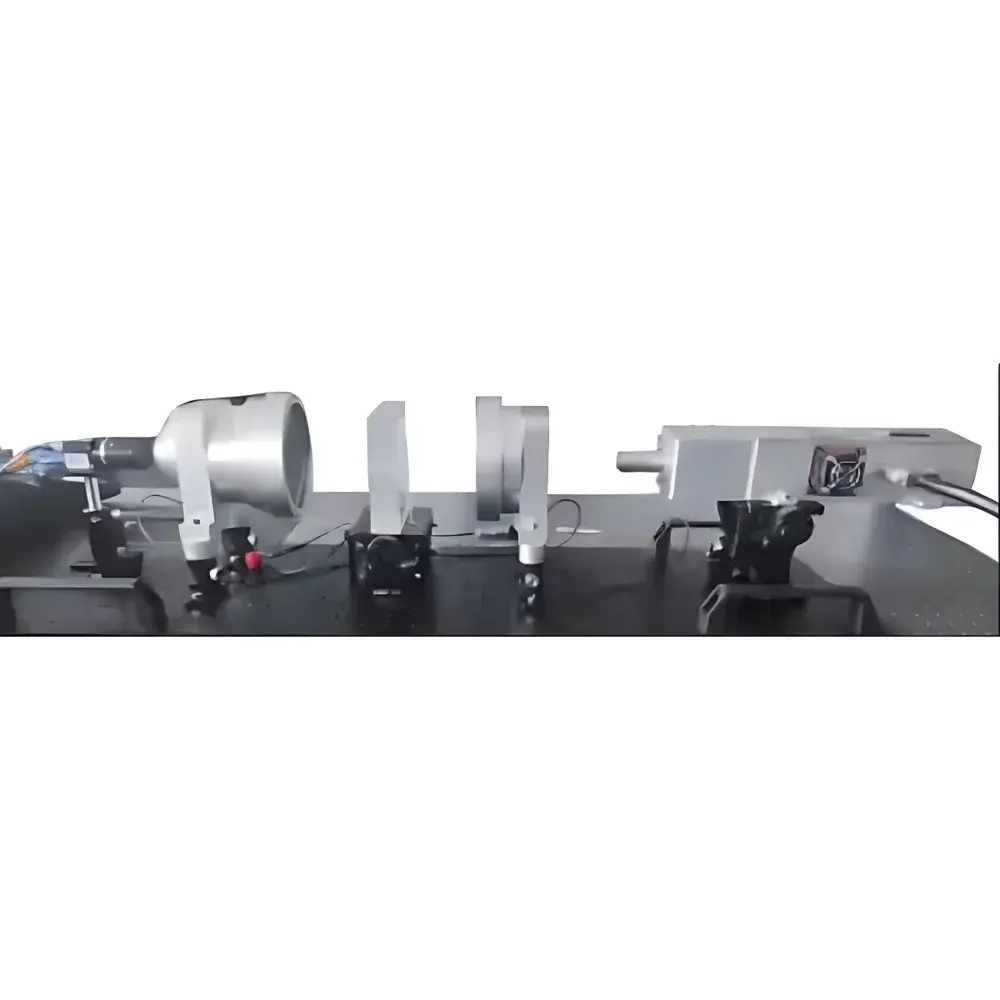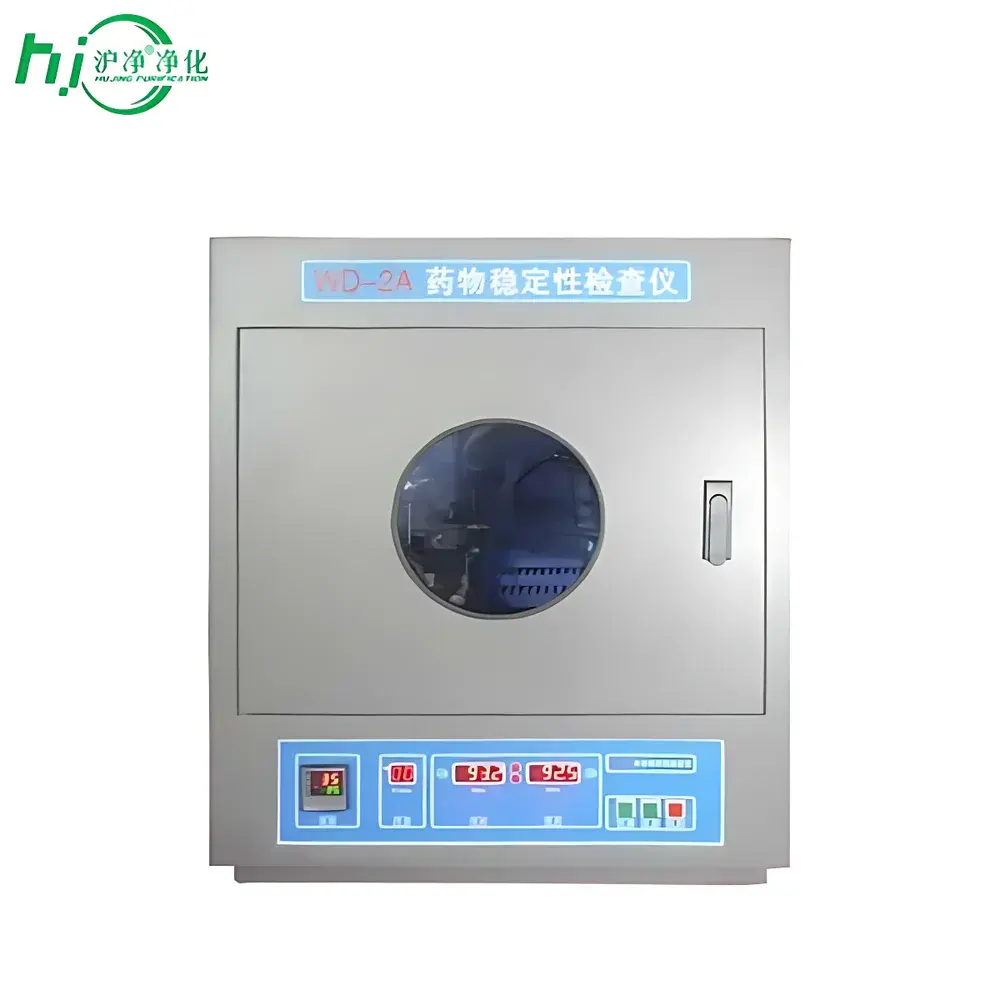
HJ WD-2A Pharmaceutical Stability Testing Chamber
| Brand | HJ (Hujing Purification) |
|---|---|
| Origin | Shanghai, China |
| Manufacturer Type | Direct Manufacturer |
| Country of Origin | China |
| Model | WD-2A |
| Pricing | Upon Request |
| Temperature Range | Ambient to 80 °C ±1 °C |
| Humidity Range | 10–100% RH ±4% |
| Dual Humidity Monitoring | Two Honeywell (USA) RH Sensors for Simultaneous 75% RH and 92.5% RH Measurement |
| Illuminance Range | 0–7,000 lx (with Three Adjustable Slit Lamps) |
| Chamber Dimensions | 51 × 40 × 38 cm (Stainless Steel Interior, Two-Tier Configuration) |
| Operating Noise Level | <50 dB(A) |
Overview
The HJ WD-2A Pharmaceutical Stability Testing Chamber is an engineered environmental simulation system designed explicitly for compliance-driven stability testing of active pharmaceutical ingredients (APIs) and finished drug products in accordance with the *Chinese Pharmacopoeia* (ChP) 2015 Edition, Volume II. It implements controlled, reproducible exposure to defined thermal, hygroscopic, and photolytic stress conditions—enabling systematic assessment of degradation kinetics over time. Unlike generic climate chambers, the WD-2A integrates dual independent humidity sensing, calibrated photometric control, and precision temperature regulation to satisfy ChP requirements for influence factor testing (e.g., high-temperature, high-humidity, and intense light exposure), accelerated stability studies (e.g., 40 °C/75% RH), and long-term storage condition validation (e.g., 25 °C/60% RH). Its architecture supports ICH Q1–Q5-aligned protocols and serves as a foundational tool for establishing shelf-life, defining storage specifications, and supporting regulatory submissions under NMPA, FDA, and EMA frameworks.
Key Features
- Precision dual-channel humidity monitoring using two certified Honeywell (USA) capacitive RH sensors—enabling concurrent real-time measurement at 75% RH and 92.5% RH per ChP Chapter 9001, eliminating manual sensor repositioning and reducing experimental cycle time by up to 50%.
- Adjustable photometric system with three independently controllable slit lamps, delivering uniform illuminance across the sample zone from 0 to 7,000 lx—calibrated traceably to CIE standard illuminants for photo-stability testing per ICH Q1B.
- High-stability temperature control with ±1 °C accuracy across the full operating range (ambient to 80 °C), achieved via PID-controlled heating elements and insulated stainless-steel double-wall construction.
- Two-tier internal chamber (51 × 40 × 38 cm total volume) with electropolished 304 stainless steel interior—resistant to corrosion, easy to decontaminate, and compliant with GMP cleanroom-compatible surface requirements.
- On-device humidity offset correction function: operators may apply user-defined calibration offsets directly via the front-panel interface to compensate for sensor drift or chamber-specific microclimate variance—enhancing long-term data integrity.
Sample Compatibility & Compliance
The WD-2A accommodates standard stability sample configurations—including glass vials, blister packs, HDPE bottles, and aluminum-folded tablets—within its tiered stainless-steel chamber. Its environmental profiles align with key pharmacopeial and international guidelines: ChP 2015 Vol. II §9001; ICH Q1A(R2), Q1B, and Q5C; USP and ; and ISO 14644-1 Class 8 background compatibility. The chamber’s humidity sensors are factory-calibrated against NIST-traceable standards, and temperature uniformity is validated per ASTM E2297-21 Annex A1. All operational parameters—including setpoints, deviations, and alarm events—are timestamped and stored locally for audit readiness.
Software & Data Management
While the WD-2A operates via an intuitive embedded touchscreen interface with local data logging (up to 30 days of 1-minute interval records), optional RS-485/Modbus RTU output enables integration into centralized laboratory information management systems (LIMS) or SCADA platforms. Raw environmental logs support CSV export for statistical analysis in JMP, Minitab, or Python-based degradation modeling workflows. Audit trails meet GLP and GMP documentation requirements, including operator ID tagging, parameter change history, and electronic signature-capable event logging—fully compatible with FDA 21 CFR Part 11 when deployed with validated third-party software extensions.
Applications
- Influence factor testing: Forced degradation under 60 °C (dry heat), 92.5% RH (high humidity), and 1.2 million lux·hr (photolysis) per ICH Q1B.
- Accelerated stability protocols: 40 °C/75% RH for 6 months to predict 24-month real-time behavior.
- Long-term and intermediate condition studies: 25 °C/60% RH and 30 °C/65% RH per ICH Q5C.
- Package integrity verification: Monitoring moisture ingress through primary packaging under cyclic humidity stress.
- Reference standard stability monitoring: Supporting USP and Ph. Eur. 2.2.46 validation requirements.
FAQ
Does the WD-2A comply with ICH Q1A(R2) accelerated testing requirements?
Yes—the chamber maintains stable 40 °C ±1 °C and 75% RH ±4% simultaneously for ≥6 months, with documented temperature/humidity uniformity mapping available upon request.
Can humidity sensors be recalibrated onsite?
Yes—using the built-in offset adjustment function and NIST-traceable saturated salt solutions (e.g., NaCl for 75% RH, KNO₃ for 92.5% RH), users may perform field verification and correction without external service.
Is the lighting system spectrally matched to daylight D65?
The slit-lamp array provides broad-spectrum white light; spectral distribution data (350–750 nm) is supplied with each unit for correlation to ICH Q1B irradiance thresholds.
What materials contact the sample chamber interior?
Only electropolished AISI 304 stainless steel—non-reactive, non-shedding, and validated for residual solvent compatibility per USP .
How is data integrity ensured during power interruption?
Internal non-volatile memory retains all logged parameters and timestamps; system resumes operation at pre-interruption setpoints upon power restoration.