
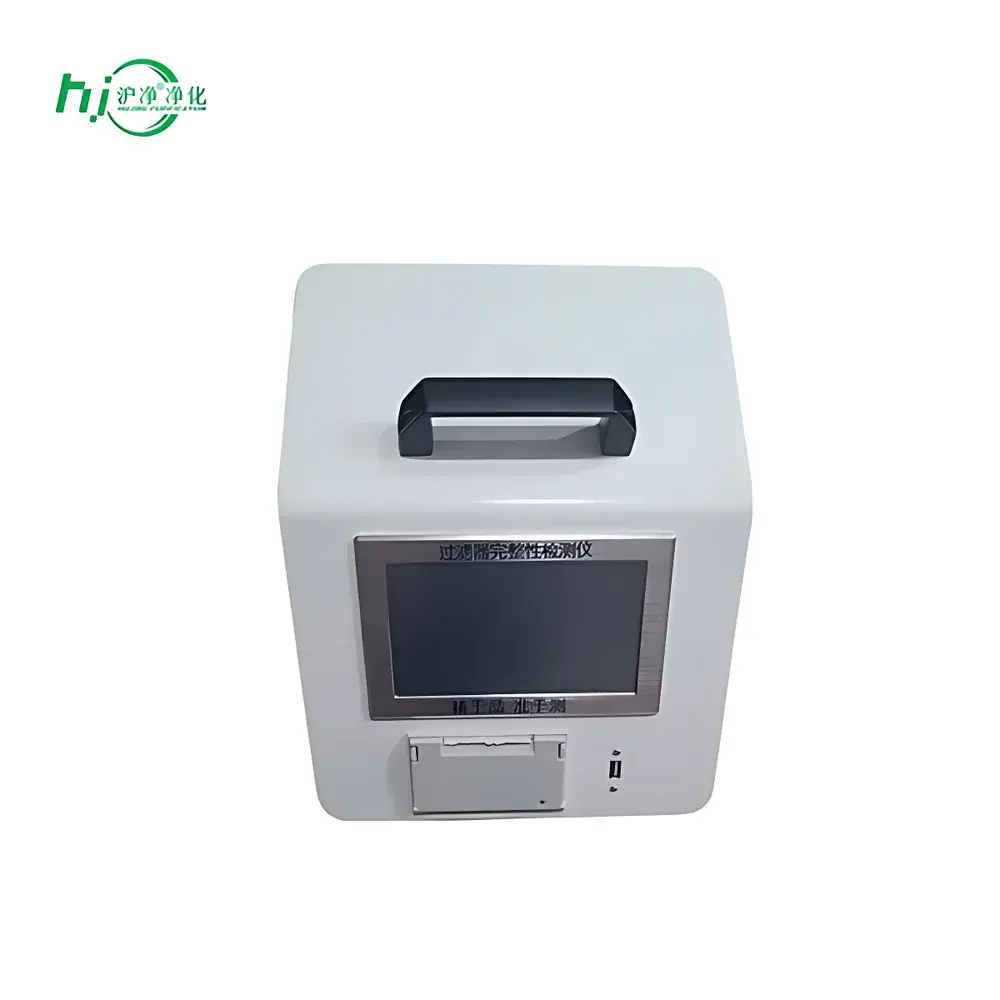
HJ Wit-V4.0 Filter Integrity Tester
| Brand | HJ |
|---|---|
| Origin | Shanghai, China |
| Manufacturer Type | Direct Manufacturer |
| Origin Category | Domestic (China) |
| Model | Wit-V4.0 |
| Power Supply | 170–240 V AC, 50/60 Hz, 100 W |
| Max Operating Pressure | 6000 mbar |
| Minimum Inlet Pressure | 200 mbar |
| Dimensions (W×D×H) | 40 × 30 × 25 cm |
| Forward Flow Range | 0.1–200 mL/min |
| Water Intrusion Flow Range | 0.05–50 mL/min |
| Bubble Point Range | 700–6000 mbar |
| Accuracy | ±3% or ±5‰ F.S. (whichever is greater) |
| Sensitivity | Forward Flow: 0.1 mL/min |
| Water Intrusion | 0.01 mL/min |
| Bubble Point | 50 mbar |
| Repeatability Error | ≤3% |
| Test Duration (typical) | Bubble Point: 2 ± 2 min |
| Diffusion Flow | 7 ± 2 min |
| Water Intrusion | 7 ± 2 min |
| System Leak Check | 3 ± 1 min |
| Display | 7-inch color touchscreen (256-color), Windows CE 6.0 OS |
| Controller | ARM11 embedded processor |
| Data Storage | 32 GB internal flash memory (≥1 million test records) |
| Printing | Integrated thermal printer for test conditions, results, and real-time curves |
| Environmental Operating Range | 0–50 °C, 10–80% RH |
| Compliance | Meets requirements of Chinese Pharmacopoeia (2020 Edition), supports 21 CFR Part 11-compliant electronic signatures, audit trail, and role-based user access control |
Overview
The HJ Wit-V4.0 Filter Integrity Tester is a fully automated, GMP-compliant instrument engineered for quantitative verification of the physical integrity of sterilizing-grade membrane filters used in pharmaceutical, biotechnology, and parenteral manufacturing processes. It implements three standardized non-destructive test methods defined in ISO 13408-2, ASTM F838, and the Chinese Pharmacopoeia (2020 Edition): Bubble Point, Diffusion (Forward) Flow, and Water Intrusion. Each method provides orthogonal validation of pore structure continuity and seal integrity—critical for ensuring microbial retention performance prior to use in aseptic processing or final filtration steps. The system operates on a pressure decay and gas flow measurement principle, utilizing high-stability pressure transducers and mass flow sensors calibrated traceable to national standards. Its embedded ARM11 controller and real-time Windows CE 6.0 operating system ensure deterministic response timing and deterministic data acquisition—essential for regulatory compliance and process reproducibility.
Key Features
- Regulatory-Ready Architecture: Built-in role-based user authentication, electronic signature capability, full audit trail with timestamped event logging (user actions, parameter changes, test execution, result modifications), and tamper-evident data storage—all aligned with FDA 21 CFR Part 11 and EU Annex 11 expectations.
- Multi-Method Flexibility: Simultaneous support for bubble point (BP), diffusion flow (DF), and water intrusion (WI) testing on a single platform—enabling method selection based on filter hydrophobicity, wetting agent compatibility, and process risk assessment.
- Compact & Portable Design: Benchtop footprint (40 × 30 × 25 cm) with integrated pressure generation, sensing, and thermal printing—optimized for QC labs, cleanroom adjacent environments, and mobile validation teams.
- Intuitive Human-Machine Interface: 7-inch high-contrast color touchscreen with context-sensitive soft keys, graphical real-time curve display (pressure vs. time, flow vs. time), and multilingual menu navigation (English, Chinese).
- Deterministic Performance: Repeatability error ≤3%, sensitivity down to 0.01 mL/min (WI) and 0.1 mL/min (DF), and pressure resolution of 50 mbar across the full 700–6000 mbar bubble point range—ensuring consistent pass/fail determinations across batches and shifts.
- Comprehensive Data Handling: 32 GB onboard flash memory retains ≥1 million complete test records—including raw sensor data, operator ID, timestamps, environmental metadata, and annotated test curves—with export via USB to CSV or PDF.
Sample Compatibility & Compliance
The Wit-V4.0 accommodates a broad spectrum of sterile filtration configurations without hardware modification. Validated sample types include disc membranes (Φ25 mm to Φ300 mm), standard cylindrical cartridges (2.5″ to 40″ length, 1–9 core), capsule filters, mini-cartridges, and vent-type air/gas filters. All test protocols adhere to internationally recognized standards: ISO 13408-2 (sterility assurance), ASTM F838-22 (bacterial challenge correlation), and USP / EP 2.6.28 (particulate and integrity testing). The instrument’s firmware and documentation package are structured to support GLP/GMP audits, including IQ/OQ documentation templates and calibration certificate traceability to CNAS-accredited laboratories.
Software & Data Management
The embedded software architecture features deterministic real-time task scheduling, preventing race conditions during concurrent data logging, pressure ramping, and print output. All test data are cryptographically hashed upon acquisition and stored with immutable metadata (operator, timestamp, instrument ID, firmware version). Optional integration with the HJ Database Expert Management System enables centralized data aggregation, statistical process control (SPC) charting, deviation trending, and automated report generation compliant with ALCOA+ principles (Attributable, Legible, Contemporaneous, Original, Accurate, Complete, Consistent, Enduring, Available). Electronic signatures meet 21 CFR Part 11 Subpart C requirements for identity verification, intent confirmation, and linkage to specific data objects.
Applications
- Pre-use integrity testing of sterilizing filters in bioreactor harvest, buffer preparation, and final fill lines
- Post-use integrity verification for filter validation studies and change control assessments
- Qualification of hydrophilic PES, PVDF, and nylon membranes and hydrophobic PTFE, PP, and glass fiber filters
- Water intrusion testing of hydrophobic filters where alcohol-wetting is prohibited (e.g., solvent-based formulations)
- Diffusion flow monitoring for low-pressure, long-duration filtration processes requiring continuous integrity assurance
- Supporting regulatory submissions (IND, BLA, MAA) with fully traceable, auditable test records
FAQ
Does the Wit-V4.0 support 21 CFR Part 11 compliance out-of-the-box?
Yes—the system includes preconfigured audit trail, electronic signature workflow, and role-based access controls validated per Part 11 Subpart C requirements.
Can it test multi-core cartridges without adapter kits?
Yes—automatic pressure distribution balancing and flow compensation algorithms eliminate the need for external manifolds or manual recalibration across 1–9 core configurations.
Is calibration traceable to national metrology institutes?
All pressure and flow sensors are factory-calibrated against CNAS-accredited reference standards, with certificates provided at delivery and available for re-calibration every 12 months.
What happens if power fails mid-test?
The ARM11 controller maintains volatile memory state for up to 10 seconds and auto-resumes or safely aborts based on test phase—preserving all acquired data points and generating an integrity log entry.
How is data security enforced during USB export?
Export files are digitally signed and encrypted using AES-128; decryption requires authorized credentials from the central database management system.
Related Products






