
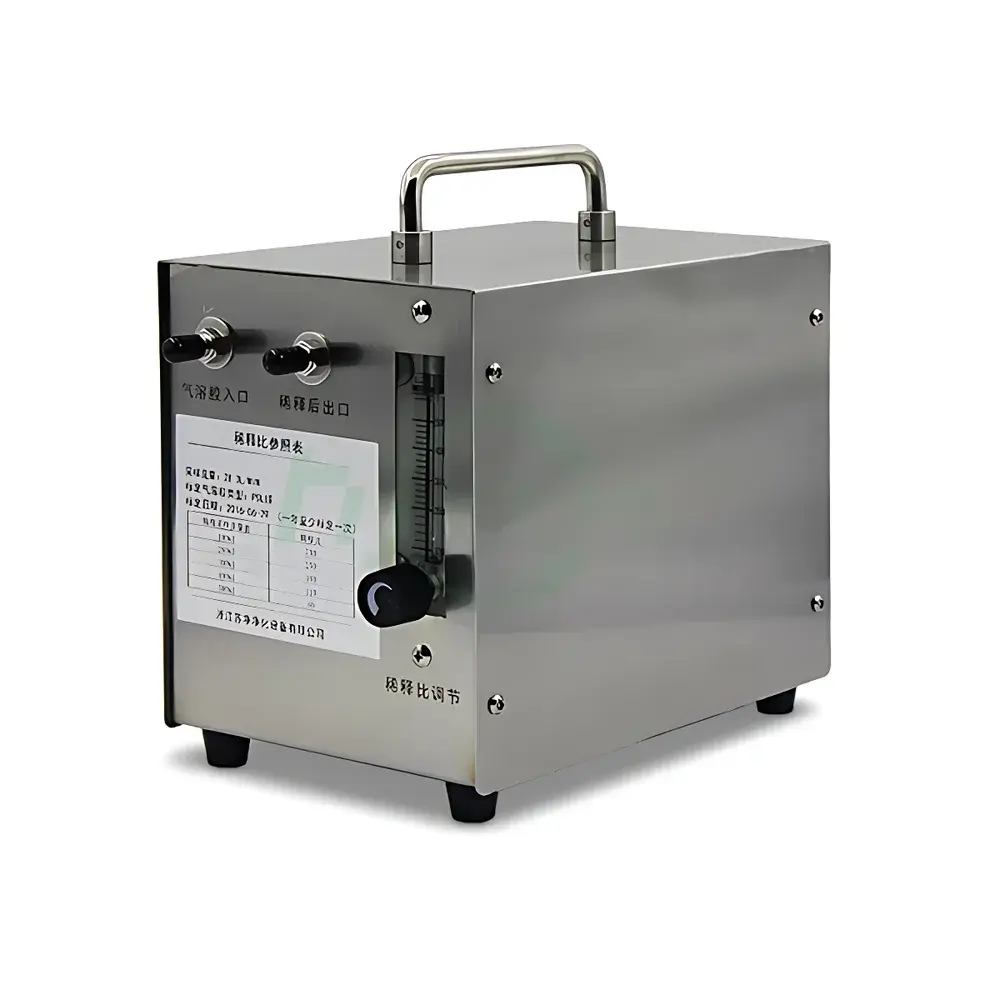
HJ ZJSJ-010 Portable Particle Diluter
| Brand | HJ |
|---|---|
| Origin | Jiangsu, China |
| Manufacturer Type | OEM Manufacturer |
| Product Category | Domestic |
| Model | ZJSJ-010 |
| Instrument Type | Optical Particle Counter Accessory |
| Dilution Ratio | 60–700× @ 28.3 L/min |
| Flow Rate | 28.3 L/min (standard) / 2.83 L/min (low-flow mode) |
| Dilution Control Method | Precision Mass Flow Regulation |
| Compliance | Designed for ISO 14644-1/3, ISO 21501-4, and USP <788> compliant particle counting workflows |
Overview
The HJ ZJSJ-010 Portable Particle Diluter is an engineered accessory designed to extend the operational range of optical particle counters (OPCs) in high-concentration airborne particulate environments. It operates on the principle of controlled isokinetic dilution—introducing a precisely metered stream of clean, particle-free air (typically HEPA-filtered) into the sample airflow to reduce particle concentration without altering size distribution or inducing agglomeration. This enables accurate, real-time monitoring of particles ≥0.3 µm and ≥0.5 µm in applications where raw sample concentrations would otherwise saturate the sensor or exceed the linear response range of the counter. The device is not a standalone measurement instrument but a critical interface component that ensures data integrity, sensor longevity, and regulatory compliance in validated cleanroom and controlled environment monitoring protocols.
Key Features
- Adjustable dilution ratio spanning 10–80× at low flow (2.83 L/min) and 60–700× at standard flow (28.3 L/min), supporting both portable handheld OPCs and fixed-installation systems;
- Integrated mass flow controllers (MFCs) with NIST-traceable calibration for stable, repeatable dilution ratios across varying inlet pressures and ambient temperatures;
- Compact, lightweight aluminum chassis with IP54-rated enclosure—designed for field deployment in cleanrooms, isolators, and HVAC ductwork;
- Gas-tight stainless-steel and fluoropolymer wetted path to prevent adsorption, leaching, or electrostatic particle loss;
- No internal pumps or compressors—operates passively using the host particle counter’s vacuum source, minimizing power requirements and mechanical failure points;
- Quick-connect fittings (ISO-KF 25 and 1/4″ Swagelok) compatible with industry-standard OPC inlets (e.g., Climet, TSI, Particle Measuring Systems, Lighthouse).
Sample Compatibility & Compliance
The ZJSJ-010 is validated for use with ISO 21501-4-compliant optical particle counters and supports sampling from diverse air handling configurations—including unidirectional airflow hoods, HEPA-filtered supply ducts, negative-pressure containment units, and recirculating HVAC loops. Its dilution stability (<±2% variation over 8-hour continuous operation) meets the repeatability requirements specified in ISO 14644-3 Annex B for filter integrity testing and in-situ challenge studies. When deployed as part of a full system (diluter + calibrated OPC + certified reference aerosol), it facilitates adherence to FDA Aseptic Processing Guidance, EU GMP Annex 1 (2022), and ISO 14644-1 Class 5–8 environmental monitoring programs. No internal software or firmware requires 21 CFR Part 11 validation—the device functions as a passive fluidic component and introduces no electronic data handling.
Software & Data Management
The ZJSJ-010 contains no embedded software, microprocessor, or data storage capability. It generates no digital output and does not interface with host counter software beyond physical airflow coupling. All calibration, configuration, and audit trail responsibilities reside with the connected particle counter and its associated acquisition platform. Users must apply appropriate dilution correction factors within their data analysis pipeline (e.g., multiplying raw counts by the selected dilution ratio). For GxP-regulated environments, documented verification of dilution ratio accuracy—performed using traceable polydisperse latex sphere (PSL) aerosols and reference-grade condensation particle counters (CPCs)—must be retained as part of equipment qualification (IQ/OQ/PQ) records.
Applications
- HEPA/ULPA filter leak testing per ISO 14644-3 using upstream challenge aerosols (e.g., PAO, DOP, or NaCl);
- In-situ particle concentration profiling in laminar flow workstations and biosafety cabinets during operational qualification;
- Monitoring of high-output clean air devices such as fan filter units (FFUs) and mini-environments;
- Validation of negative-pressure isolation rooms and anterooms in healthcare and pharmaceutical manufacturing;
- Supporting USP particulate matter testing in parenteral production areas where background aerosol levels exceed OPC upper limits;
- Field-based commissioning of HVAC systems prior to formal cleanroom certification.
FAQ
Is the ZJSJ-010 compatible with all optical particle counters?
Yes—provided the host counter has sufficient vacuum capacity (≥−15 kPa at inlet) and accepts 28.3 L/min or 2.83 L/min sample flow. Mechanical fitment must be verified using included adapters or user-supplied ISO-KF or Swagelok hardware.
Does the diluter require annual recalibration?
While the unit itself contains no sensors requiring periodic recalibration, users must verify dilution ratio accuracy before each critical test campaign using a traceable reference method (e.g., dual-instrument comparison with a CPC and monodisperse PSL aerosol).
Can custom dilution ratios be factory-programmed?
The flow control architecture supports user-defined ratios outside the standard ranges; however, non-standard configurations require pre-delivery performance verification and are subject to extended lead time and documentation review.
Is the ZJSJ-010 suitable for liquid particle counting applications?
No—it is designed exclusively for gaseous-phase airborne particle dilution. Liquid stream dilution requires separate fluidic systems with different wetted materials and pressure ratings.
What maintenance is required?
Routine inspection of O-rings, inlet filters, and flow path cleanliness; quarterly cleaning with isopropyl alcohol and lint-free wipes; replacement of HEPA pre-filters every 500 operating hours or per facility SOP.



