
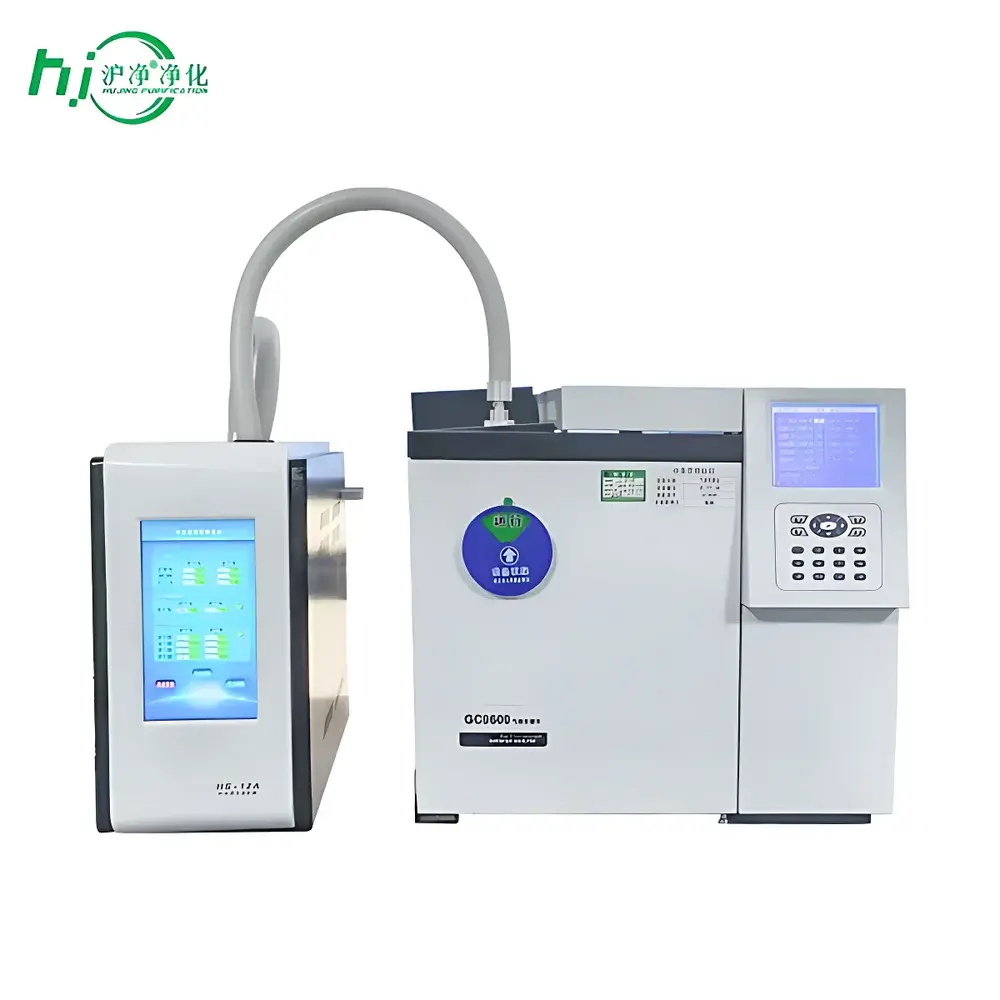
HJGC-8500 Epoxy Ethane Gas Chromatograph by Hujing Purification
| Brand | Hujing Purification (HJ) |
|---|---|
| Origin | Shanghai, China |
| Manufacturer Type | Original Equipment Manufacturer (OEM) |
| Regional Classification | Domestic (PRC) |
| Model | HJGC-8500 |
| Application Scope | General-purpose GC analysis for ethylene oxide (EO) residual testing and volatile organic compound (VOC) profiling |
| Temperature Control Range | Ambient +5°C to 400°C (0.1°C increment) |
| Temperature Stability | ±0.1°C |
| Programmed Temperature Ramping | 5-step, with isothermal hold time 0–999 min (0.1 min increment), max ramp rate 40°C/min below 200°C / 20°C/min above 200°C |
| Dimensions (W×D×H) | 555 × 525 × 485 mm |
| Power Supply | AC 220 V ±7%, 50 Hz, 2 kW |
| Net Weight | ~52 kg |
| Detector Compatibility | Simultaneous TCD and FID operation supported |
| Carrier Gas Protection | Automatic cutoff upon low-pressure or leak detection |
| Oven Airflow Control | Intelligent rear-door system with dynamic baffle adjustment |
| Injection Options | Packed column head injection, glass liner injection, split/splitless capillary injection with septum purge |
| External Event Channels | 8-channel TTL-compatible event control |
| Optional | Integrated electronic pressure/flow display module and embedded GC workstation |
Overview
The HJGC-8500 Epoxy Ethane Gas Chromatograph is a purpose-engineered analytical platform designed for precise quantification of residual ethylene oxide (EO) in medical devices, pharmaceutical packaging, and sterilized consumables—applications governed by ISO 10993-7, USP , and ASTM F1980. Built on a robust dual-detection architecture, it implements classical gas chromatographic separation using capillary or packed columns, coupled with flame ionization detection (FID) for trace-level EO quantitation and thermal conductivity detection (TCD) for carrier gas purity verification or auxiliary compound screening. Its oven temperature control system—capable of five-stage programmed heating with sub-0.1°C stability—ensures reproducible retention time alignment across batch analyses, critical for GLP-compliant residual gas validation protocols. The instrument operates under constant-flow or constant-pressure modes, with real-time digital monitoring of inlet pressure, column head pressure, and detector gas flows when equipped with the optional electronic flow control module.
Key Features
- High-resolution 5.7-inch LCD interface with Chinese-language menu navigation and real-time display of all temperature zones (oven, injector, detectors), flow parameters, and system status.
- Six independently controlled temperature zones—including separate heating circuits for packed-column and capillary injectors—enabling method flexibility without hardware reconfiguration.
- Comprehensive self-diagnostic firmware: automatically identifies and displays fault codes, root causes (e.g., “TCD filament open”, “oven thermistor drift”), and corrective guidance in plain language.
- Dual-layer thermal protection: hardware-based overtemperature cutoff at user-defined thresholds, plus software-monitored thermal runaway prevention across all heated modules.
- Carrier gas failure mitigation: automatic power-down and heater deactivation upon detection of pressure drop below preset limits—preserving column integrity and detector longevity.
- Dynamic rear-door airflow regulation: continuously modulates exhaust baffle position based on oven setpoint and ambient conditions, enabling stable temperature control within ±0.1°C even at near-ambient oven settings (e.g., 35°C).
- Modular inlet system supporting multiple sample introduction strategies: packed-column head injection, glass-liner-equipped capillary injection, and split/splitless operation with active septum purge to minimize ghost peaks.
- Expandable detector capacity: accommodates up to four detectors simultaneously—including FID, TCD, ECD, or NPD—with independent gas supply routing and electrical isolation.
Sample Compatibility & Compliance
The HJGC-8500 is validated for use with standard EO calibration standards (e.g., NIST-traceable ethylene oxide in nitrogen), headspace vials (20 mL crimp-top), and stainless-steel or passivated sampling bags per ISO 11358. It supports both direct injection of gaseous samples and headspace analysis of solid or liquid matrices following validated extraction protocols. Regulatory alignment includes full compatibility with FDA 21 CFR Part 11 requirements when paired with its optional embedded workstation—featuring audit trail logging, electronic signatures, user access tiers, and data immutability controls. Instrument qualification documentation (IQ/OQ/PQ templates) and installation verification checklists are provided to support GMP and ISO/IEC 17025 laboratory accreditation.
Software & Data Management
The optional integrated workstation runs on embedded Linux with a web-accessible GUI, eliminating dependency on external PCs. It delivers baseline correction, peak integration (tangent skim, vertical drop), retention time locking, and multi-point calibration curve generation (linear, quadratic, or weighted least-squares). Raw data files adhere to ANDI/NetCDF format for cross-platform compatibility with third-party review tools (e.g., OpenLab CDS, Chromeleon). All acquisition and processing events—including method edits, integration parameter changes, and report exports—are timestamped and logged with operator ID, satisfying ALCOA+ data integrity principles. Backup is performed automatically to internal SSD and optionally to network-attached storage via configurable SMB/CIFS mounts.
Applications
- Residual EO quantification in ethylene oxide-sterilized medical devices (catheters, syringes, surgical drapes) per ISO 10993-7 Annex B.
- Validation of EO sterilization cycle efficacy through chamber air and product headspace analysis.
- Stability-indicating assays for EO-degraded pharmaceutical excipients (e.g., polysorbates, PEGs).
- Volatile impurity profiling in active pharmaceutical ingredients (APIs) per ICH Q3C guidelines.
- Environmental monitoring of EO emissions from sterilization facilities (NIOSH Method 2536).
- Quality control of EO-based chemical intermediates in fine organic synthesis.
FAQ
Is the HJGC-8500 compliant with ISO 10993-7 for medical device EO residue testing?
Yes—the system meets all instrumental performance criteria outlined in Clause 6.2 of ISO 10993-7, including temperature precision, retention time repeatability (<0.5%), and limit of quantitation (LOQ) ≤ 0.1 µg/g when operated with a 30 m × 0.32 mm ID DB-624 column and FID.
Can the instrument run both FID and TCD simultaneously during a single analysis?
Yes—its dual-detector gas manifold and independent power/control circuits allow concurrent FID and TCD operation without signal interference or thermal crosstalk.
What level of cybersecurity does the embedded workstation provide?
The Linux-based OS implements TLS 1.2 encryption for remote web access, role-based authentication (admin/operator/auditor), and write-once-read-many (WORM) archive mode for raw data folders.
Does the system support unattended overnight analysis?
Yes—via the 8-channel external event interface, users can automate valve switching, oven cooling cycles, and detector shutdown sequences; combined with auto-sampler integration (optional), up to 120 samples can be processed sequentially.
Is factory calibration traceable to national metrology institutes?
All temperature sensors are calibrated against NIM (National Institute of Metrology, China) reference standards, with certificates of calibration included; flow sensors are certified per JJG 643-2003 (Chinese national verification regulation for flow meters).





