
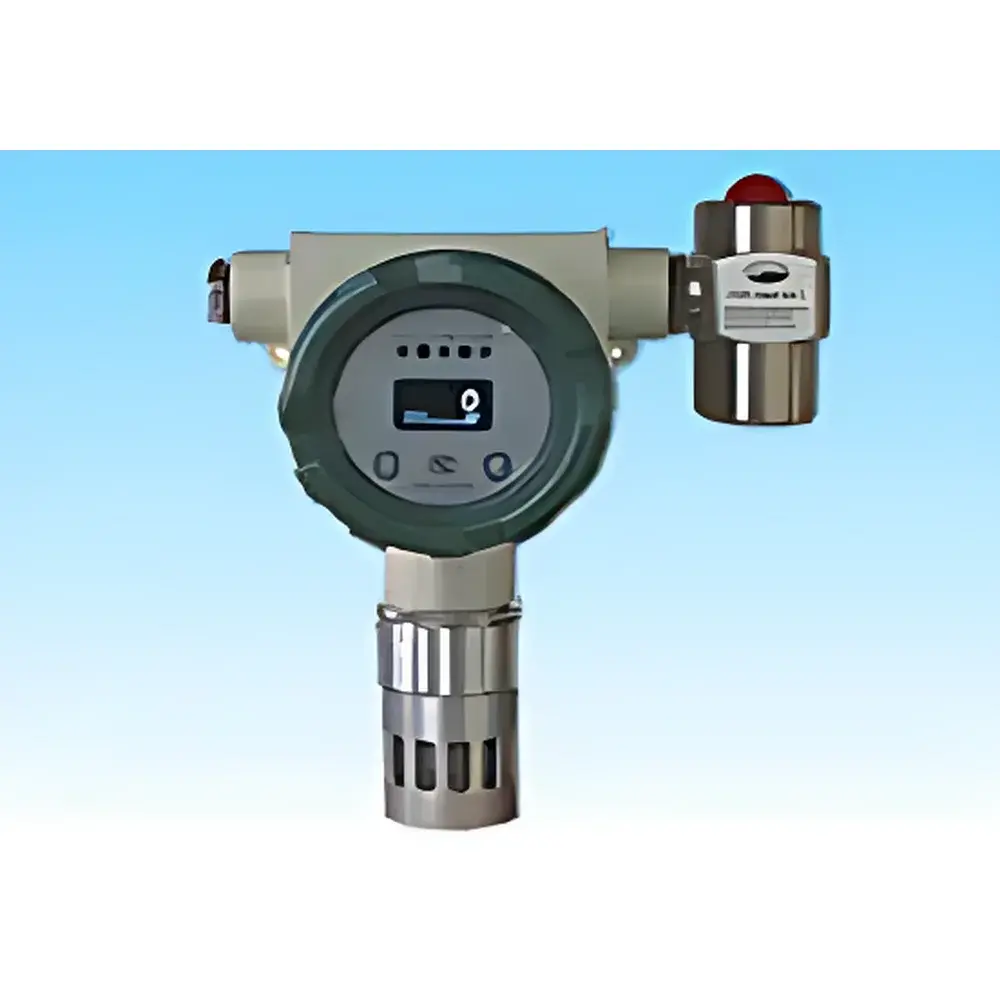
HK-7100A Catalytic Bead Combustible Gas Detector
| Origin | Beijing |
|---|---|
| Manufacturer Type | Authorized Distributor |
| Origin Category | Domestic (PRC) |
| Detection Principle | Catalytic Combustion |
| Model Variant | HK-7100A (Catalytic Bead Configuration) |
| Pricing | Available Upon Request |
Overview
The HK-7100A Catalytic Bead Combustible Gas Detector is a certified fixed-point gas monitoring instrument engineered for continuous, real-time detection of combustible gases in industrial and hazardous environments. It operates on the catalytic combustion (pellistor) principle: flammable gas molecules oxidize exothermically on a heated platinum coil coated with catalyst material, causing a measurable resistance change proportional to gas concentration. This method delivers stable, repeatable measurements across a wide ambient temperature range and is widely accepted under international safety standards for hydrocarbon and hydrogen detection. Designed for integration into centralized safety systems, the HK-7100A complies with GB 15322.1–2003 (Chinese national standard for point-type combustible gas detectors) and meets intrinsic safety and explosion protection requirements for Zone 1/21 hazardous locations.
Key Features
- 32-bit embedded microcontroller architecture enabling high-speed signal processing and low-latency alarm response
- Dual power configuration support: compatible with both centralized bus-powered networks (e.g., controller-based 4–20 mA loops) and independent regional DC power supplies (18–30 VDC)
- High-contrast, wide-temperature OLED display with bilingual (English/Chinese) menu navigation and visual status indicators for alarm level I/II and fault conditions
- Non-contact operation via optional magnetic stylus or bidirectional infrared remote control—eliminating mechanical wear and enhancing operational safety in classified zones
- Modular sensor platform: single detector housing supports hot-swappable catalytic bead sensors; fully interoperable with other sensor types (electrochemical, infrared, PID, semiconductor) within the HK-7100 series ecosystem
- Self-diagnostic firmware continuously monitors sensor health, heater integrity, and bridge balance—automatically triggering fault alerts upon deviation beyond calibrated thresholds
- Surface-mount technology (SMT) PCB assembly reduces unit footprint by >35% versus legacy through-hole designs while improving thermal stability and long-term reliability
Sample Compatibility & Compliance
The HK-7100A is optimized for detection of Class I gases—including methane, propane, butane, hydrogen, and other hydrocarbons—in accordance with their Lower Explosive Limit (LEL) values. It employs natural diffusion sampling, requiring no external pump or sample line. The device is certified for use in explosive atmospheres with Exd II CT6 flameproof enclosure rating (IEC 60079-1) and IP66 ingress protection (IEC 60529), ensuring resilience against dust, rain, and temporary water immersion. Environmental operating limits span −40 °C to +70 °C ambient temperature and 86–106 kPa atmospheric pressure. All electrical interfaces—including 4–20 mA analog output, CAN bus, and RS485—are galvanically isolated to prevent ground-loop interference and comply with EMC directive 2014/30/EU.
Software & Data Management
While the HK-7100A operates as a standalone field device, its digital communication protocols (CAN bus and RS485) enable seamless integration with distributed control systems (DCS), programmable logic controllers (PLCs), and centralized SCADA platforms. Alarm thresholds for Level I (pre-alarm) and Level II (critical alarm) are user-configurable via local interface or remote HART-compatible configuration tools. Event logging—including alarm timestamps, sensor fault codes, and calibration history—is retained onboard for audit trail purposes. When deployed in regulated industries (e.g., petrochemical, pharmaceutical manufacturing), the device supports traceability requirements aligned with ISO 9001 quality management systems and can be validated per GMP Annex 11 principles when interfaced with compliant host software featuring electronic signatures and 21 CFR Part 11–compliant audit trails.
Applications
- Continuous monitoring in oil & gas refineries, LNG terminals, and pipeline compressor stations
- Confined space entry safety systems in wastewater treatment plants and utility tunnels
- Process safety instrumentation for chemical synthesis reactors and solvent storage areas
- Fire prevention surveillance in underground parking garages, battery charging rooms, and hydrogen fueling stations
- Compliance-driven ambient air quality monitoring in industrial parks subject to local environmental regulations (e.g., China’s HJ 688–2013)
FAQ
What gases does the HK-7100A detect using catalytic combustion?
It detects combustible gases whose Lower Explosive Limit (LEL) falls within the 0–100% LEL measurement range, including methane, propane, hydrogen, and most saturated hydrocarbons.
Can the sensor be replaced without powering down the unit?
Yes—the catalytic bead sensor supports true hot-swap functionality; removal and insertion do not require system shutdown or recalibration.
Is the HK-7100A suitable for outdoor installation?
Yes—its IP66-rated enclosure and −40 °C to +70 °C operating range make it suitable for unsheltered outdoor deployment in most climatic zones.
Does it meet international explosion protection standards?
It carries Exd II CT6 certification per GB 3836.1/2 and conforms to IEC 60079-1 for flameproof enclosures; however, end-user verification against local ATEX or IECEx requirements is recommended prior to installation.
How is calibration performed?
Field calibration uses certified test gas (typically 50% LEL methane or propane); zero and span adjustments are accessible via the IR remote or magnetic stylus interface, with calibration data logged internally.







