
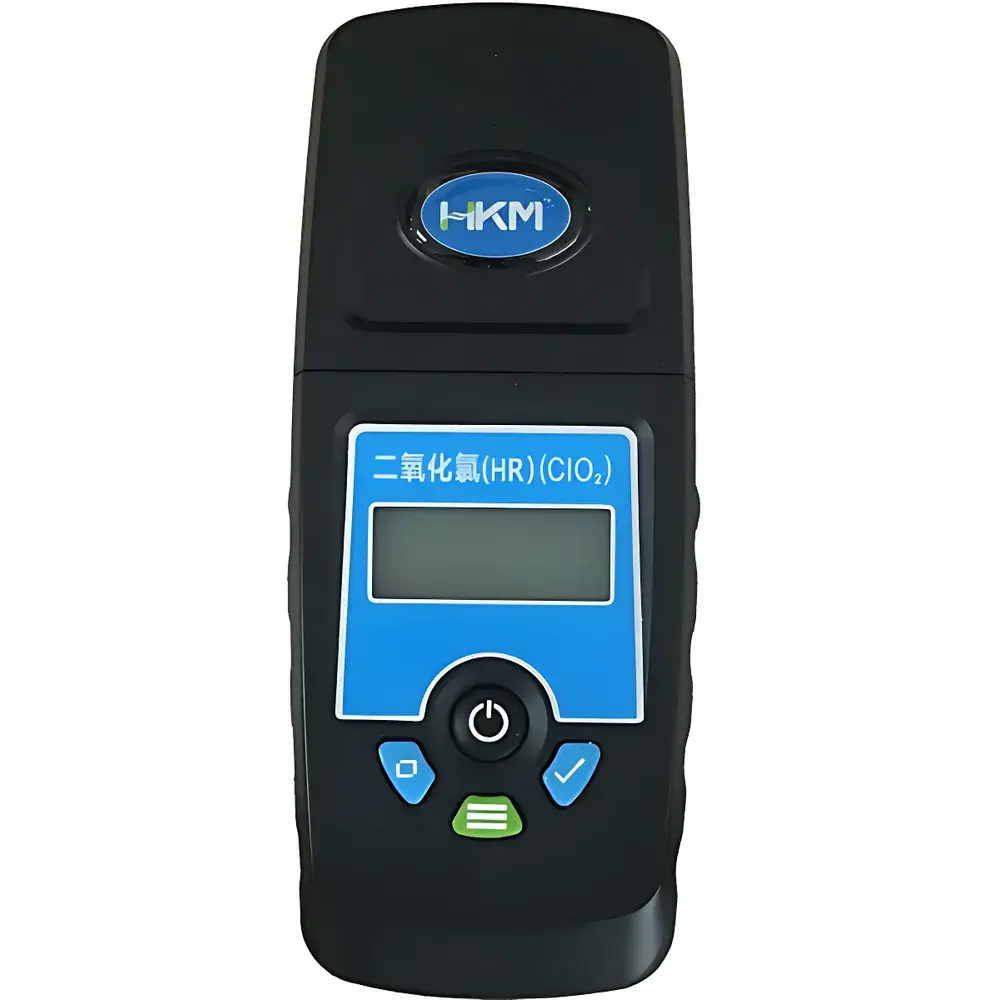
HKM S-206 Chlorine Dioxide Pocket Colorimeter (LR)
| Brand | HKM |
|---|---|
| Origin | Guangdong, China |
| Model | S-206 |
| Instrument Type | Portable |
| Measurement Parameter | Chlorine Dioxide (ClO₂) |
| Measurement Range | 5–999 mg/L |
| Accuracy | ±5% |
| Repeatability | ±3 mg/L |
| Resolution | 1 mg/L |
| Detection Limit | 1 mg/L |
| Light Source | LED |
| Wavelength | 445 nm |
| Power Supply | 4 × 1.5 V AA batteries |
| Dimensions | 159 × 68 × 35 mm |
| Weight | 220 g (including batteries) |
| Compliance | Compatible with Standard Iodometric Methods (Five-Step and Malonic Acid Iodometric Methods) |
Overview
The HKM S-206 Chlorine Dioxide Pocket Colorimeter (LR) is a compact, field-deployable photometric analyzer engineered for rapid, on-site quantification of aqueous chlorine dioxide (ClO₂) concentration. Unlike conventional titrimetric or electrochemical methods, this instrument employs direct absorbance photometry at a fixed wavelength of 445 nm—optimized for the characteristic absorption peak of ClO₂ in solution—eliminating the need for chemical reagents, color-developing steps, or sample derivatization. The device operates on the Beer–Lambert principle: incident light from a stable LED source passes through a sealed optical path containing the water sample, and the transmitted intensity is measured by a calibrated photodetector. The resulting absorbance is linearly converted to concentration (mg/L) and displayed in real time on a backlit LCD screen. Designed specifically for unambiguous ClO₂ measurement—without cross-sensitivity to free chlorine, chloramines, or other oxidants—the S-206 ensures selective detection across its full operational range (5–999 mg/L), making it suitable for high-concentration disinfectant validation in industrial water treatment, food processing rinse water, and healthcare sterilization protocols.
Key Features
- Reagent-free operation: No chemical reagents, no colorimetric kits, no calibration curves required—reducing consumable cost and operator error.
- Dedicated 445 nm LED optical system: Matches the primary absorption maximum of dissolved ClO₂, minimizing spectral interference from coexisting oxidants.
- High-resolution display: LCD screen shows concentration directly in mg/L with 1 mg/L resolution and automatic unit scaling.
- Portable architecture: Lightweight (220 g with batteries), ergonomic form factor (159 × 68 × 35 mm), and battery-powered operation enable use in remote locations, mobile labs, or production floor QC stations.
- Robust repeatability: ±3 mg/L standard deviation under controlled conditions supports routine monitoring and trend analysis per ISO 8655-6 and ASTM D1253-22 guidelines for residual oxidant measurement.
- Traceable performance: Instrument response validated against reference standards prepared via standardized iodometric titration (five-step and malonic acid methods), ensuring alignment with USP , EPA Method 300.0, and EN ISO 7890-3.
Sample Compatibility & Compliance
The S-206 accepts clear, non-turbid aqueous samples with minimal suspended solids (<5 NTU) and low organic load (COD < 50 mg/L). It is compatible with drinking water, process water, cooling tower effluents, food-grade rinse solutions, and hypochlorite-free disinfectant formulations. Sample volume requirement is 10 mL, introduced into the integrated cuvette chamber. The instrument complies with fundamental metrological requirements outlined in ISO/IEC 17025 for field-deployable analyzers and supports documentation practices aligned with GLP and GMP environments. While not inherently 21 CFR Part 11 compliant (lacking electronic signature or audit trail functionality), raw measurement data can be manually recorded in laboratory notebooks or exported via optional serial interface for integration into LIMS systems.
Software & Data Management
The S-206 operates as a standalone photometer without embedded firmware-based data logging or wireless connectivity. All measurements are displayed in real time and must be manually transcribed. However, its consistent optical output and stable LED source allow for external digital capture using calibrated smartphone spectrophotometry apps or third-party data acquisition modules (e.g., Arduino-based USB-serial adapters). For regulated environments, users may implement procedural controls—including daily verification with NIST-traceable ClO₂ reference standards—and maintain instrument-specific calibration logs per ISO/IEC 17025 clause 7.7. The absence of onboard memory simplifies validation and reduces cybersecurity exposure in critical infrastructure settings.
Applications
- Validation of ClO₂ dosing systems in municipal and industrial water treatment plants.
- Real-time monitoring of sanitizer concentration during CIP (clean-in-place) cycles in beverage and dairy processing lines.
- Verification of disinfectant efficacy in hospital sterilization tunnels and endoscope reprocessing units.
- Field testing of emergency water purification units deployed in disaster relief operations.
- Quality control of ClO₂-based biocides used in pulp & paper mill cooling systems.
- Academic and regulatory lab verification of ClO₂ stability in buffered and pH-controlled matrices.
FAQ
Does the S-206 measure free chlorine or chloramines?
No. Its optical design is spectrally selective for ClO₂ at 445 nm and does not respond to monochloramine (λmax ≈ 254 nm) or free chlorine (λmax ≈ 292 nm) under typical matrix conditions.
Can it be used with turbid or colored samples?
Not without pretreatment. Turbidity >5 NTU or strong background absorbance (e.g., humic acids, iron complexes) will bias results; centrifugation or membrane filtration is recommended prior to analysis.
How often does the instrument require calibration verification?
Daily verification with a mid-range ClO₂ standard (e.g., 100 mg/L) is recommended before first use and after extended storage; full recalibration is not user-serviceable and requires factory service.
Is the 1 mg/L detection limit achievable in all water matrices?
The stated LOD assumes deionized water spiked with pure ClO₂; in high-conductivity or saline matrices, the effective LOD may increase to 3–5 mg/L due to scattering effects.
What battery life can be expected during continuous operation?
Approximately 8–10 hours of intermittent use (100–150 measurements/day) with fresh alkaline AA cells; lithium AA batteries extend runtime by ~30% but do not improve photometric stability.







