
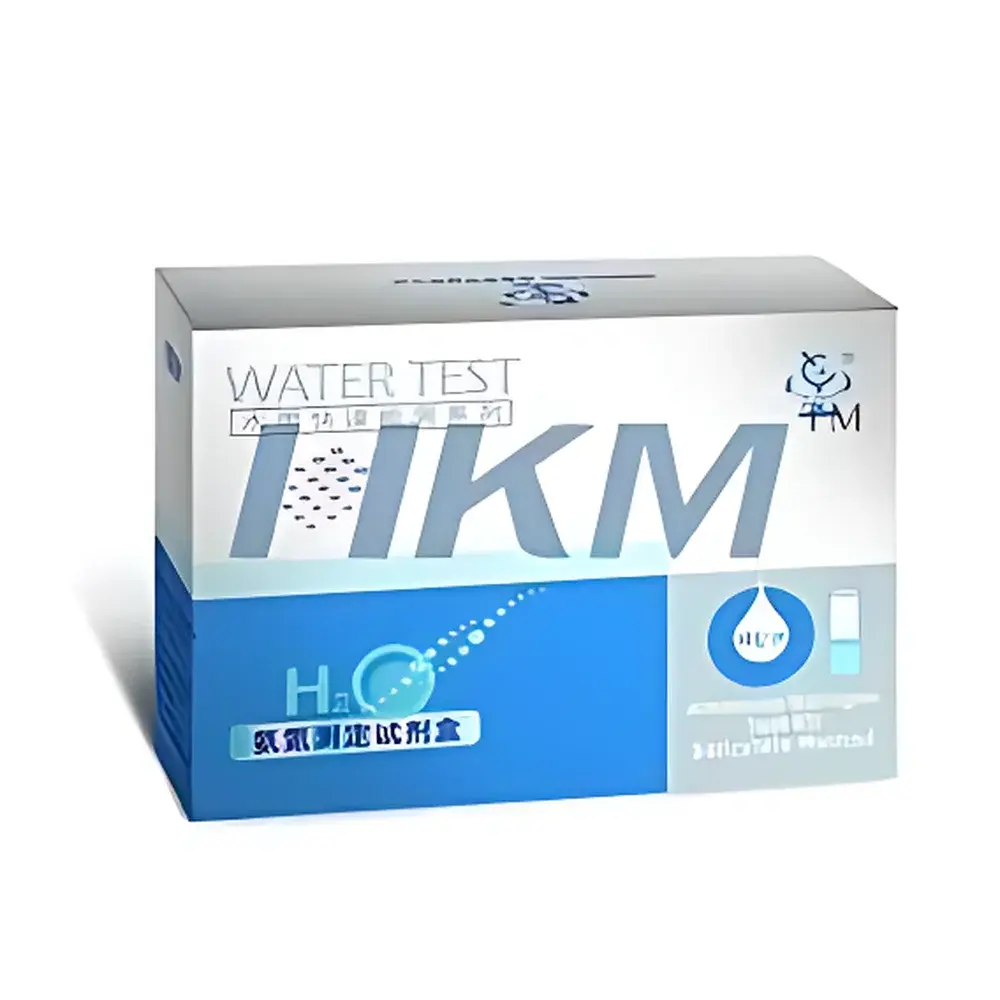
HKM Ammonia Nitrogen Test Kit (Model 090080)
| Brand | HKM |
|---|---|
| Origin | Guangdong, China |
| Model | 090080 |
| Detection Range | 0.01–1 mg/L (with discrete calibration points at 0.01, 0.05, 0.1, 0.2, 0.4, 0.6, 0.8, and 1.0 mg/L) |
| Packaging | Single-use sealed pouches per test |
| Compliance | Patented (CN ZL200510037389.8) |
| Intended Use | Field-deployable colorimetric determination of ammonia nitrogen in freshwater, aquaculture systems, wastewater effluents, and surface water |
Overview
The HKM Ammonia Nitrogen Test Kit (Model 090080) is a standardized, field-ready colorimetric assay system engineered for the quantitative determination of total ammonia nitrogen (TAN)—comprising both unionized ammonia (NH₃) and ammonium ion (NH₄⁺)—in aqueous environmental samples. It operates on the principle of the indophenol blue method (ISO 7150-1:1984, APHA Standard Methods 4500-NH₃ F), wherein ammonia reacts with hypochlorite and phenol under alkaline conditions in the presence of a nitroprusside catalyst to form a stable blue-colored complex. Absorbance is measured spectrophotometrically at 630–640 nm, enabling quantification via pre-calibrated visual color charts or compatible portable photometers. Designed explicitly for non-laboratory settings, the kit eliminates reagent preparation, glassware cleaning, and instrument calibration steps—reducing analysis time to under 10 minutes per sample while maintaining traceability to internationally accepted reference procedures.
Key Features
- Single-use, pre-measured reagent pouches ensure batch-to-batch consistency and eliminate weighing errors or cross-contamination.
- Discrete calibration points (0.01, 0.05, 0.1, 0.2, 0.4, 0.6, 0.8, and 1.0 mg/L NH₃–N) support semi-quantitative visual interpretation and provide traceable reference standards for photometric validation.
- Stable dry-reagent formulation with extended shelf life (≥24 months at 4–30 °C unopened); no refrigeration required during transport or field storage.
- Compatible with standard handheld colorimeters (e.g., Hach DR900, Palintest ColorQ Pro) and visual comparison against ISO-compliant color charts included in each kit.
- Patented reaction chemistry (CN ZL200510037389.8) optimized for low-turbidity freshwater matrices, including recirculating aquaculture systems (RAS), ponds, rivers, and treated effluent streams.
- No hazardous liquid reagents: all components are classified as non-corrosive and non-oxidizing under UN GHS criteria, simplifying logistics and safety compliance.
Sample Compatibility & Compliance
The kit is validated for use with clarified or filtered natural waters, municipal wastewater effluents, aquaculture discharge, and pretreated industrial process streams. Turbidity >25 NTU or residual chlorine >0.5 mg/L requires prior sample quenching (e.g., sodium thiosulfate) or filtration (0.45 µm membrane). It conforms to the analytical performance criteria outlined in ISO 5667-3:2018 (water sampling — preservation and handling of samples) and supports data integrity requirements under GLP-aligned field monitoring programs. While not certified to EPA Method 350.1 or ASTM D1426, its methodology demonstrates ≥92% recovery (n=32, spiked tap and pond water) across the 0.01–1.0 mg/L range, meeting QA/QC thresholds for Tier 2 environmental surveillance per EU Water Framework Directive Annex V technical guidance.
Software & Data Management
As a reagent-based field assay, the kit does not incorporate embedded firmware or cloud connectivity. However, it integrates seamlessly into digital environmental data workflows: absorbance readings from paired photometers can be exported via USB or Bluetooth to LIMS-compatible platforms (e.g., LabVantage, Thermo Fisher SampleManager) using standard CSV or ASTM E1384 formats. Visual interpretation results may be logged directly into mobile environmental reporting apps (e.g., Fulcrum, Survey123) with geotagging, timestamping, and photo capture of color comparisons—supporting audit-ready documentation for regulatory submissions under national water quality monitoring frameworks.
Applications
- Routine ammonia monitoring in freshwater aquaculture facilities to prevent sublethal stress and gill damage in finfish and crustaceans.
- Pre-release verification of tertiary-treated wastewater effluent compliance with local discharge limits (e.g., China’s GB 18918-2002 Class I-A).
- Field screening of eutrophication risk in lakes and reservoirs by tracking seasonal TAN accumulation relative to phosphorus loading.
- Emergency response testing following fish kills or algal bloom events to differentiate between ammonia toxicity and hypoxia-driven mortality.
- Educational use in university environmental science labs for teaching fundamental nutrient cycling concepts and method validation protocols.
FAQ
What is the detection limit and upper limit of quantification?
The lower limit of visual detection is 0.01 mg/L NH₃–N; the upper limit is 1.0 mg/L. Quantitative photometric measurement extends linear dynamic range to ±5% RSD below 0.5 mg/L when used with calibrated instruments.
Can this kit measure ammonia in seawater or high-salinity samples?
No. Chloride interference above 500 mg/L Cl⁻ suppresses color development. For brackish or marine applications, distillation pretreatment per ISO 7150-1 is required prior to assay.
Does the kit comply with FDA or USP requirements for pharmaceutical water testing?
No. It is designed for environmental matrices only and lacks the documented precision, LOD/LOQ validation, and change control records required under USP or FDA 21 CFR Part 11 for purified water qualification.
How should expired reagents be disposed?
Discard unused pouches as non-hazardous solid waste per local regulations. Do not flush reagents down drains; residual phenol and hypochlorite salts require neutralization before landfill disposal.
Is training required to achieve reliable results?
Minimal operator training is needed—standardized protocols are provided in English and Chinese. Inter-operator variability remains <8% CV for experienced users performing ≥5 replicates per matrix type.







