
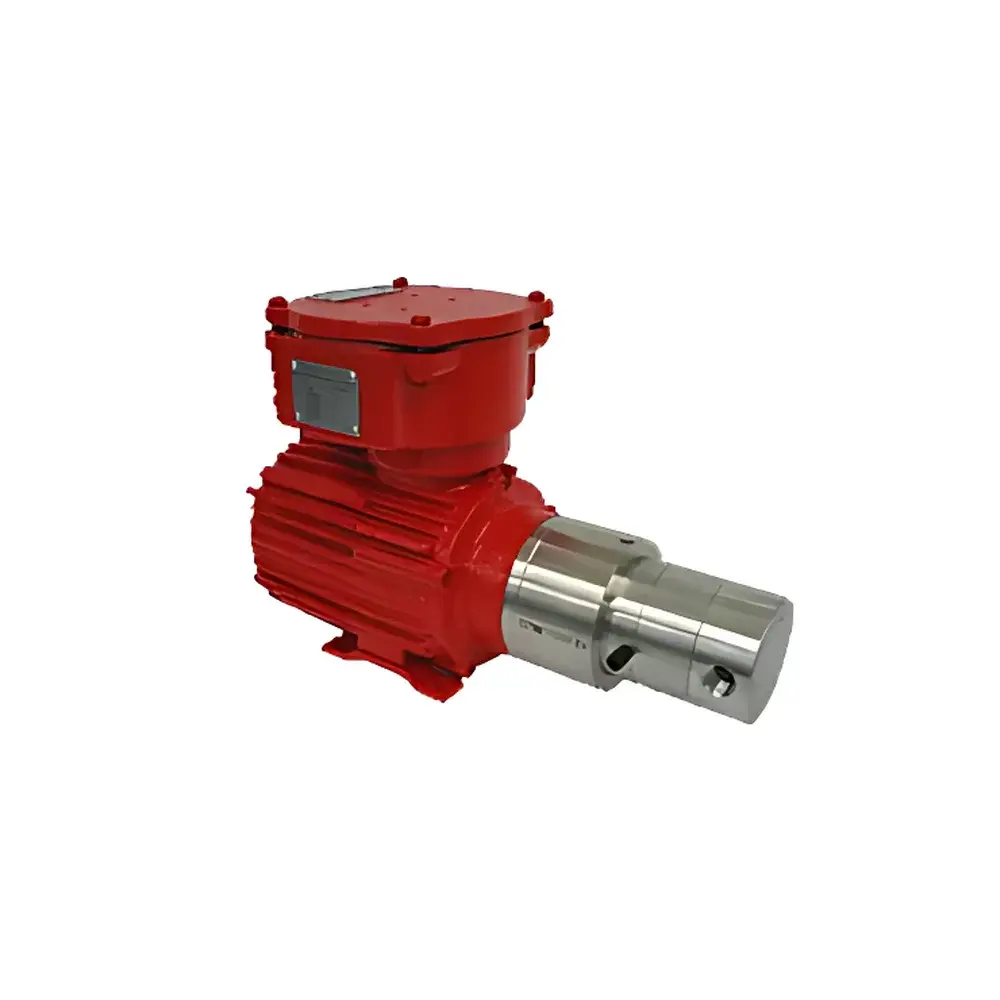
HNPM MZR-11507 ATEX-Certified Explosion-Proof Micro-Dosing Peristaltic Pump
| Brand | HNPM |
|---|---|
| Origin | Germany |
| Model | MZR-11507 |
| Flow Rate | 58–1152 mL/min |
| Speed Range | 300–6000 rpm |
| Precision (CV) | <1% |
| Max Differential Pressure | 40 bar (at 1 mPa·s), 80 bar (≥16 mPa·s) |
| Viscosity Range | 0.3–5,000 mPa·s (up to 10,000 mPa·s with optional configuration) |
| Displacement per Revolution | 192 µL |
| Minimum Dose Volume | 100 µL |
| Motor | 3-phase AC, 250 W, IEC 063, IP55, 240/400 V, 50 Hz |
| Wetted Materials | SS 316L (1.4435), Tungsten Carbide, Alloy C276 (2.4819), Graphite-Reinforced PTFE, FPM (optional EPDM/FFPM) |
| Connection | 3/8" NPT female (lateral option available) |
| Dimensions (L×W×H) | 358 × 120 × 224 mm |
| Weight | ~22 kg |
| Ambient Temp | −20 to +40 °C (−55 to +60 °C with options) |
| Operating Temp | −5 to +40 °C (−20 to +120 °C with options) |
| ATEX Certification | II 2G c T4 X (Zone 1 & 2) |
| Thermal Protection | 6-piece PTC thermistor array |
Overview
The HNPM MZR-11507 is an ATEX-certified, explosion-proof micro-dosing peristaltic pump engineered for precise, pulse-free, low-shear fluid handling in hazardous environments. Unlike conventional peristaltic or diaphragm pumps, the MZR-11507 employs a rotary micro annular gear displacement principle—distinct from peristalsis—where a tungsten carbide rotor rotates within a precisely machined stainless steel stator cavity. This positive displacement architecture ensures volumetric accuracy independent of backpressure, fluid viscosity, or inlet conditions. Its design meets stringent requirements for continuous duty in Zone 1 and Zone 2 classified areas under Directive 94/9/EC (ATEX 95), making it suitable for laboratories and pilot-scale process lines where flammable solvents (e.g., methanol, acetone), reactive monomers, or volatile organic compounds are handled. The pump delivers stable flow across a wide viscosity spectrum—from low-viscosity solvents (0.3 mPa·s) to shear-sensitive gels and pastes (up to 5,000 mPa·s, extendable to 10,000 mPa·s with configuration)—without requiring recalibration or mechanical adjustment.
Key Features
- ATEX-certified explosion protection (II 2G c T4 X) for safe operation in gas Group IIA/IIB environments, compliant with EN 60079-0, -7, and -31
- Tungsten carbide rotor and bearings ensure exceptional wear resistance and dimensional stability over extended service life—critical for abrasive or non-lubricating media
- Volumetric precision with coefficient of variation (CV) <1% across full speed and flow range, validated per ISO 5725-2 for repeatability
- High differential pressure capability: up to 40 bar at 1 mPa·s; up to 80 bar above 16 mPa·s—enabling integration into pressurized reactor feeds or high-resistance filtration loops
- Low-pulsation delivery (<2% amplitude variation) and minimal shear stress preserve integrity of emulsions, suspensions, and biological formulations
- Robust wetted path constructed from SS 316L (1.4435), tungsten carbide, Hastelloy C276 (2.4819), and graphite-reinforced PTFE seals—resistant to aggressive chemicals including strong acids, halogenated solvents, and UV-curable adhesives
- Integrated PTC-based thermal monitoring (6-sensor array) with automatic shutdown prevents motor overheating during dry-run or high-backpressure conditions
Sample Compatibility & Compliance
The MZR-11507 accommodates diverse fluid classes without degradation of metrological performance: polar protic solvents (methanol, ethanol), aprotic solvents (THF, DMF), hydrocarbon oils, silicone greases, cyanoacrylate adhesives, UV-curable acrylates, water-based dispersions, and non-Newtonian gels. Its construction complies with FDA-relevant material standards (USP Class VI for elastomers), and all metallic components meet ASTM A276/A479 for corrosion-resistant alloys. For regulated environments—including pharmaceutical process validation and chemical synthesis under GLP/GMP—the pump supports audit-ready documentation packages and can be integrated into systems compliant with FDA 21 CFR Part 11 when paired with compatible controllers featuring electronic signature and change-tracking capabilities.
Software & Data Management
While the MZR-11507 operates as a standalone analog/digital-controlled unit, it features a 0–10 V DC speed input and pulse output for real-time RPM feedback, enabling seamless integration with PLCs (Siemens S7, Rockwell ControlLogix), SCADA platforms, or laboratory automation frameworks (LabVIEW, Python-based control via Modbus RTU/TCP). Optional HNPM digital drive modules provide RS-485 Modbus communication, programmable ramp profiles, dose-volume triggering, and event logging with timestamps. All operational parameters—including total volume dispensed, cumulative runtime, and thermal events—are accessible via serial query, supporting traceability requirements in ISO 17025-accredited testing labs and process validation protocols.
Applications
- Continuous metering of catalysts and initiators in exothermic polymerization reactors
- Precision dosing of UV-curable inks and coatings in gravure or inkjet R&D lines
- Controlled reagent addition in explosion-proof fume hood-based synthesis stations
- Feeding high-viscosity sealants and structural adhesives into automated dispensing cells
- Vacuum-compatible solvent transfer in glovebox-integrated battery electrolyte filling systems
- Calibration fluid delivery in field-deployable gas chromatography (GC) and ion chromatography (IC) analyzers
- Low-shear pumping of shear-thinning hydrogels for 3D bioprinting preclinical workflows
FAQ
Is the MZR-11507 suitable for sterile or aseptic applications?
No—it is not designed for SIP (steam-in-place) or gamma sterilization. Wetted materials meet USP Class VI but lack validation for ISO 13408 or EU Annex 1 bioburden control.
Can the pump handle abrasive slurries containing solid particles?
Only if particle size remains below 50 µm and concentration is ≤1 vol%. Tungsten carbide components resist abrasion, but stator geometry limits tolerance for suspended solids.
What is the recommended maintenance interval under continuous operation?
Rotor/stator inspection every 2,000 operating hours; seal replacement every 6,000 hours or upon observed leakage—documented in HNPM Maintenance Manual Rev. 4.2.
Does the ATEX certification cover dust environments (Zone 21/22)?
No—the II 2G c T4 X marking applies exclusively to gaseous atmospheres (Group IIA/IIB). Dust-specific certification (II 2D) requires separate configuration.
Is flow calibration traceable to national standards?
Yes—HNPM provides optional factory calibration certificates accredited to ISO/IEC 17025 by DAkkS (German Accreditation Body), with uncertainty budgets referenced to PTB primary standards.
Related Products



