
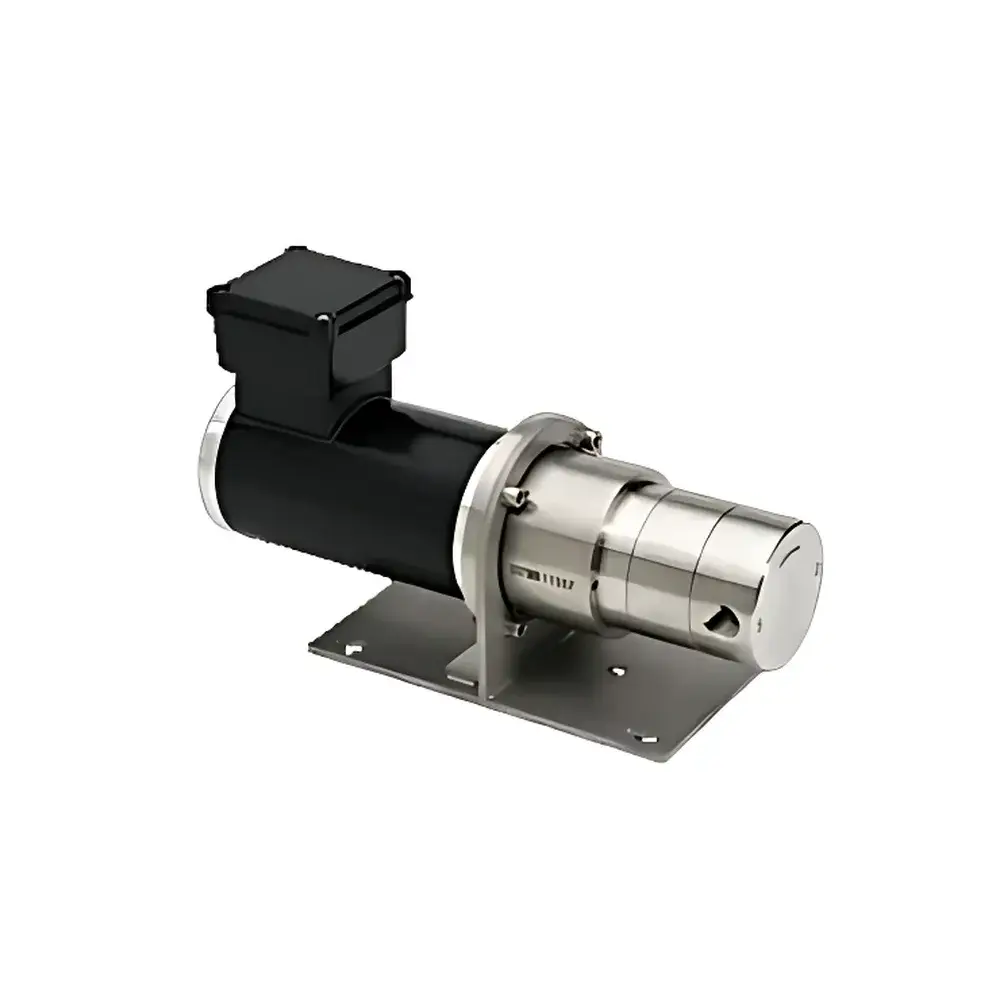
HNPM MZR-11557 Corrosion-Resistant Micro-Dosing Gear Pump
| Brand | HNPM |
|---|---|
| Origin | Germany |
| Model | MZR-11557 |
| Flow Rate | 29–1152 mL/min |
| Viscosity Range | 0.3–1,000 mPa·s |
| Precision | CV < 1% |
| Speed Range | 150–6000 rpm |
| Max Pressure | 60 bar |
| Displacement | 192 µL |
| Minimum Dose | 100 µL |
| Wetted Materials | Alloy C22 (DIN 2.4602), SSiC, Al₂O₃, ZrO₂, FFKM (Kalrez® Spectrum™ 6375) |
| Motor | 240/400 V AC, 4-pole, 100 Hz, 240 W, IP55 |
| Dimensions | 291 × 130 × 171 mm |
| Weight | ~12 kg |
| Operating Temperature | −5 to +60 °C (up to +100 °C with optional configuration) |
| Torque Transmission | 6-pole NdFeB magnetic coupling |
| Inlet Connection | 3/8" NPT female |
Overview
The HNPM MZR-11557 is a high-integrity, corrosion-resistant micro-dosing gear pump engineered for precise, pulse-free fluid handling in aggressive chemical environments. Based on rotary positive displacement principles, it employs a micro-engineered ring-gear mechanism—free of valves, check balls, or diaphragms—to deliver consistent volumetric dosing across a wide operational envelope. Its core architecture is purpose-built for flow chemistry, continuous manufacturing, and lab-scale process intensification where chemical inertness, dimensional stability under thermal stress, and long-term metrological reliability are non-negotiable. Unlike elastomer-dependent peristaltic or diaphragm pumps, the MZR-11557 achieves intrinsic chemical resistance through fully ceramicized wetted components and high-nickel superalloy housing—eliminating degradation pathways associated with swelling, leaching, or hydrolysis.
Key Features
- Ceramic rotor and functional elements fabricated from stabilized zirconia (ZrO₂), with optional tungsten carbide–nickel composite for ultra-high wear resistance
- Wetted housing constructed from corrosion-resistant Alloy C22 (DIN 2.4602), certified to ASTM B575 and NACE MR0175/ISO 15156 for sour service applications
- Bearing system utilizing sintered silicon carbide (SSiC) paired with alumina (Al₂O₃) ceramic shaft and bearing races—ensuring zero metal-to-metal contact and immunity to galvanic corrosion
- Hermetically sealed torque transmission via 6-pole neodymium-iron-boron (NdFeB) magnetic coupling—rated for continuous duty at full pressure differential without seal wear or leakage risk
- High-efficiency 4-pole AC motor (IEC 056 frame, IP55 enclosure) with external frequency inverter compatibility for linear speed control and dynamic flow modulation
- Optional double-shell thermal jacketing for temperature-controlled operation (−20 to +100 °C), supporting exothermic/endothermic reaction integration
- Low-pulse performance (<0.5% flow ripple) validated per ISO 5171, enabling stable residence time distribution in microreactor systems
Sample Compatibility & Compliance
The MZR-11557 maintains compatibility with oxidizing acids (e.g., nitric, sulfuric >70%), reducing media (e.g., hydrazine, sodium borohydride), halogenated solvents (e.g., chlorobenzene, dichloromethane), and strong alkalis (e.g., 50% NaOH). All wetted seals utilize FFKM (Kalrez® Spectrum™ 6375), meeting USP Class VI and FDA 21 CFR 177.2600 requirements for pharmaceutical contact surfaces. The pump complies with ATEX Category 2G (Zone 1) when specified with appropriate motor and coupling configurations. Design documentation supports GMP validation protocols—including IQ/OQ/PQ—and includes full material traceability (EN 10204 3.1), surface finish reports (Ra ≤ 0.4 µm on wetted paths), and third-party corrosion test data per ASTM G31 immersion testing.
Software & Data Management
When integrated with external programmable logic controllers (PLCs) or industrial PCs, the MZR-11557 supports deterministic flow control via 0–10 V analog input or Modbus RTU/ASCII over RS-485. Optional HART-enabled versions provide diagnostic telemetry—including motor current draw, thermal protection status, and cumulative operating hours—for predictive maintenance scheduling. All configuration parameters and calibration logs are stored in non-volatile memory with audit trail functionality compliant with FDA 21 CFR Part 11 Annex 11 requirements. Raw flow data export (CSV/TXT) enables traceability for GLP/GMP batch records and regulatory submissions.
Applications
- Continuous-flow synthesis of APIs and fine chemicals requiring stoichiometric precision and residence time control
- Microreactor feed systems for photochemical, electrochemical, and catalytic transformations
- Automated reagent delivery in analytical sample preparation (e.g., ICP-MS, HPLC autosamplers)
- Corrosive catalyst precursor dosing in pilot-scale hydrogenation and oxidation units
- On-line standard addition calibration in process analytical technology (PAT) frameworks
- High-purity solvent transfer in semiconductor wafer cleaning modules
FAQ
What materials are in direct contact with the fluid path?
The wetted path comprises Alloy C22 (DIN 2.4602) housing, sintered silicon carbide (SSiC) bearings and shaft, alumina (Al₂O₃) ceramic bearing races, and a stabilized zirconia (ZrO₂) rotor. Seals are FFKM (Kalrez® Spectrum™ 6375); stainless steel 316L is available as an alternative housing material upon request.
Can the pump handle abrasive slurries?
It is not designed for solid-laden fluids. Particulates exceeding 10 µm or concentrations >0.1 wt% may accelerate wear of ceramic surfaces. For slurry applications, upstream filtration to ≤5 µm is mandatory.
Is the pump suitable for vacuum inlet conditions?
Yes—maximum allowable inlet depression is −0.8 bar (absolute), provided vapor pressure of the medium remains below this threshold at operating temperature to prevent cavitation.
How is calibration traceability maintained?
Each unit ships with a factory calibration certificate referencing NIST-traceable flow standards (gravimetric method per ISO 4064-2). Field recalibration is supported using certified master meters or gravimetric verification rigs.
What safety protections are built-in?
Thermal cut-off (normally closed bimetallic contact), motor overload protection, and magnetic coupling slip detection (via current signature analysis) are standard. Optional explosion-proof motor variants meet IECEx and UL/cUL requirements.



