
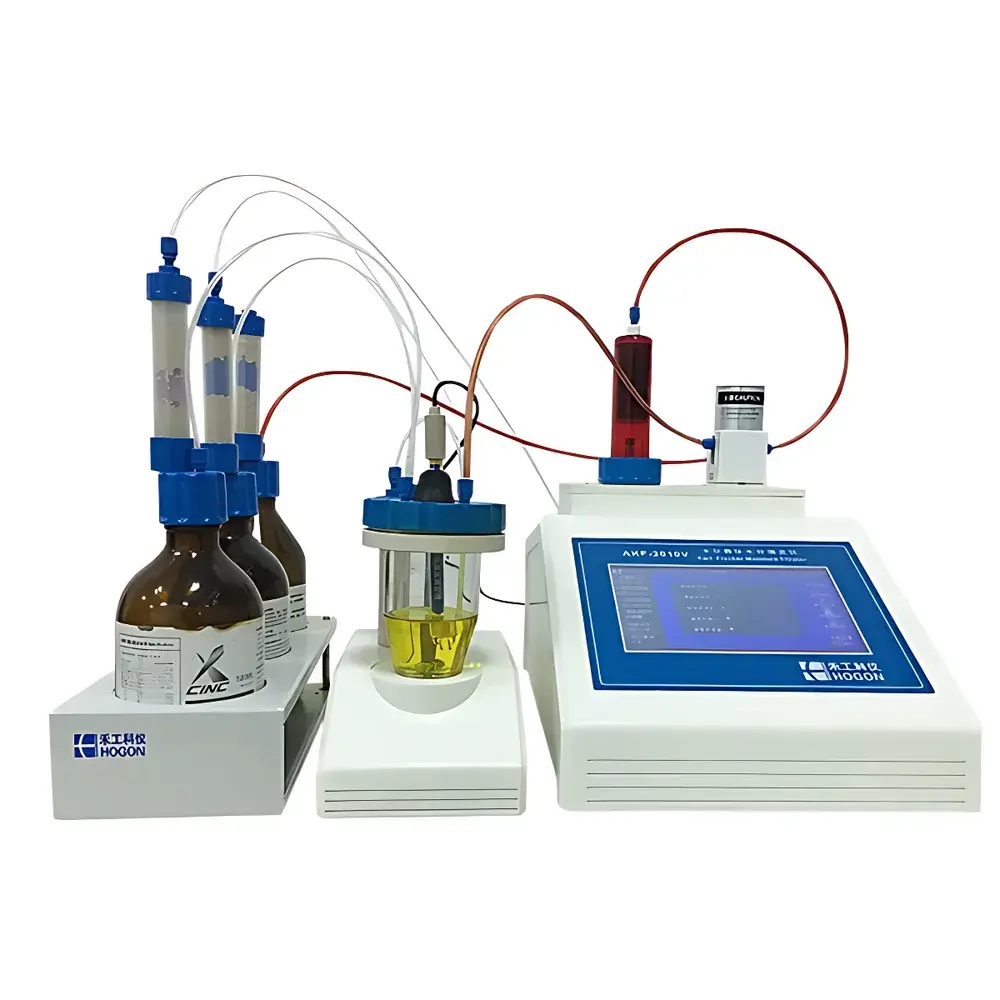
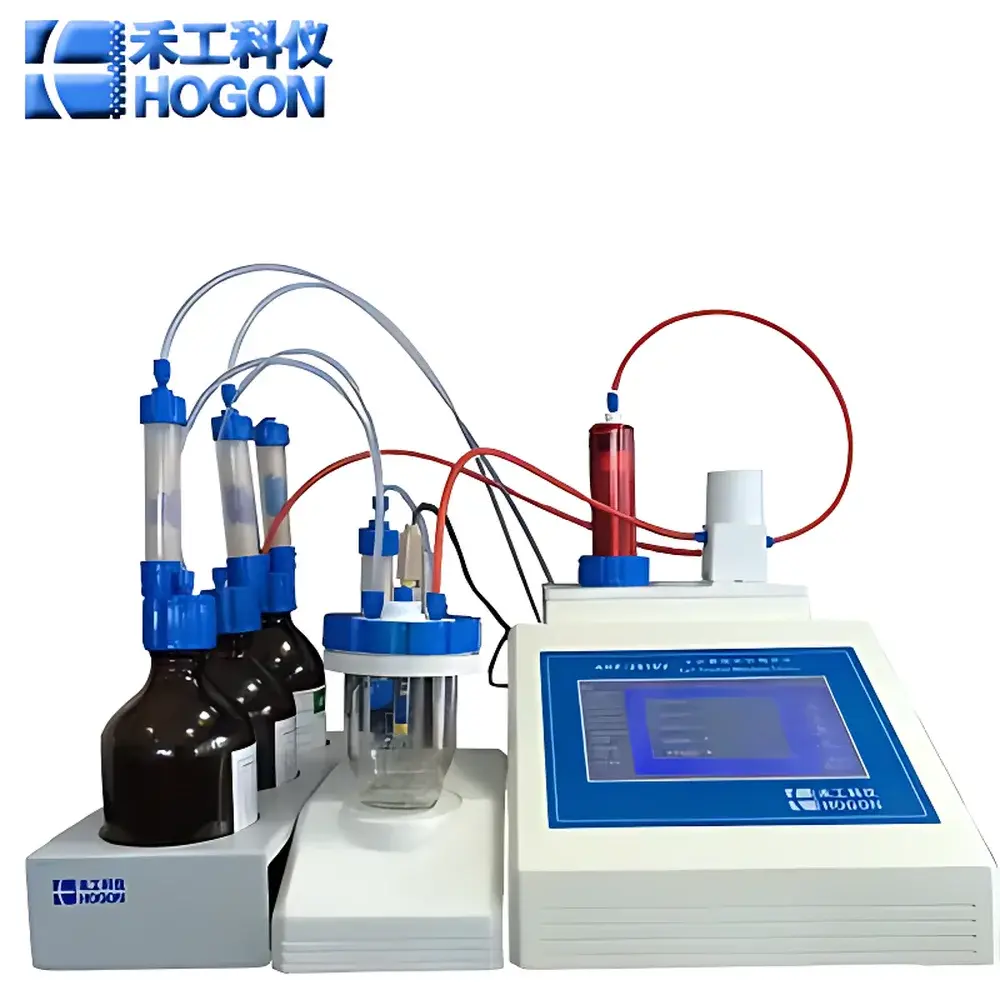
HOGON AKF-2010V High-Precision Automated Karl Fischer Coulometric & Volumetric Moisture Titrator
| Brand | HOGON |
|---|---|
| Origin | Shanghai, China |
| Manufacturer Type | Direct Manufacturer |
| Instrument Type | Volumetric Karl Fischer Moisture Titrator |
| Measurement Resolution | 0.1 µg |
| Moisture Content Range | 0.001–100% (extendable with specialized reagents and accessories) |
| Accuracy | ≤0.15% RSD (at 2 mL titrant consumption) |
| Minimum Dispensing Volume | 0.2 µL |
| Titration Control Precision | 0.2 µL (upgradable via precision burette exchange) |
| Polarization Current Range | ±150 µA |
| Electrode Potential Range | −2000 mV to +2000 mV |
| Valve & Tubing Material | FEP-coated 3-way dual-position solenoid valves with UV resistance and zero-dead-volume design |
| Display | 7-inch capacitive touchscreen (bilingual: English/Chinese) |
| Data Storage | >200 method files, >200 analysis records |
| Interface Options | RS-232C, USB, Ethernet, Web API |
| Environmental Operating Conditions | 5–40 °C, ≤80% RH |
| Dimensions (L×W×H) | 360 × 250 × 320 mm |
| Net Weight | 7.5 kg |
Overview
The HOGON AKF-2010V is an advanced, fully automated volumetric Karl Fischer (KF) moisture titrator engineered for high-reproducibility quantitative water determination in solid, liquid, and gaseous samples. It operates on the classical iodometric redox principle defined by Karl Fischer chemistry—where iodine reacts stoichiometrically with water in the presence of sulfur dioxide, a base (e.g., imidazole), and a solvent (typically methanol or chloroform-based KF reagents). The AKF-2010V implements a dual-mode endpoint detection system: dynamic polarization current monitoring (±150 µA range) combined with real-time electrode potential tracking (−2000 to +2000 mV), ensuring robust identification of the true titration endpoint even under variable sample matrix conditions. Designed for compliance-critical environments—including pharmaceutical QC labs, polymer R&D centers, and food safety testing facilities—the instrument features a hermetically sealed titration cell with zero-dead-volume FEP fluidic architecture, minimizing ambient moisture ingress and drift (<10 µg H₂O/hr typical baseline stability). Its modular hardware platform supports optional integration with KF-compatible heating ovens, headspace samplers, and Peltier-cooled reaction chambers for thermally sensitive or low-solubility matrices.
Key Features
- Hermetically sealed titration cell with proprietary FEP-lined 3-way solenoid valves, eliminating dead volume and enabling ultra-low drift performance
- Intelligent adaptive titration algorithm: automatically modulates titrant delivery rate (fast/slow/micro-dosing) without user intervention, optimizing speed and precision
- Real-time background drift compensation: continuously measures and subtracts environmental moisture contribution during analysis
- Self-diagnostic hardware protection: monitors motor load, valve actuation, electrode impedance, and reagent level; initiates safe shutdown upon anomaly detection
- High-precision dispensing system: 0.2 µL resolution per step (upgradable to sub-0.1 µL with calibrated burette modules)
- Bilingual 7-inch capacitive touchscreen interface with graphical titration curve overlay, live endpoint trace, and interactive parameter adjustment
- Comprehensive endpoint management: supports delayed titration, endpoint hold, endpoint stabilization delay, and auxiliary verification modes
- Integrated data integrity controls: timestamped audit trail, user-access logging, and electronic signature support aligned with FDA 21 CFR Part 11 readiness
Sample Compatibility & Compliance
The AKF-2010V accommodates diverse sample types—including hygroscopic solids (e.g., APIs, excipients), viscous liquids (e.g., resins, oils), volatile solvents, and gas-phase samples (via headspace injection). Its flexible reagent compatibility allows use with commercially available KF reagents from major suppliers (e.g., Honeywell, Merck, Sigma-Aldrich), eliminating vendor lock-in. The system complies with multiple international and national standards governing moisture analysis, including ISO 14897:2002 (polyols), ASTM D6304 (petroleum products), USP , EP 2.5.12, GB/T 6283-2008 (general chemical products), GB 5009.3-2010 (food), and GB/T 2441.3-2010 (urea). All firmware and software operations adhere to GLP/GMP documentation requirements, supporting full traceability of methods, raw curves, calculated results, and system events.
Software & Data Management
The embedded operating system provides native method creation, editing, and validation workflows. Each method stores complete configuration parameters—including solvent type, reagent titer, sample weight, drift correction settings, and endpoint criteria—alongside metadata (operator ID, date/time, instrument serial number). Analytical results are automatically calculated as mass % H₂O, absolute µg H₂O, reagent consumption (mL), and equivalent water concentration (mg/mL). Data export supports CSV, PDF, and XML formats via USB or Ethernet; optional PC-based desktop software enables centralized database archiving, statistical process control (SPC) charting, and multi-instrument fleet management. Web API access permits integration into LIMS environments and automated report generation pipelines.
Applications
The AKF-2010V serves as a primary moisture quantification tool across regulated and industrial laboratories. In pharmaceutical manufacturing, it validates water content in active pharmaceutical ingredients (APIs), lyophilized powders, and tablet coatings per ICH Q5C guidelines. Polymer producers rely on it for moisture specification testing of polyamide, polyurethane precursors, and silicone elastomers where residual water impacts curing kinetics and mechanical properties. Food and beverage labs apply it to dairy powders, edible oils, and flavor concentrates under Codex Alimentarius and FDA food labeling requirements. Petrochemical QA teams deploy it for trace moisture analysis in hydrocarbon streams (per ASTM D6304), while agrochemical formulators use it to verify water limits in wettable powders and suspension concentrates (per ISO 8792).
FAQ
Does the AKF-2010V support both coulometric and volumetric KF methods?
No—it is a dedicated volumetric titrator. Coulometric functionality requires a separate electrode cell configuration not present in this model.
Can the instrument be validated for GxP environments?
Yes. It supports IQ/OQ documentation templates, electronic audit trails, user role-based access control, and 21 CFR Part 11–compliant electronic signatures when paired with approved desktop software.
What maintenance intervals are recommended for long-term accuracy?
Daily: electrode cleaning and solvent replacement. Quarterly: valve inspection and calibration verification using certified water standards (e.g., 1.00 mg H₂O/g standard). Annually: full system performance qualification per ISO/IEC 17025.
Is remote monitoring or troubleshooting possible?
Yes—via built-in Ethernet port and web interface. Authorized technicians can initiate diagnostic routines, review real-time sensor logs, and push firmware updates remotely.
How does the system handle samples with interfering substances (e.g., aldehydes, ketones)?
It offers programmable pre-titration conditioning steps, solvent selection flexibility, and optional auxiliary reagents (e.g., imidazole-based stabilizers) to suppress side reactions—protocols align with ISO 760 and ASTM E203 recommendations.
Related Products




