
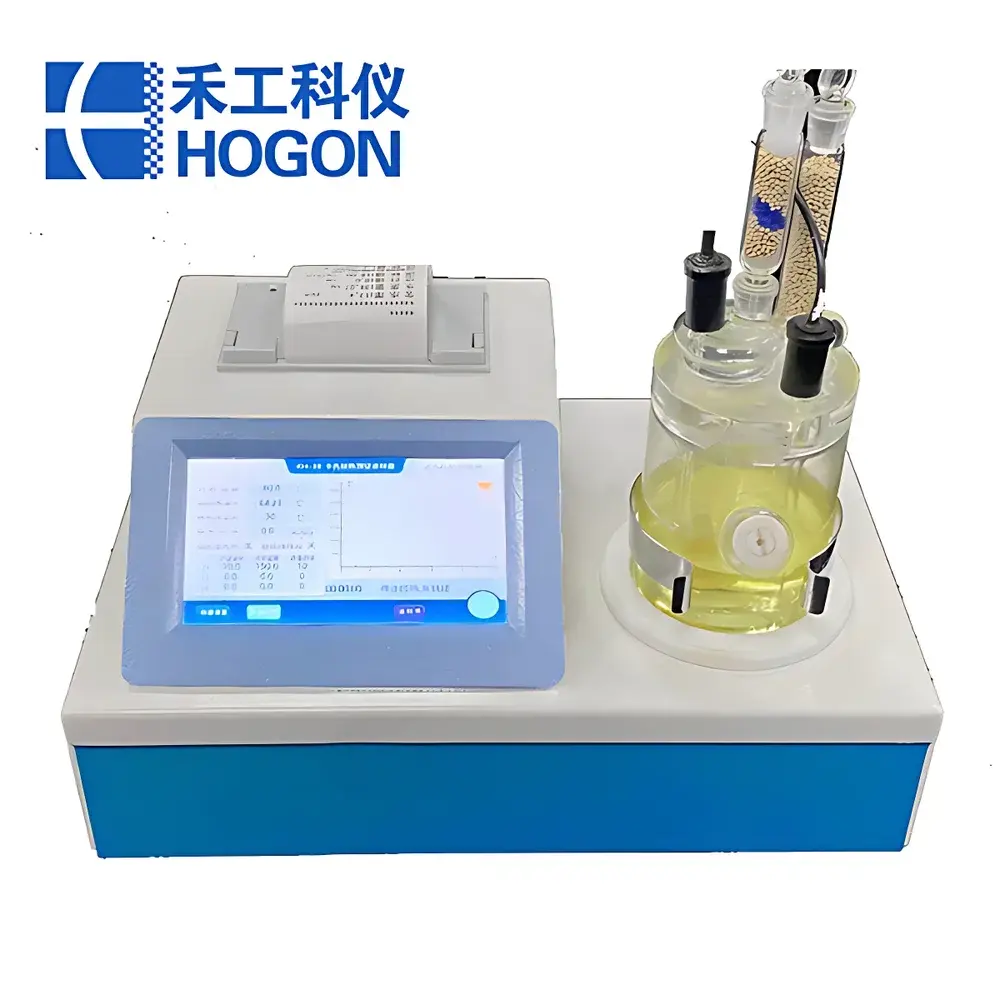
HOGON AKF-3B Bromine Number and Bromine Index Analyzer
| Brand | HOGON |
|---|---|
| Origin | Shanghai, China |
| Manufacturer Type | Direct Manufacturer |
| Regional Classification | Domestic (China) |
| Model | AKF-3B |
| Pricing | Upon Request |
| Measurement Principle | Coulometric Titration (Microcoulometry) |
| Sample Form | Liquid |
| Detection Method | Potentiometric Endpoint Detection |
| Display | Color LCD Touchscreen |
| Measurement Range | Bromine Number: 0–300 g Br/100g oil |
| Bromine Index | 1–1000 mg Br/100g oil |
| Resolution | 0.01 mg Br |
| Detection Limit | 0.1 mg Br |
| Accuracy | ±3% (for bromine index ≥1 mg Br/100g oil) |
| Electrolysis Control | Multi-stage adjustable |
| Endpoint Sensor | Dual Platinum Electrodes |
| Cell Volume | 200 mL |
| Stirring Mechanism | Magnetic Stirring |
| Power Supply | 220 V / 50 Hz |
| Dimensions (W×D×H) | 320 × 210 × 180 mm |
| Weight | ~3 kg |
| Communication Interface | RS232 |
| Compliance Standards | SH/T 0630–1996, SH/T 1551–2018, SH/T 1767–2008 (2015), GB/T 11136–1989 (2004), GB/T 1815–2019, ASTM D1492 |
Overview
The HOGON AKF-3B Bromine Number and Bromine Index Analyzer is a dedicated coulometric titration system engineered for precise quantification of unsaturation in hydrocarbon-based liquid samples. It operates on the fundamental principle of microcoulometric titration: electrochemical generation of bromine at the anode within a sealed titration cell, followed by stoichiometric reaction with carbon–carbon double bonds in the sample. The total charge consumed during electrolysis—measured in coulombs—is directly proportional to the mass of bromine reacted, enabling calculation of bromine number (g Br/100g sample) or bromine index (mg Br/100g sample) per ASTM D1492 and SH/T 0630–1996. Unlike classical volumetric bromination methods, this instrument eliminates reagent standardization, solvent handling variability, and endpoint subjectivity—delivering high reproducibility and traceable results under routine QC laboratory conditions.
Key Features
- Potentiometric endpoint detection using dual platinum electrodes ensures stable signal response and minimizes drift-induced false endpoints.
- Multi-stage electrolysis current control allows optimization of titration speed for low- and high-reactivity samples—improving resolution for trace-level unsaturation without compromising dynamic range.
- Integrated magnetic stirring provides uniform mixing and consistent mass transfer across the electrode surface, critical for accurate coulombic integration.
- Touch-enabled color LCD interface supports intuitive method setup, real-time current/voltage monitoring, and on-screen result validation—including automatic deviation alerts against reference standards.
- Compatible with low-toxicity, benzene-free electrolyte systems (e.g., LiBr in methanol/acetic acid mixtures), reducing occupational exposure risk and simplifying waste disposal compliance.
- Compact benchtop architecture (320 × 210 × 180 mm; ~3 kg) enables deployment in space-constrained QC labs or mobile testing units without sacrificing analytical robustness.
Sample Compatibility & Compliance
The AKF-3B is validated for use with refined petroleum fractions including gasoline, kerosene, diesel fuel, lubricating base oils, and aromatic streams such as BTX (benzene–toluene–xylene) and heavier alkylated benzenes. Its design conforms to multiple national and international test standards governing unsaturation analysis: SH/T 0630–1996 (Chinese standard for petroleum products), SH/T 1551–2018 (industrial aromatics), GB/T 1815–2019 (benzene derivatives), and ASTM D1492 (standard test method for bromine index of aromatic hydrocarbons by coulometric titration). Instrument performance meets GLP-relevant requirements for auditability—electrolysis charge data, endpoint timestamps, and calibration logs are timestamped and stored internally. RS232 output supports secure export to LIMS or ELN platforms compliant with FDA 21 CFR Part 11 when paired with validated software drivers.
Software & Data Management
While the AKF-3B operates autonomously via embedded firmware, its RS232 interface enables bidirectional communication with external PCs running validated data acquisition software. Raw coulombic integrals, endpoint detection events, and calculated bromine values are logged with ISO 8601 timestamps. Each analysis record includes operator ID (manually entered), sample ID, injection volume, ambient temperature (if monitored externally), and pass/fail status against user-defined tolerance bands. Audit trails capture all parameter modifications—ensuring full traceability for internal quality audits or regulatory inspections. Data files export in CSV format for statistical process control (SPC) integration or third-party validation packages.
Applications
- Quality control of refinery naphtha cuts to monitor olefin content prior to catalytic reforming.
- Verification of hydrogenation efficiency in styrene or butadiene production streams.
- Batch release testing of aviation turbine fuel per ASTM D1319 (hydrocarbon type analysis), where bromine index serves as a proxy for diene contamination.
- Stability assessment of transformer oils—elevated bromine index correlates with oxidation-induced unsaturation and polymerization precursors.
- Routine screening of feedstock aromatic purity in petrochemical plants, particularly for ethylbenzene and cumene synthesis units where residual alkenes poison catalysts.
FAQ
What distinguishes coulometric titration from potentiometric titration in bromine index analysis?
Coulometric titration generates titrant (Br₂) electrochemically in situ, eliminating volumetric errors associated with burette calibration, reagent degradation, or delivery inconsistency. Potentiometric titration relies on manual or motorized addition of pre-standardized bromine solution—introducing uncertainty in equivalence point localization and reagent stability management.
Can the AKF-3B analyze solid or viscous samples?
No. The system is designed exclusively for low-viscosity liquid samples (<50 cSt at 25 °C) that dissolve fully in the electrolyte matrix. Solid or high-boiling residues must be dissolved in compatible solvents (e.g., chloroform or xylene) prior to injection—and solubility must be verified to prevent electrode fouling or incomplete reaction.
How often does the titration cell require maintenance?
Under normal operation (≤10 samples/day), the 200 mL cell should be cleaned weekly with fresh electrolyte rinse and dried under inert gas. Platinum electrodes require periodic polishing with 0.3 µm alumina slurry if baseline noise exceeds 2 mV RMS over 30 s.
Is method validation support available for regulatory submissions?
Yes. HOGON provides IQ/OQ documentation templates aligned with ISO/IEC 17025 and ASTM E2500. Full validation protocols—including specificity, linearity (5–1000 mg Br/100g), repeatability (RSD ≤2.1% at 100 mg Br/100g), and intermediate precision—can be executed onsite by certified application engineers.





