
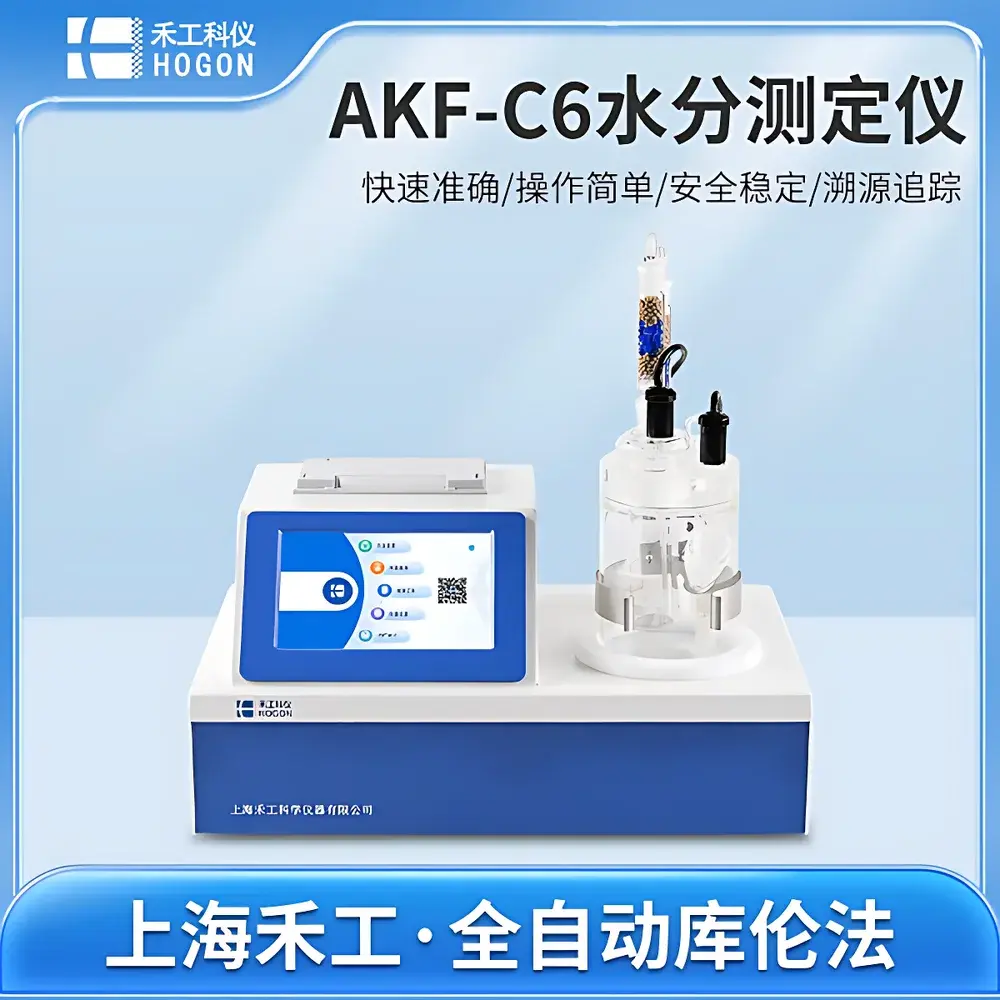
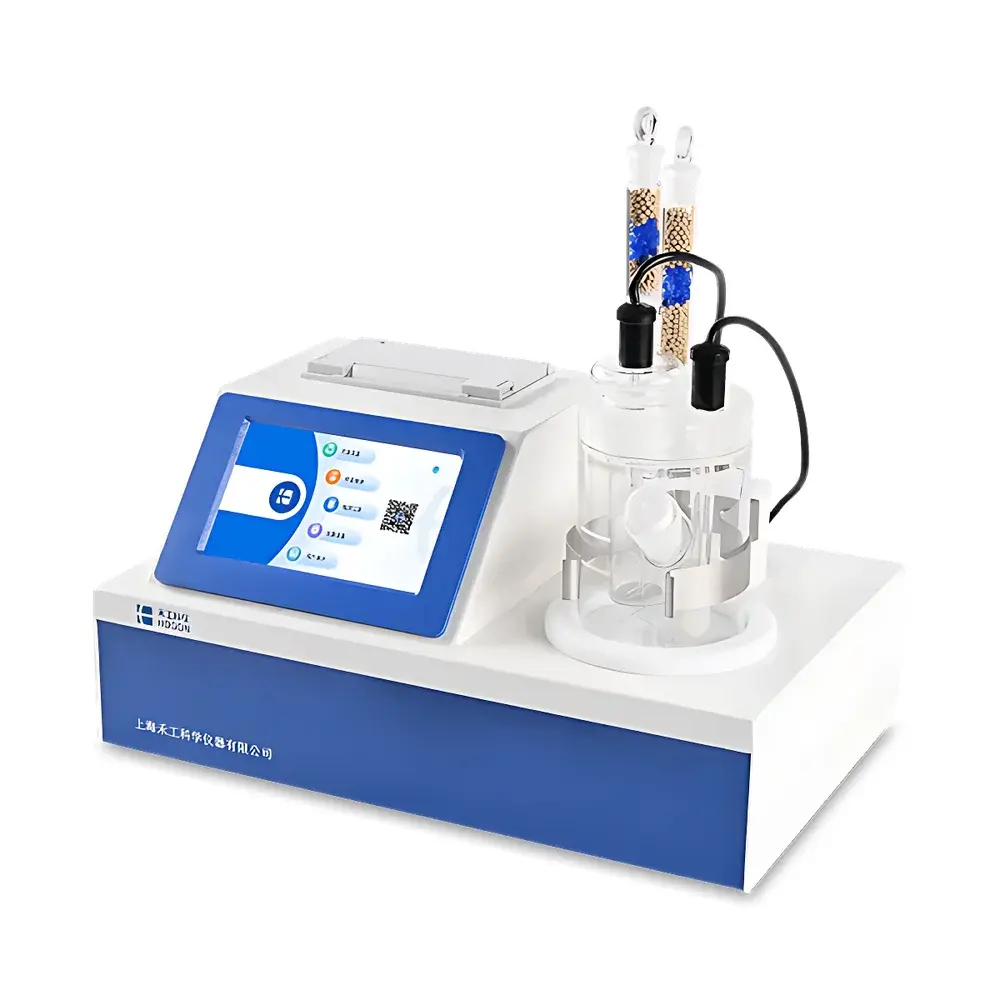
HOGON AKF-C6 Coulometric Karl Fischer Moisture Titrator
| Brand | HOGON |
|---|---|
| Origin | Shanghai, China |
| Manufacturer Type | Direct Manufacturer |
| Instrument Type | Coulometric Karl Fischer Moisture Analyzer |
| Model | AKF-C6 |
| Titration Mode | Fully Automatic Coulometric Titration |
| Measurement Resolution | 0.01 µg |
| Water Content Range | 0.001–100% w/w |
| Accuracy | >99.7% (at 1000 µg water) |
| Minimum Dispensing Volume | 1/2000 of burette volume |
| Repeatability | ±0.3% RSD (n=6, 1000 µg water) |
| Linearity Correlation Coefficient | ≥0.999 |
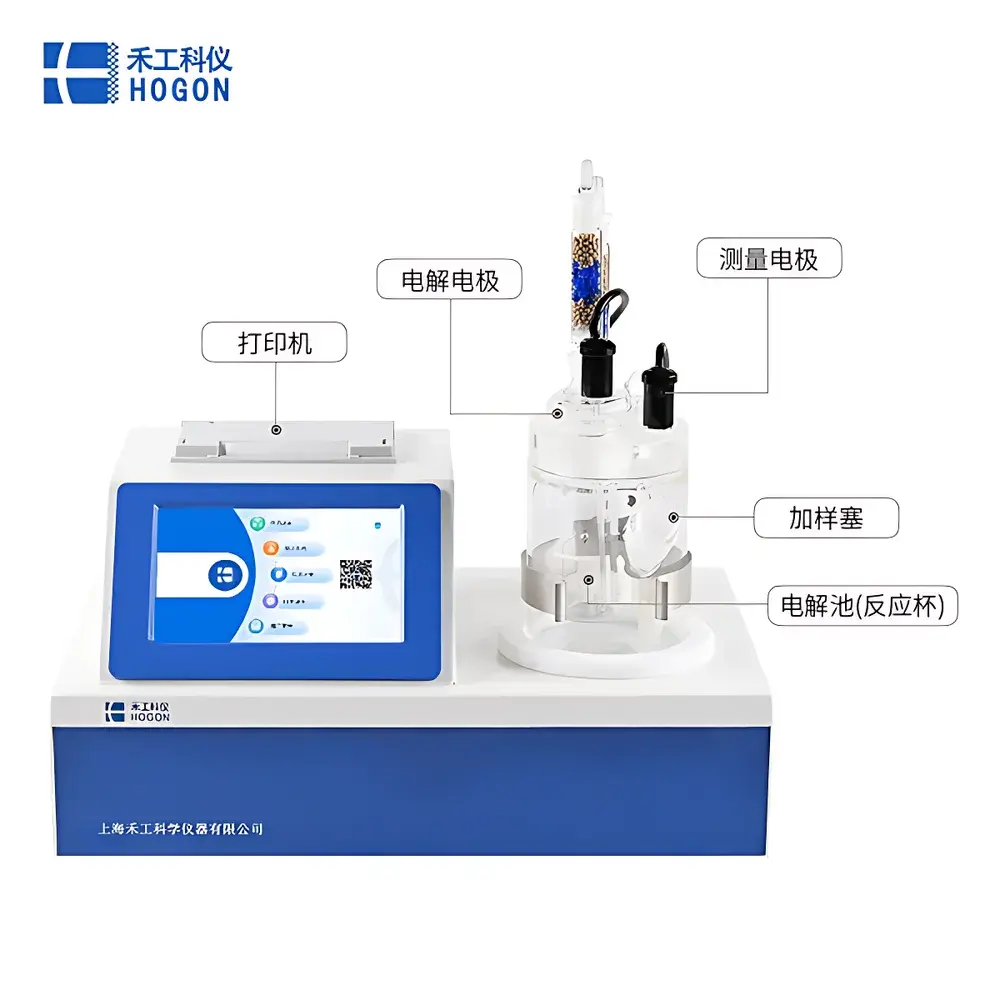
| Electrolysis Electrode | Dual-platinum generator electrode with integrated indicator electrode |
| Current Control Precision | ±0.1 mA |
| Power Supply | 110–240 V AC, 50–61 Hz |
| Data Storage Capacity | 200 test records |
Overview
The HOGON AKF-C6 is a fully automated coulometric Karl Fischer (KF) moisture titrator engineered for high-precision quantitative determination of trace water content in pharmaceuticals, fine chemicals, polymers, and inorganic materials. Based on the electrochemical generation of iodine via Faraday’s law—where water reacts stoichiometrically with iodine in the KF reagent—the AKF-C6 quantifies moisture by measuring the total charge (coulombs) required to regenerate iodine at the generator electrode. This coulometric principle eliminates volumetric reagent consumption variability and enables sub-microgram-level resolution (0.01 µg), making it suitable for samples with ultra-low water content (down to 0.001% w/w) as well as hygroscopic or high-moisture matrices up to 100% w/w. Designed in alignment with the 2020 edition of the Chinese Pharmacopoeia and international regulatory expectations, the AKF-C6 integrates hardware stability with software architecture compliant with GMP/GLP data integrity requirements.
Key Features
- Sub-microgram resolution: Real-time electrolytic current control (1–400 mA range, ±0.1 mA precision) ensures accurate charge integration and minimizes drift-induced error.
- Adaptive environmental compensation: Multiple preconfigured electrolysis current ranges and dynamic endpoint detection algorithms accommodate variable ambient humidity and diverse KF reagent formulations (e.g., methanol-based, chloroform-free, or low-toxicity alternatives).
- Multi-analyte capability: Native support for bromine index determination without hardware modification—leveraging identical electrochemical cell architecture and reagent compatibility.
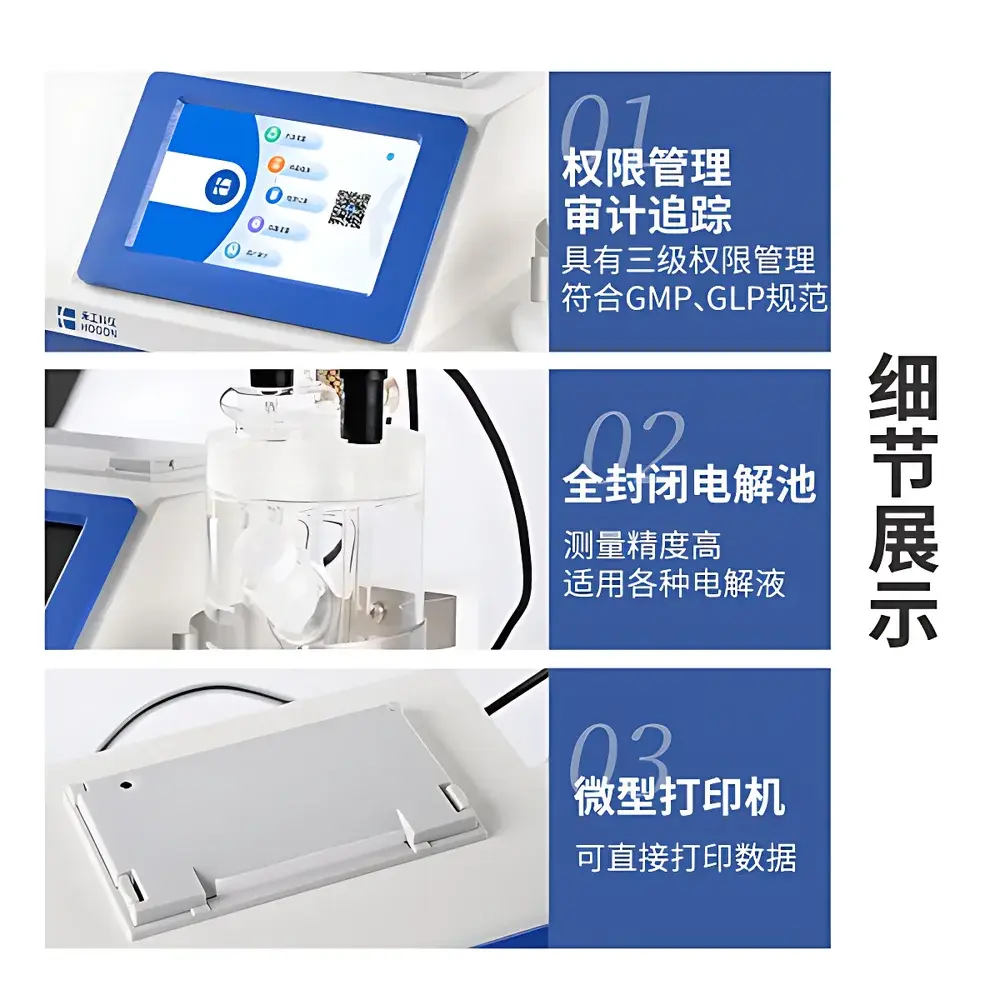
- Intuitive human-machine interface: 7-inch full-color capacitive touchscreen with numeric keypad, one-touch start, and context-sensitive soft keys; no specialized training required for routine operation.
- Comprehensive method flexibility: Up to 20 user-defined methods stored onboard—including dedicated protocols for solids, liquids, gases, and bromine index—each configurable for sample weight, titration current, drift correction, blank subtraction, and endpoint threshold.
- Integrated diagnostics: Real-time hardware health monitoring (electrode impedance, cell voltage, power supply stability), automatic fault logging, and programmable safety stops (e.g., timeout, over-current, open-circuit detection).
Sample Compatibility & Compliance
The AKF-C6 accommodates a broad spectrum of sample types—including viscous oils, powdered APIs, lyophilized biologics, metal oxides, and hydrophobic resins—via optional accessories such as heated titration stands, KF ovens (up to 300 °C), and multi-position headspace autosamplers. Its coulometric design avoids reagent calibration drift and delivers consistent performance across matrix complexity. From a regulatory standpoint, the instrument meets essential criteria for GMP-compliant environments: audit-trail-enabled software with immutable timestamped logs, role-based three-tier user access (Administrator / Supervisor / Analyst), electronic signature support, and full data export (CSV, PDF) with metadata retention. All operations comply with ALCOA+ principles and align with FDA 21 CFR Part 11 technical controls for electronic records and signatures.
Software & Data Management
The embedded firmware implements a validated, closed-loop data management system. Each analysis generates a complete digital record containing raw current/time curves, calculated water mass (µg), % w/w result, drift value (µg/min), blank correction, operator ID, timestamp, and method parameters. All entries are write-once, append-only, and cryptographically timestamped. Audit trails capture every login, parameter change, result modification, or report export—with no ability to delete or overwrite historical entries. Data can be exported via USB or network interface in formats compatible with LIMS integration. Software validation documentation (IQ/OQ/PQ templates) and electronic signature configuration guides are provided to support laboratory qualification processes under ISO/IEC 17025 and ICH Q7 frameworks.
Applications
- Pharmaceutical QC: Residual moisture testing of active pharmaceutical ingredients (APIs), excipients, and final dosage forms per USP , EP 2.5.12, and JP 2.05.
- Electronics materials: Quantification of trace water in lithium battery electrolytes, silicon wafers, and encapsulation resins where ppm-level moisture compromises device reliability.
- Polymer & coating industry: Monitoring hydrolytic degradation risk in polyesters, polyamides, and epoxy prepolymers during synthesis and storage.
- Fuel & lubricant analysis: Bromine index measurement in hydrocarbon streams using the same KF cell—eliminating cross-contamination and equipment duplication.
- Academic & contract research: Method development for challenging matrices (e.g., cellulose derivatives, metal-organic frameworks, or carbon black) supported by customizable drift compensation and multi-point blank management.
FAQ
What distinguishes coulometric from volumetric Karl Fischer titration?
Coulometric KF generates iodine electrochemically within the titration cell, enabling direct quantification via Faraday’s law. It offers superior precision for samples containing ≤1000 µg water, whereas volumetric KF relies on standardized iodine-containing reagent delivery and is preferred for higher water concentrations.
Does the AKF-C6 support 21 CFR Part 11 compliance out of the box?
Yes—the system includes built-in electronic signature workflows, audit-trail logging, and user-role enforcement. Full Part 11 readiness requires site-specific configuration (e.g., password policy, signature justification prompts) and documented validation per internal SOPs.
Can the instrument be integrated into a laboratory network for centralized data collection?
Yes—via Ethernet or USB host mode, the AKF-C6 supports scheduled data exports and LIMS-compatible CSV output with embedded metadata (sample ID, method name, operator, timestamp, result uncertainty).
Is method validation support available for pharmacopeial applications?
HOGON provides IQ/OQ documentation templates, system suitability test protocols aligned with USP , and guidance on establishing detection limit (LOD), quantitation limit (LOQ), and robustness per ICH Q2(R2).
What maintenance is required for long-term electrolytic cell stability?
Routine maintenance includes periodic cleaning of the dual-platinum electrodes with ethanol, verification of cell seal integrity, and replacement of molecular sieve desiccant in the reagent bottle drying tube every 3–6 months depending on usage frequency and ambient humidity.






