
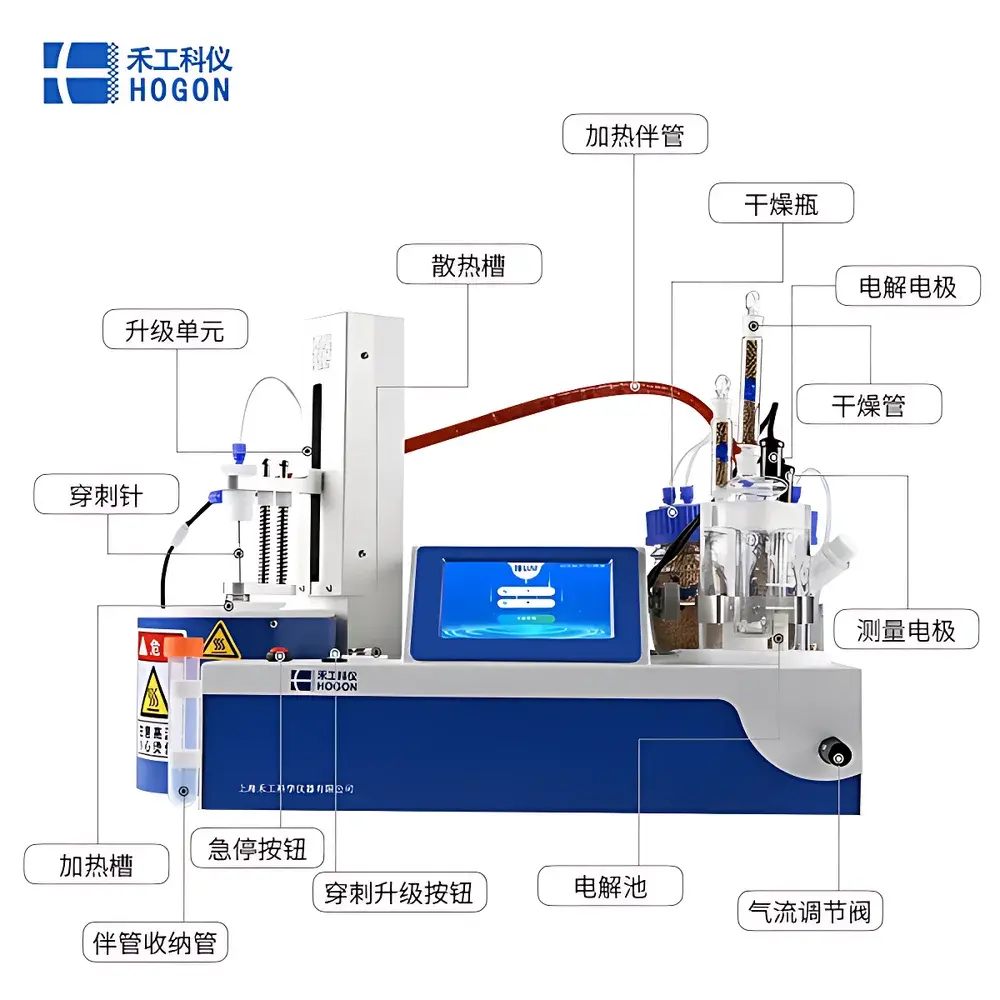
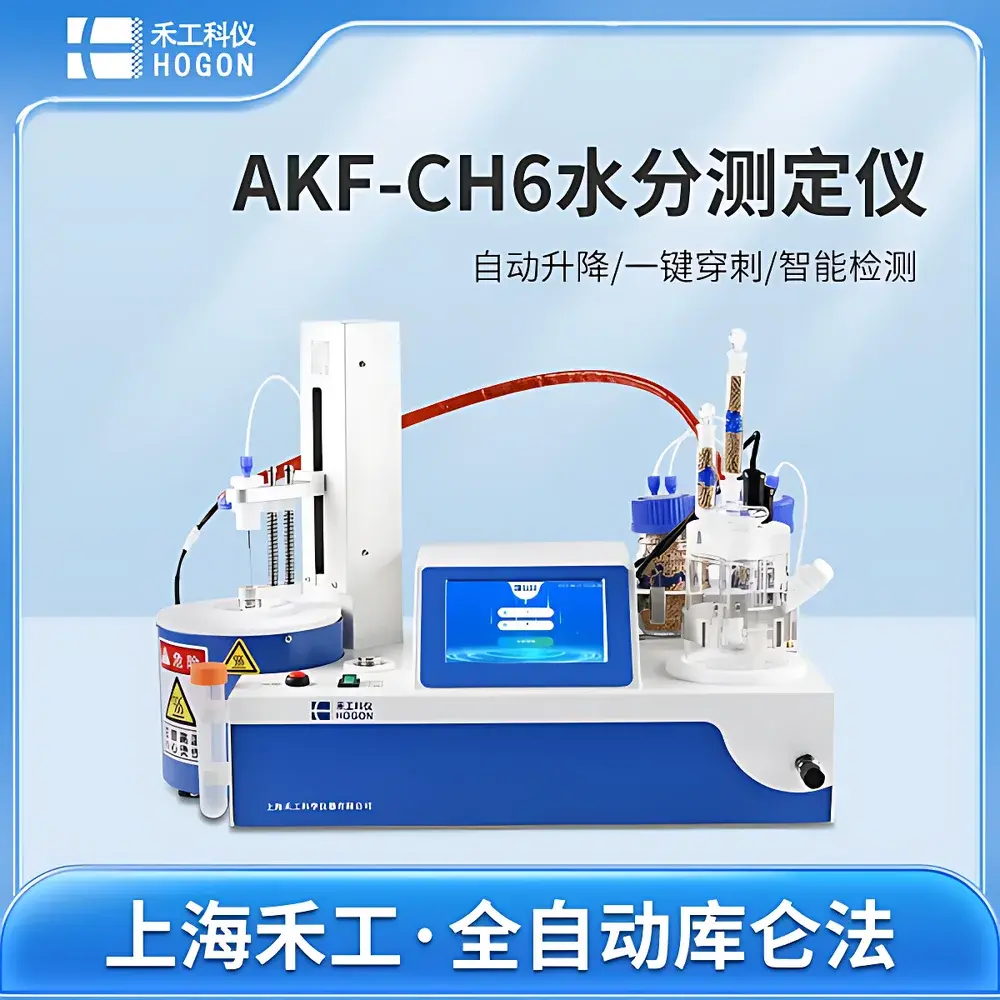
HOGON AKF-CH6 Dedicated Karl Fischer Coulometric Moisture Analyzer for In Vitro Diagnostic Reagents
| Brand | HOGON |
|---|---|
| Origin | Shanghai, China |
| Manufacturer Type | Direct Manufacturer |
| Instrument Type | Combined Coulometric Karl Fischer Moisture Analyzer with Integrated Sample Evaporator |
| Water Content Range | 3 µg – 199 mg H₂O (0.01 µg resolution) |
| Measurement Accuracy | ≥99.7% at 1000 µg H₂O |
| Repeatability | RSD ≤0.3% |
| Linearity Correlation Coefficient | ≥0.999 |
| Polarization Voltage Adjustment Range | ±10% |
| Titration Control Precision | 0.01 µg H₂O |
| Electrode Type | Dual-platinum electrolysis electrode |
| Power Supply | 110–240 V AC, 50–62 Hz |
| Data Storage | Internal non-volatile memory with timestamped audit trail |
| Sample Introduction | Heated headspace evaporation with dry carrier gas (N₂ or air), dual-mode sampling (puncture-seal + screw-cap vial handling) |
Overview
The HOGON AKF-CH6 is a purpose-built coulometric Karl Fischer moisture analyzer engineered specifically for the stringent analytical requirements of in vitro diagnostic (IVD) reagent manufacturing and pharmaceutical quality control laboratories. Unlike conventional standalone coulometers or hybrid volumetric-coulometric systems, the AKF-CH6 integrates a precision-controlled sample evaporator directly into the instrument architecture—eliminating external heating ovens, complex gas routing, and inter-unit calibration drift. Its measurement principle relies on the stoichiometric electrochemical generation of iodine via controlled electrolysis of Karl Fischer reagent (I⁻ → ½I₂ + e⁻), where the amount of charge passed (Coulombs) is directly proportional to the mass of water consumed in the reaction: I₂ + SO₂ + 2H₂O → 2HI + H₂SO₄. This fundamental Faradaic relationship enables absolute quantification without reagent standardization, delivering trace-level sensitivity (detection limit: 3 µg H₂O) and metrological traceability aligned with ISO 8573-3, USP , and EP 2.5.12.
Key Features
- Integrated heated headspace evaporator with programmable temperature ramping (ambient to 250 °C), PID-controlled thermal stability (±0.5 °C), and intelligent overtemperature cut-off
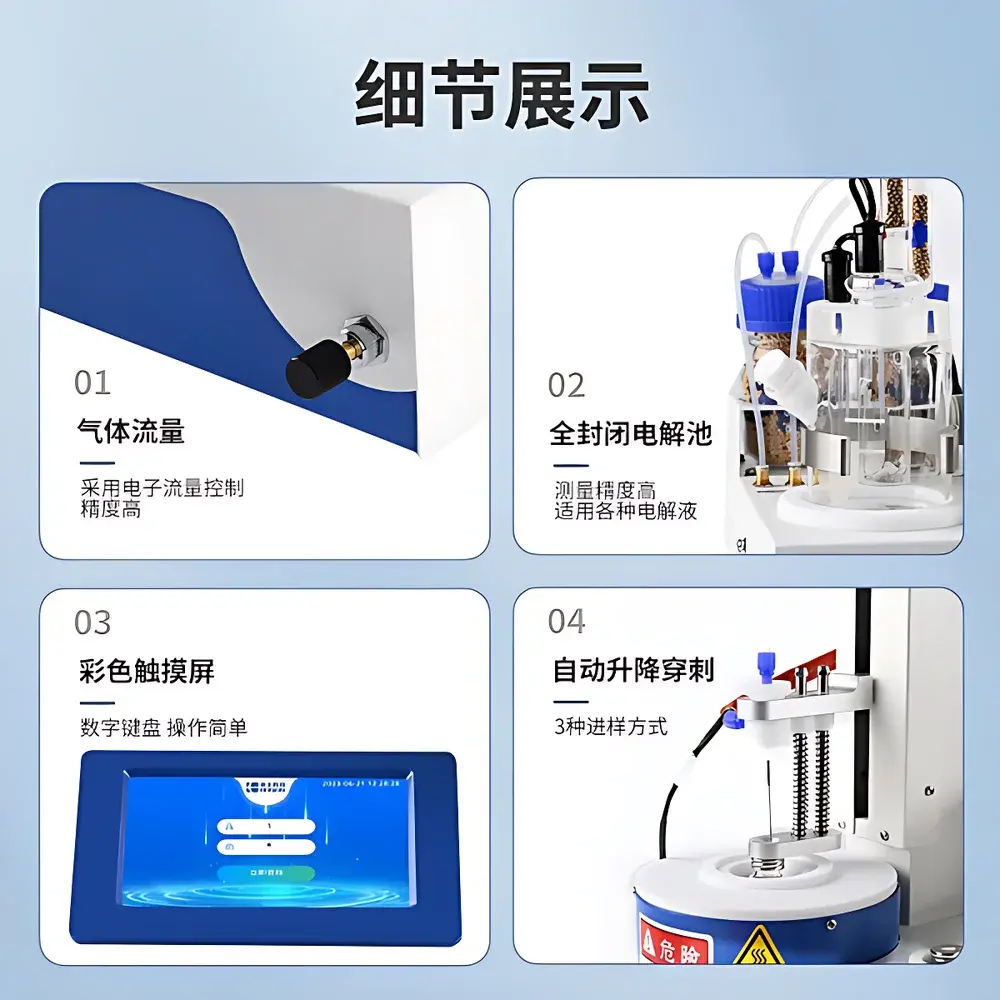
- Dual-mode sample introduction: automated needle-puncture of crimp-top vials and torque-controlled screw-cap sealing for volatile or oxygen-sensitive IVD reagents
- HOGON Smart Detection Technology: real-time drift compensation, adaptive baseline stabilization, and environmental humidity/temperature drift correction
- Electronically regulated carrier gas flow display (0–500 mL/min) with insulated heated transfer line (up to 120 °C) to prevent condensation loss
- High-resolution coulometric titration cell with dual-platinum working electrodes and optimized electrode geometry for rapid current response and minimal polarization error
- Full-color capacitive touchscreen interface with numeric keypad, one-touch method launch, and GLP-compliant user authentication (role-based access control)
- Onboard method library supporting up to 99 customizable protocols—including gradient heating profiles, multi-step titration sequences, and dynamic endpoint detection algorithms
Sample Compatibility & Compliance
The AKF-CH6 accommodates diverse physical forms critical to IVD and biopharmaceutical workflows: aqueous buffers, lyophilized proteins (e.g., retinol-binding protein, fibronectin), contrast agents (gadobutrol), small-molecule APIs (etifoxine), serum matrices, hydrogel precursors (PLA, PVA), and excipients (lactose, povidone K30). It meets regulatory expectations for data integrity under FDA 21 CFR Part 11 (electronic signatures, audit trail with immutable timestamps), EU Annex 11 (data validation, system access controls), and ISO/IEC 17025:2017 (method validation documentation support). All firmware operations generate ALCOA+ compliant records—including raw current-time curves, integrated charge values, temperature logs, and operator metadata—ensuring full traceability during GMP audits.
Software & Data Management
The embedded HOGON MoistureSuite™ software provides validated instrument control, real-time visualization of moisture evolution curves, and automated calculation of water content (µg/g, % w/w, ppm). Data export supports CSV, PDF, and XML formats compatible with LIMS integration. Audit trails record every parameter change, method execution, user login/logout, and hardware event (e.g., electrode cleaning cycle, gas flow deviation). Password-protected administrator mode enables calibration certificate management, electronic signature configuration, and secure firmware updates—all verified via SHA-256 hash integrity checks.
Applications
The AKF-CH6 is routinely deployed across regulated environments for: residual moisture analysis in freeze-dried IVD calibrators and controls; water content verification of solvent-based reagent formulations (acetonitrile, chloroform, glacial acetic acid); stability-indicating testing of hygroscopic excipients (magnesium chloride hexahydrate, starch); QC release testing of surgical suture materials (polyglycolic acid, polyglactin 910); and moisture mapping of ophthalmic solutions (diquafosol sodium eye drops). Its linear dynamic range (1 ppm to 100% w/w) eliminates the need for dilution or method switching—reducing analyst variability and cross-contamination risk in high-throughput labs.
FAQ
Does the AKF-CH6 comply with pharmacopeial requirements for coulometric moisture determination?
Yes—it fully satisfies USP “Water Determination”, EP 2.5.12 “Loss on Drying and Water Determination”, and JP 2.05 “Water Content” when operated using validated methods and certified reagents.
Can the instrument be used inside an inert-atmosphere glovebox?
Yes—the compact footprint (W320 × D380 × H420 mm) and internal evaporator eliminate external gas manifolds, making it suitable for nitrogen- or argon-purged enclosures without modification.
Is method transfer possible from legacy HOGON or Metrohm coulometers?
Method parameters (temperature ramps, gas flow rates, endpoint thresholds) are exportable as .csv templates and can be imported with minor recalibration for electrode conditioning.
What maintenance intervals are recommended for routine operation?
Daily: electrode cleaning with methanol; weekly: drying tube replacement and seal inspection; quarterly: full system performance qualification per IQ/OQ protocol included in the delivery package.



