
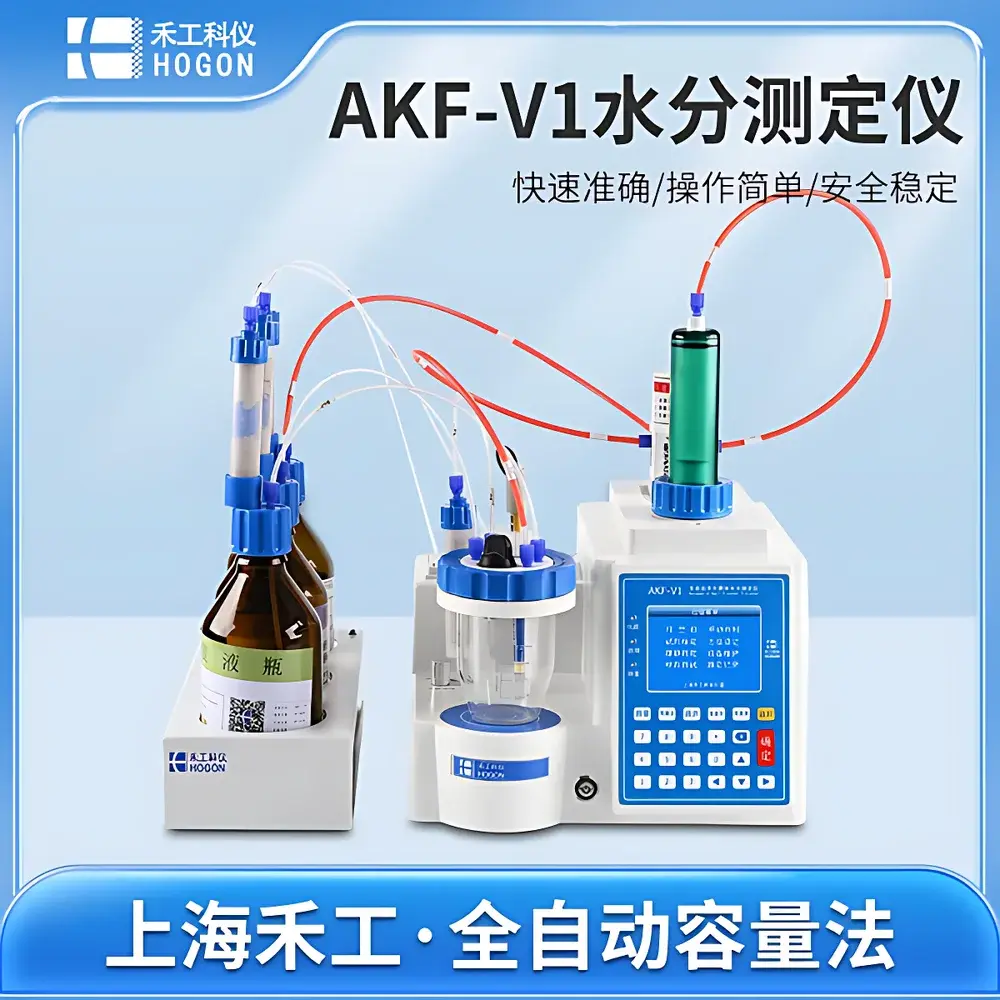
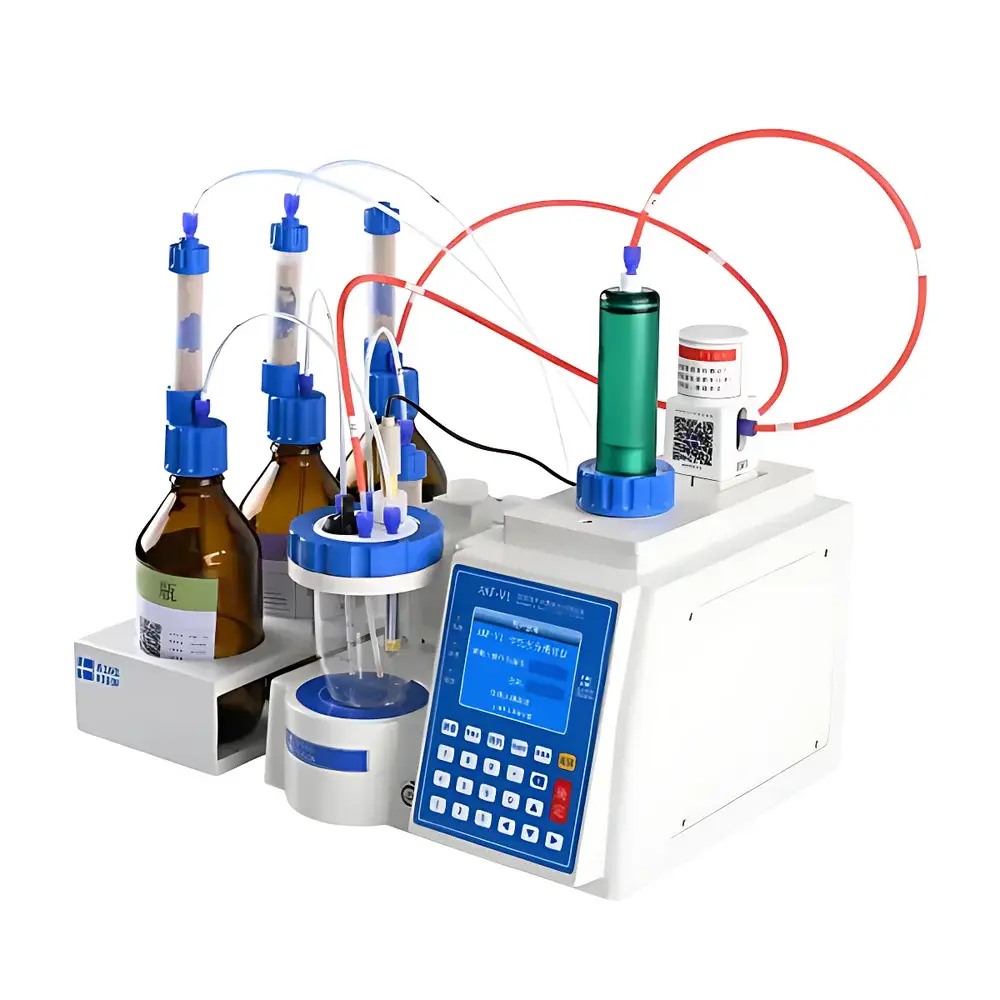
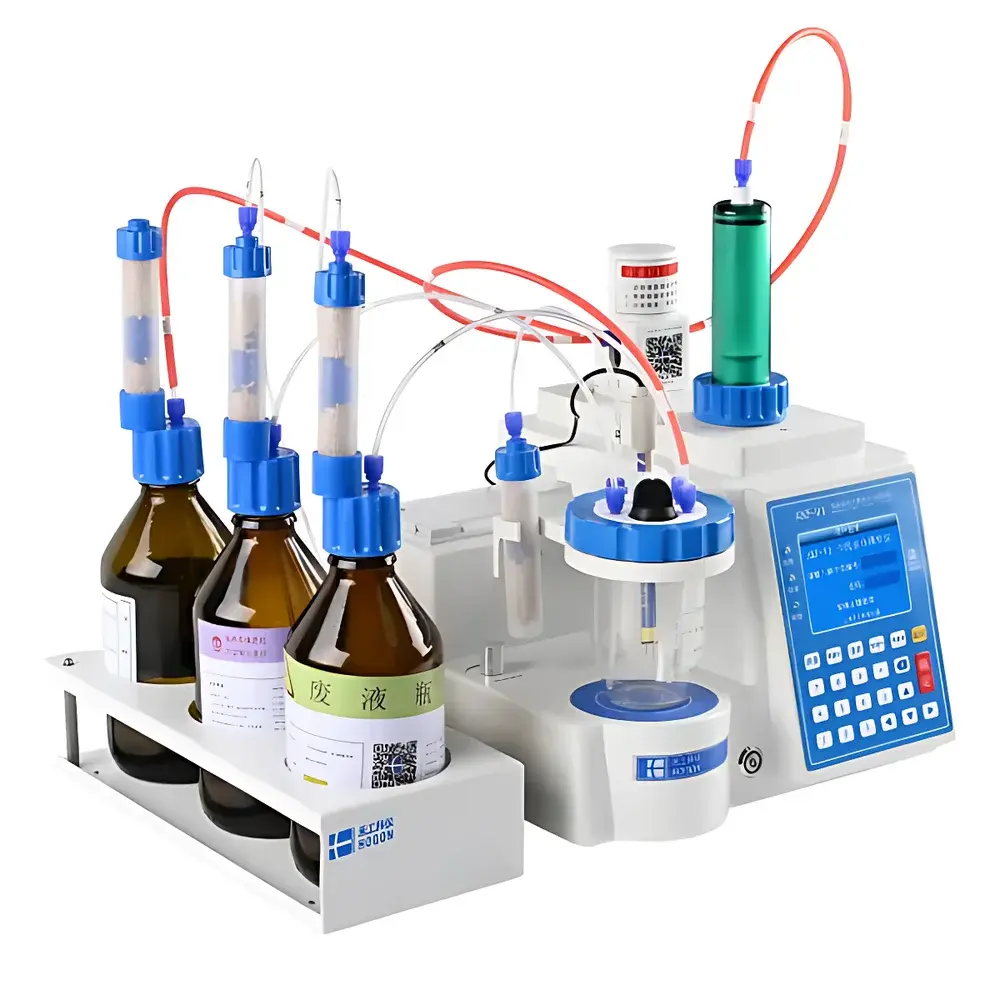
HOGON AKF-V1 Karl Fischer Moisture Analyzer for Polyethylene Glycol (PEG) in Chemical Industry
| Brand | HOGON |
|---|---|
| Origin | Shanghai, China |
| Manufacturer Type | Direct Manufacturer |
| Instrument Type | Volumetric Karl Fischer Titrator |
| Moisture Range | 0.001–100.00% (10 ppm – 100% w/w) |
| Resolution | 1 ppm |
| Endpoint Detection Precision | ±1 mV |
| Minimum Dispensing Volume | 1 µL |
| Repeatability | RSD ≤ 0.5% (at 20 mg H₂O) |
| Linearity of Titration Response | ≥ 0.998 |
| Polarization Voltage Adjustment Range | 0–120 mV |
| Burette | 20 mL Long-Life Automatic Burette |
| Burette Accuracy | ±0.001 mL |
| Power Supply | 110–240 V AC, 50–60 Hz |
| Data Storage Capacity | 100 test records |
Overview
The HOGON AKF-V1 Karl Fischer Moisture Analyzer is a volumetric titration-based instrument engineered for precise and trace-level water quantification in hygroscopic, high-molecular-weight polymer matrices—particularly polyethylene glycol (PEG) used extensively in chemical synthesis, pharmaceutical excipient manufacturing, and cosmetic formulation. It operates on the classical coulometric-irrelevant but stoichiometrically rigorous volumetric Karl Fischer (KF) principle: iodine generated *in situ* via reaction with sulfur dioxide and base in anhydrous methanol reacts quantitatively with water (1 mol I₂ ≡ 1 mol H₂O). The endpoint is detected potentiometrically using dual-platinum electrodes, monitoring the abrupt shift in polarization current upon completion of the redox reaction. Unlike coulometric systems, the AKF-V1 employs a pre-standardized KF reagent (titer ≈ 3.366 mg/mL), enabling robust, reproducible analysis across viscous, non-volatile, and low-solubility samples like PEG 400 to PEG 20,000 without derivatization or thermal drying artifacts.
Key Features
- Volumetric precision architecture: Equipped with a 20 mL high-accuracy automatic burette delivering ±0.001 mL dispensing resolution—critical for maintaining stoichiometric fidelity when analyzing low-water-content PEG batches (e.g., <0.5% w/w).
- Dual-platinum end-point detection: Real-time amperometric monitoring with adjustable polarization voltage (0–120 mV) ensures reliable endpoint discrimination in heterogeneous or slow-reacting polymer solutions.
- Hermetically sealed titration cell: Fully enclosed dry-gas purged (optional N₂) measurement chamber eliminates ambient moisture ingress—essential for sub-100 ppm determinations under standard lab humidity (40–65% RH).
- Intelligent drift compensation: Software-enabled dynamic background drift subtraction corrects for gradual reagent hydrolysis or solvent evaporation during extended titrations—improving accuracy for high-viscosity PEG melts requiring prolonged mixing.
- Optimized mechanical agitation: Motor-driven magnetic stirrer with variable speed control ensures homogeneous dispersion of solid or semi-solid PEG samples in anhydrous methanol, accelerating dissolution and reaction kinetics without foaming or splashing.
- Regulatory-ready operation: Supports audit-trail enabled method storage, user access levels, and timestamped result logging—aligned with GLP, ISO/IEC 17025, and FDA 21 CFR Part 11 data integrity expectations for QC laboratories.
Sample Compatibility & Compliance
The AKF-V1 is validated for direct analysis of solid, liquid, and paste-like PEG grades (PEG 200 to PEG 20,000), including pharmaceutical-grade USP/EP-compliant materials and industrial polymer intermediates. Its solvent compatibility extends to anhydrous methanol (primary), chloroform–methanol blends, and imidazole-containing media for enhanced solubilization of high-MW PEGs. All wetted components—including burette piston, septum, and electrode housings—are chemically inert (PTFE, glass, platinum) to prevent catalytic degradation or adsorption artifacts. The system complies with ASTM D6304 (Standard Test Method for Determination of Water in Petroleum Products, Bituminous Materials, and Non-Viscous Petroleum-Based Lubricants by Coulometric and Volumetric Karl Fischer Titration) and ISO 760 (Determination of Water—General Principles of Karl Fischer Titration). Method validation per ICH Q2(R2) is supported through built-in repeatability assessment (RSD ≤ 0.5% at 20 mg H₂O) and linearity verification (r² ≥ 0.998 over full range).
Software & Data Management
Built-in embedded firmware provides intuitive touchscreen navigation with dedicated workflows for blank titration (“Solvent Purge”), reagent standardization (“Water Standardization”), and sample analysis (“Sample Measurement”). Up to 100 complete test records—including raw titration curves, endpoint voltages, drift values, titer history, and calculated moisture %—are stored locally with UTC timestamps and operator IDs. Export is supported via USB to CSV format for LIMS integration. The software enforces method locking, electronic signatures, and change logs—fulfilling ALCOA+ principles (Attributable, Legible, Contemporaneous, Original, Accurate) required in GMP-regulated environments. Optional PC-based HOGON LabLink software enables remote calibration tracking, multi-instrument fleet management, and automated PDF report generation compliant with 21 CFR Part 11 Annex 11 requirements.
Applications
- Quality control of PEG raw materials per USP and Ph. Eur. 2.5.12 specifications
- Stability-indicating assay of PEGylated biopharmaceutical intermediates
- In-process moisture monitoring during PEG melt extrusion or spray congealing
- Verification of desiccant efficacy in PEG-based ointment bases and transdermal patches
- Batch release testing of PEG surfactants (e.g., polysorbates) where residual water impacts hydrolytic stability
- Supporting ISO 8573-3 compressed air purity validation when PEG-coated sensors are employed
FAQ
Is the AKF-V1 suitable for measuring water in high-viscosity PEG 10,000 or PEG 20,000?
Yes—the combination of programmable stirring intensity, extended endpoint delay (up to 120 s), and optimized methanol:chloroform solvent ratios ensures complete dissolution and reaction completion within the 30-minute maximum titration time limit.
Can the instrument be calibrated using certified water standards traceable to NIST?
Absolutely—standardization is performed using gravimetrically dispensed pure water (e.g., 10 µL via dried syringe), and the system accepts user-defined titer values from CRM-certified standards (e.g., Merck Hydranal® Water Standard 1.00 mg/mL).
Does the AKF-V1 support compliance with pharmaceutical data integrity regulations?
Yes—audit trail, electronic signature, method version control, and exportable raw data meet core requirements of FDA 21 CFR Part 11, EU Annex 11, and PIC/S PI 041-1 for analytical instrumentation in regulated QC labs.
What maintenance is required for long-term reliability of the 20 mL burette?
The burette uses chemically resistant ceramic piston seals and requires only quarterly cleaning with anhydrous methanol; no recalibration is needed between standardizations due to its factory-traceable volumetric accuracy.
How does the system handle drifting baselines caused by aging KF reagent?
The integrated drift compensation algorithm continuously monitors and subtracts baseline current drift in real time—ensuring stable endpoint detection even after >500 titrations with the same reagent batch.




