
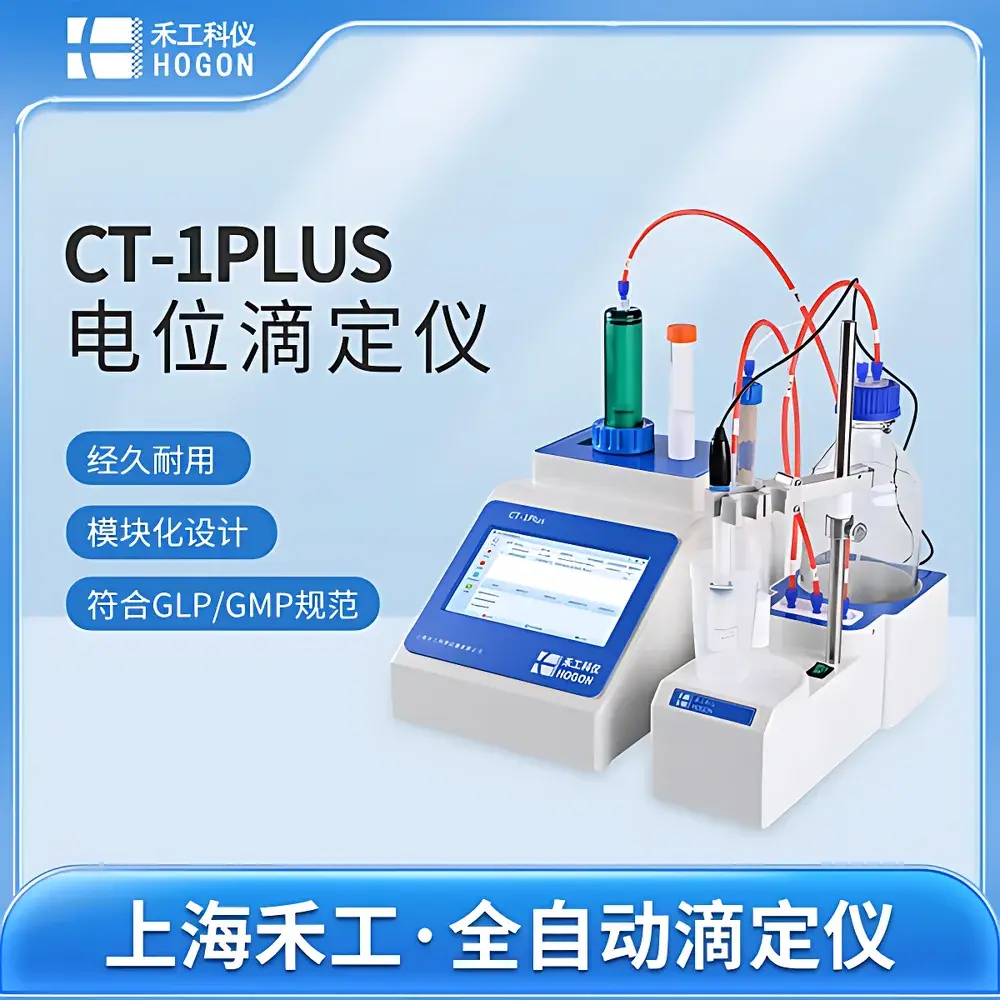
HOGON CT-1Plus Automatic Potentiometric Titrator for Acid Number Determination in Lubricating Oils
| Brand | HOGON |
|---|---|
| Origin | Shanghai, China |
| Manufacturer | HOGON Scientific Instrument Co., Ltd. |
| Type | General-purpose automatic potentiometric titrator |
| Application Scope | Universal |
| pH Measurement Range | 1–14 |
| Potential Resolution | 0.1 mV |
| Potential Display Range | ±2000 mV |
| Potential Accuracy | ±0.2 mV |
| Burette Precision (standard 20 mL) | 0.001 mL |
| Burette Resolution (optional 10 mL) | 0.0005 mL |
Overview
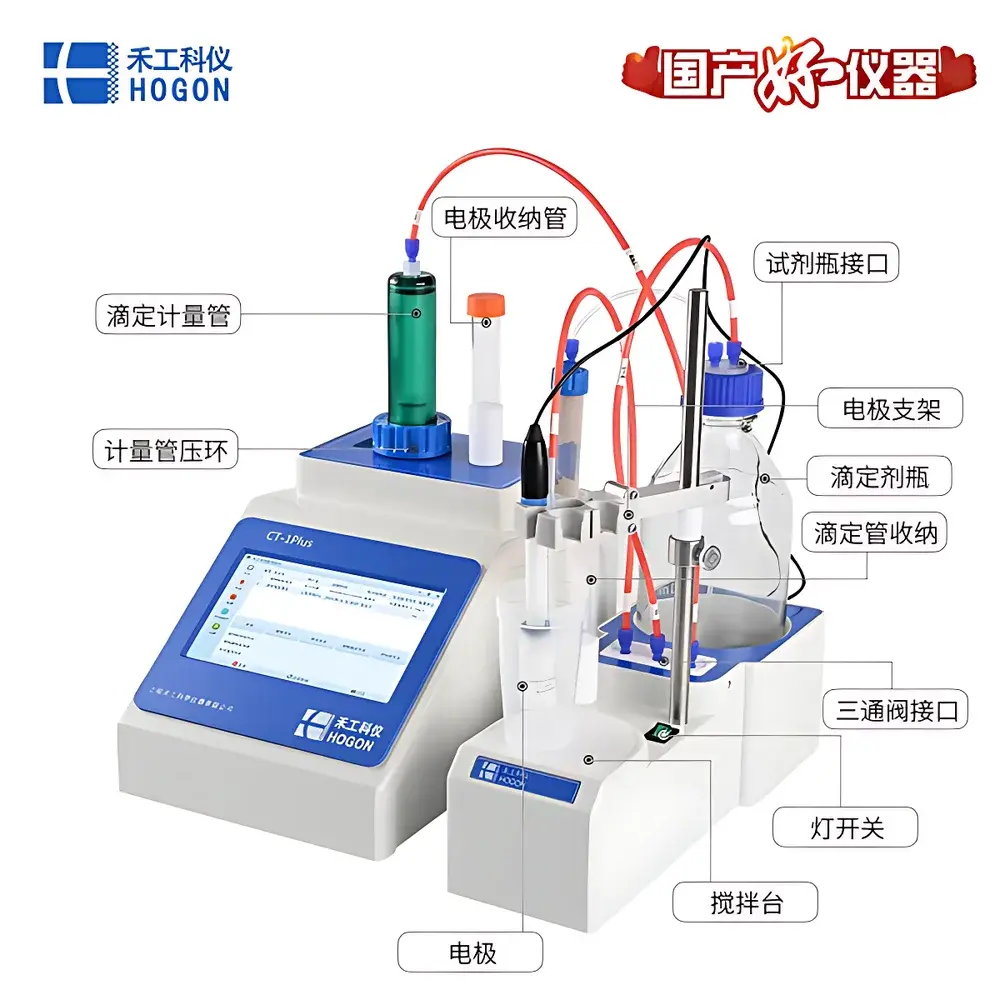
The HOGON CT-1Plus is a dedicated automatic potentiometric titrator engineered for precise and reproducible acid number (AN) determination in lubricating oils and petroleum products per standardized methods including ASTM D664, ISO 6618, and GB/T 7304. It operates on the fundamental principle of potentiometric endpoint detection—measuring the inflection point in electrode potential (mV) during titration with alcoholic potassium hydroxide (KOH), thereby eliminating subjectivity associated with visual colorimetric endpoints. The system integrates a high-stability non-aqueous composite pH electrode (model pH-105), a precision 20 mL glass burette with <1 µL per step delivery capability, and a temperature-compensated titration cell—enabling robust performance under variable ambient conditions. Designed for routine QC laboratories in oil refineries, additive manufacturers, and third-party testing facilities, the CT-1Plus delivers traceable, auditable results compliant with GLP and GMP requirements.
Key Features
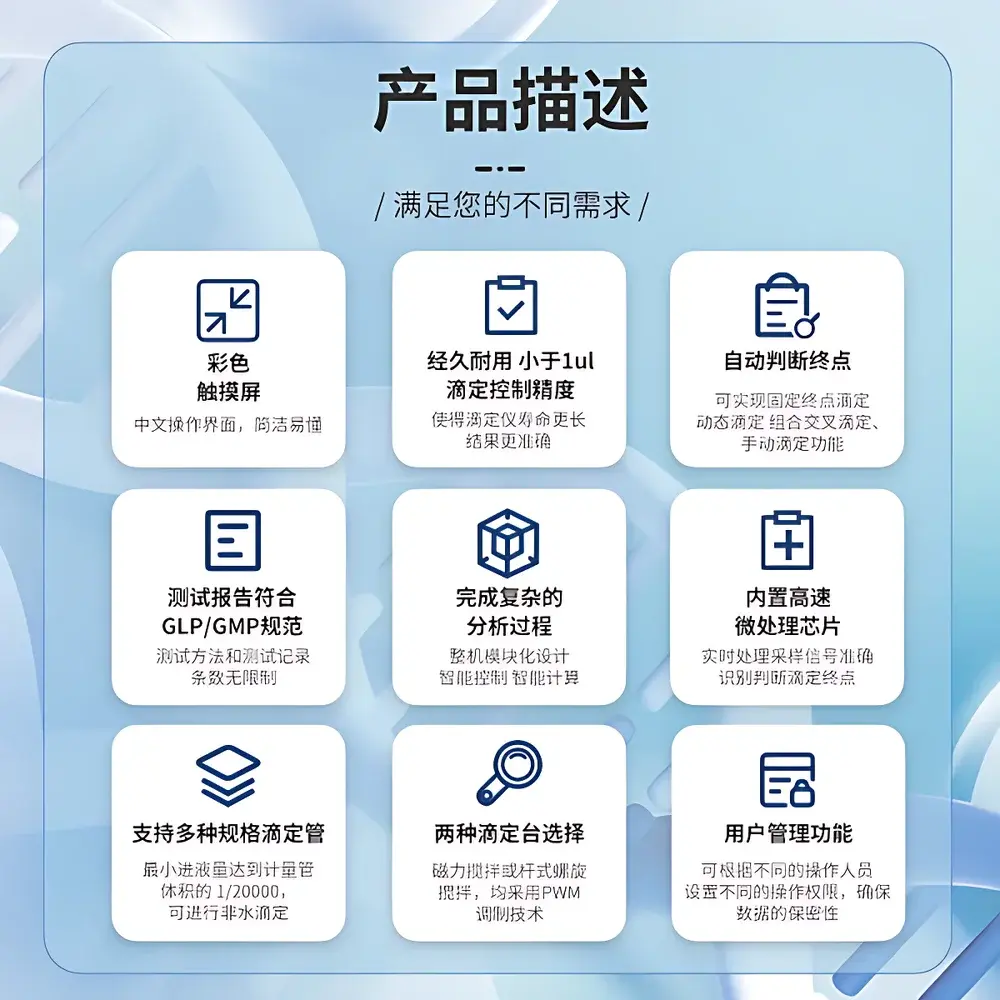
- High-resolution potentiometric detection: 0.1 mV resolution and ±0.2 mV accuracy across ±2000 mV range ensures reliable endpoint identification in low-conductivity non-aqueous media.
- Dual-burette configuration support: Standard 20 mL burette (0.001 mL minimum dispensing volume) and optional 10 mL burette (0.0005 mL resolution) for enhanced precision in low-acid or high-sensitivity applications.
- Programmable titration parameters: Adjustable minimum/most frequent drop volume (20–80 µL), stir speed (200 rpm), inter-drop delay (2000 ms), and first-derivative (dE/dV) endpoint algorithm with customizable threshold (e.g., 5 mV/mL).
- Modular hardware architecture: Interchangeable electrode holders, motorized titration stand, and detachable reagent reservoirs facilitate maintenance, calibration, and method adaptation.
- Integrated colorimetric endpoint module (optional): Utilizes machine vision-based RGB analysis to detect phenolphthalein or other indicator transitions—extending applicability to samples where potentiometric response is unstable or ambiguous.
- GLP/GMP-compliant data integrity: All methods, raw sensor traces, calculation logs, and final reports are timestamped, user-authenticated, and exported as encrypted PDFs to USB storage with digital signature verification.
Sample Compatibility & Compliance
The CT-1Plus accommodates viscous and non-polar matrices typical of lubricants, base oils, and used engine oils. Sample dissolution uses standardized solvent mixtures (e.g., toluene–isopropanol–water per ASTM D664). The 100 mL titration cup accommodates up to 2 g sample + 50 mL solvent, ensuring complete homogenization and stable potential response. The instrument meets essential regulatory expectations for analytical instrumentation: compliance with IEC 61000-4 electromagnetic immunity standards; electrical safety per GB 4793.1 (equivalent to IEC 61010-1); and software design aligned with FDA 21 CFR Part 11 principles—including audit trail, electronic signatures, and data immutability. Method validation documentation supports IQ/OQ/PQ protocols required for pharmaceutical and aerospace-grade lubricant certification.
Software & Data Management
HOGON TitraSoft v3.2 provides intuitive workflow-driven operation: preloaded ASTM/ISO/GB acid number methods, customizable titration sequences, real-time dE/dV curve visualization, and automatic blank subtraction. Raw data (mV vs. volume) and derivative plots are stored in proprietary .TIT binary format with embedded metadata (operator ID, timestamp, environmental conditions). Export options include CSV (for LIMS integration), XML (for ELN systems), and password-protected PDF reports containing full traceability: electrode calibration history, burette factor verification, drift compensation logs, and statistical summary (n ≥ 3 replicates). Report templates conform to ISO/IEC 17025 clause 7.8.2 for test report content.
Applications
- Acid number quantification in new and in-service lubricating oils (ASTM D664, ISO 6618, GB/T 7304)
- Neutralization number analysis of transformer oils and hydraulic fluids
- Titratable acidity in biodiesel (EN 14104), surfactants, and organic acid formulations
- Free fatty acid (FFA) content in edible oils (AOCS Cd 3d-63)
- Alkalinity and chloride titrations in process water and coolant formulations
- Redox titrations using cerimetric or iodometric reagents (with compatible electrodes)
FAQ
What electrode is recommended for acid number titration in non-aqueous media?
The pH-105 non-aqueous composite electrode is factory-calibrated for low-dielectric solvents and features a double-junction reference system with LiCl in ethanol to prevent junction clogging.
Does the CT-1Plus support automatic blank correction?
Yes—users can define and execute separate blank titrations; the software automatically subtracts blank volume from sample results and propagates uncertainty in final AN calculation (mg KOH/g).
Can method parameters be locked to prevent unauthorized modification?
Method files support role-based access control (administrator/operator modes); critical parameters (burette factor, electrode slope, endpoint criteria) require elevated credentials to edit.
Is validation documentation available for regulated environments?
HOGON provides a comprehensive Validation Support Package including Installation Qualification (IQ) checklist, Operational Qualification (OQ) test protocol with acceptance criteria, and Performance Qualification (PQ) templates aligned with USP and ISO/IEC 17025.
How is data integrity ensured during power interruption?
The system employs non-volatile memory to retain active titration state; upon recovery, it resumes from last valid data point without loss of raw mV/volume pairs or endpoint calculation context.





