
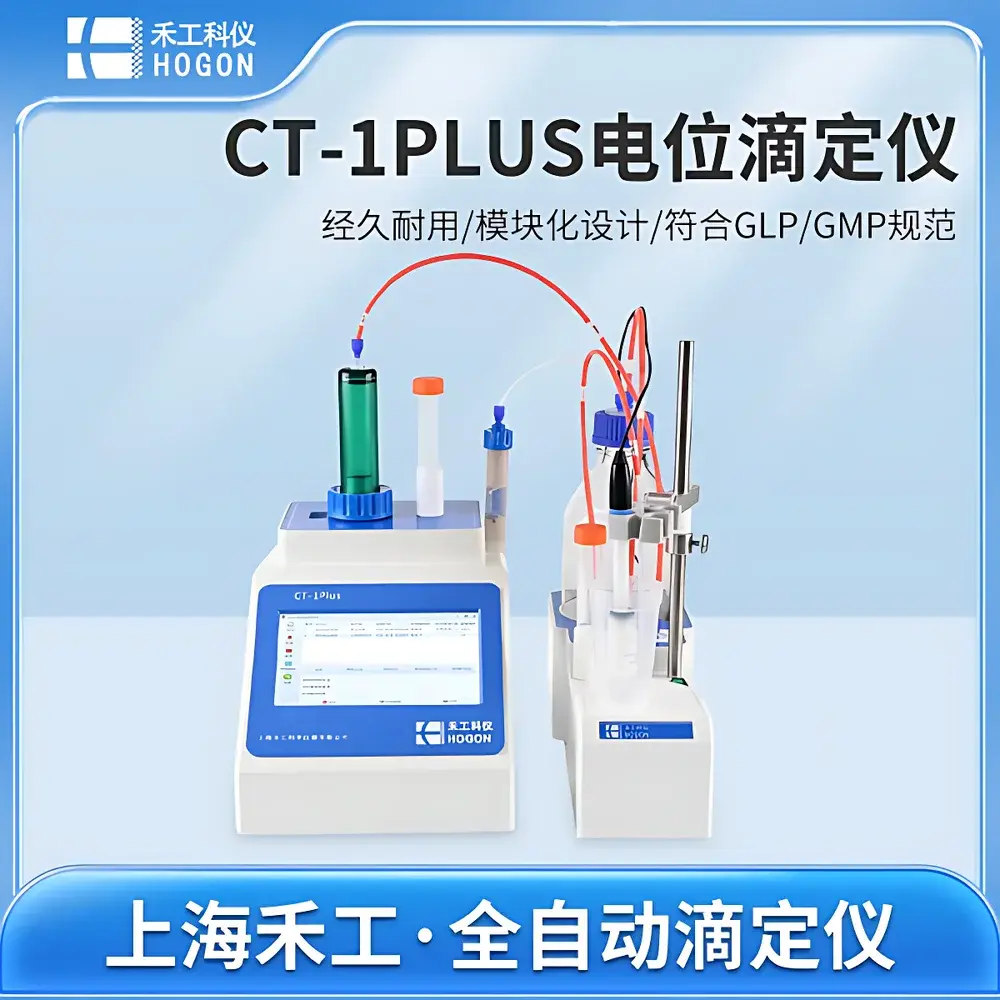
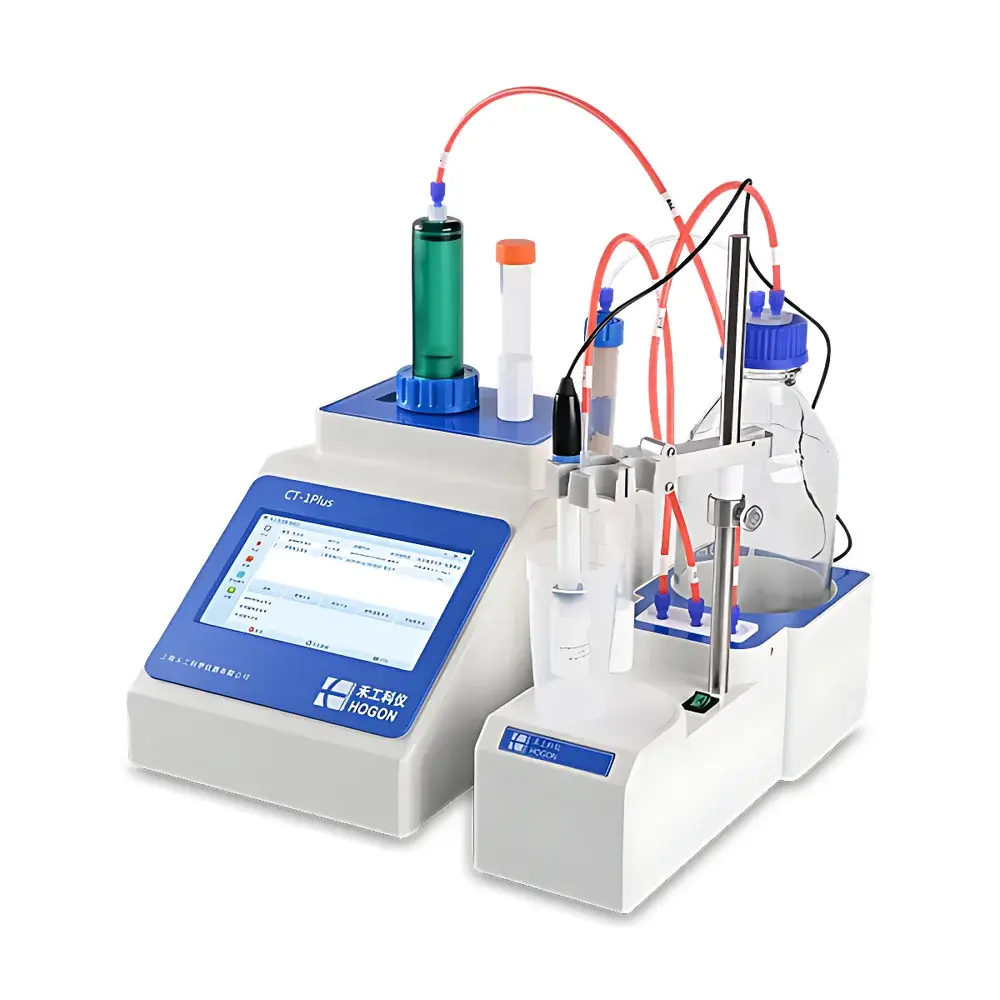
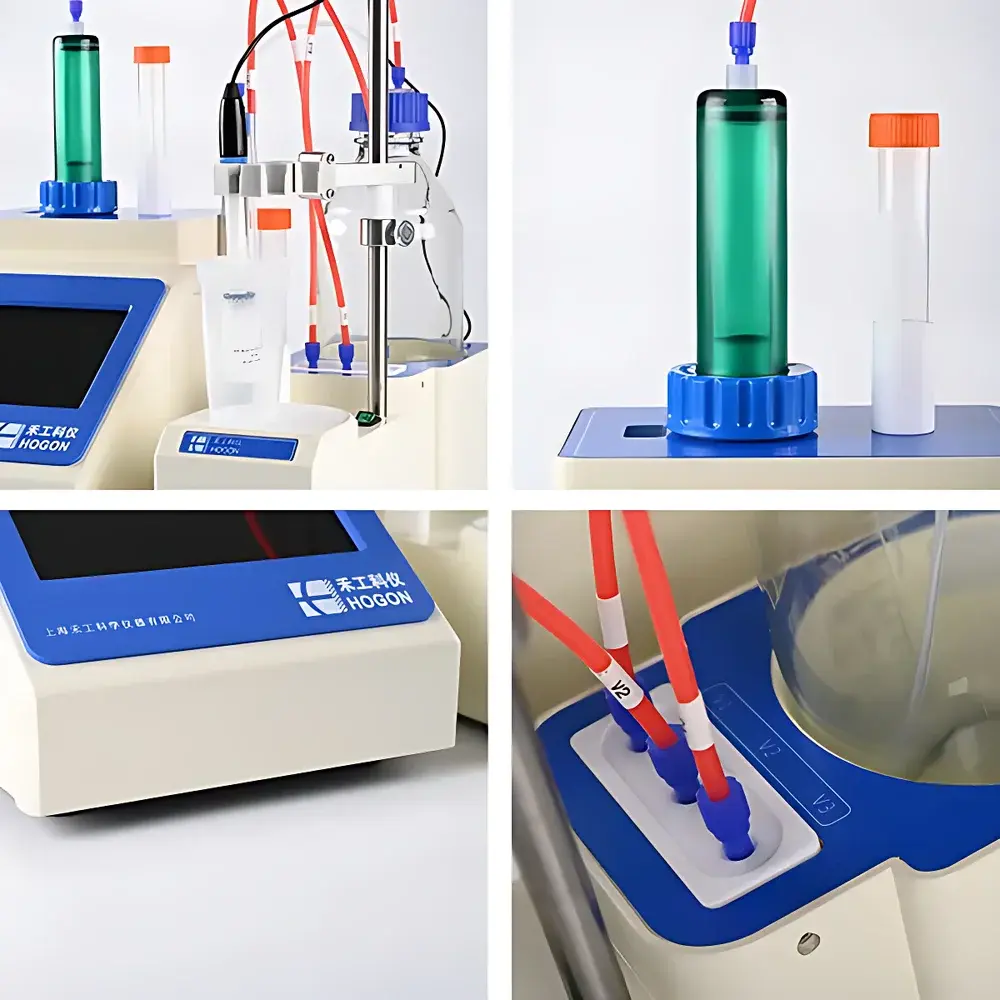
HOGON CT-1Plus Automatic Potentiometric Titrator for Amine Value Determination
| Brand | HOGON |
|---|---|
| Origin | Shanghai, China |
| Manufacturer | HOGON Scientific Instruments Co., Ltd. |
| Model | CT-1P |
| Instrument Type | General-purpose Automatic Potentiometric Titrator |
| Application Scope | Universal |
| Measurement Range | Potential: ±2000 mV |
| pH | 0–14 |
| Temperature | −5 to 125 °C |
| Meter Accuracy | ±0.3% of full scale |
| Meter Resolution | Potential: 0.1 mV |
| pH | 0.001 |
| Temperature | 0.1 °C |
| Titration Accuracy | (±0.3 mV ±1 digit) over 3 h |
| Titration Resolution | ±2000 mV range, 0.1 mV resolution, ±0.2 mV absolute accuracy |
| Minimum Dispensing Volume | 10 µL |
| Maximum Dispensing Volume | 100 µL |
| Stirring Speed | 200 rpm |
| Drop Interval | 1000 ms |
| Endpoint Detection Mode | First Derivative (dE/dV), Threshold Set at 200 mV/mL |
Overview
The HOGON CT-1Plus is a precision-engineered automatic potentiometric titrator designed specifically for quantitative determination of amine value in curing agents—critical parameters in epoxy resin formulation, polyurethane synthesis, and polymer crosslinking quality control. It operates on the fundamental principle of potentiometric endpoint detection: monitoring the electromotive force (EMF) change across a high-stability reference–indicator electrode pair (e.g., pH-105 composite electrode) during titration with standardized hydrochloric acid or perchloric acid solution. The instrument employs a microprocessor-controlled burette drive system with glass syringe-based dispensing, enabling reproducible delivery of titrant volumes down to 10 µL per increment. Its real-time dE/dV algorithm dynamically identifies inflection points in the titration curve, eliminating subjective visual interpretation and ensuring metrological traceability consistent with ISO 8971, ASTM D2074, and GB/T 12007.2 standards for amine value analysis.
Key Features
- High-resolution potentiometric measurement: ±0.1 mV resolution with ±0.2 mV absolute accuracy over ±2000 mV range, supporting robust redox and acid–base titrations.
- Programmable dispensing architecture: Adjustable minimum volume (10 µL) and maximum volume (100 µL) per step; 1000 ms inter-drop interval ensures complete reaction equilibration—critical for slow-protonating aliphatic amines.
- Stirring control optimized for heterogeneous systems: Fixed-speed magnetic stirring at 200 rpm maintains homogeneous mixing without vortex formation or electrode disturbance.
- Dual-mode endpoint recognition: Primary first-derivative (dE/dV) detection with user-configurable threshold (default 200 mV/mL); secondary fixed-pH or fixed-potential stop options available for method flexibility.
- Integrated temperature compensation: Built-in Pt100 sensor supports automatic correction of electrode potential drift across −5 to 125 °C—enabling elevated-temperature titrations for viscous or low-solubility samples.
- Robust hardware design: All fluidic pathways constructed from chemically resistant PTFE and borosilicate glass; corrosion-resistant chassis compliant with IEC 61010-1 safety requirements.
Sample Compatibility & Compliance
The CT-1Plus accommodates standard laboratory consumables including 100 mL titration beakers, 20 mL Class A volumetric burettes, and interchangeable ion-selective or combination electrodes (e.g., pH-105, Ag/AgCl, or redox electrodes). It meets essential regulatory expectations for analytical instrumentation used in GMP environments: audit-trail-capable method storage, electronic signature support (via optional software module), and data integrity features aligned with FDA 21 CFR Part 11 Annex 11 principles. While not pre-certified as a medical device, its performance validation protocol satisfies GLP documentation requirements per OECD 1998 Principles of Good Laboratory Practice. Method transfer between instruments is facilitated by standardized .TIT file export and CSV-formatted raw data output.
Software & Data Management
The embedded firmware supports up to 50 user-defined titration methods stored in non-volatile memory. Each method includes programmable parameters: initial delay, stirring pre-conditioning time, incremental volume logic, endpoint sensitivity, and post-titration rinse cycles. Real-time graphical display renders E vs. V and dE/dV curves on the 7-inch TFT touchscreen with zoom/pan functionality. Data export options include USB flash drive (CSV, PDF report templates), RS-232 serial interface for LIMS integration, and optional Ethernet connectivity for centralized instrument management. All measurements are timestamped, annotated with operator ID, ambient temperature/humidity (if external sensor connected), and electrode calibration history—ensuring full traceability for internal QA audits.
Applications
Beyond amine value quantification in epoxy hardeners (per ISO 13894), the CT-1Plus delivers validated performance in chloride ion titration (Mohr method), total acidity in lubricants (ASTM D974), free fatty acid content in biodiesel (EN 14104), and Karl Fischer water determination when coupled with coulometric KF reagents. Its broad pH and potential range enables characterization of weak bases (e.g., imidazoles, polyetheramines) and multi-step protonation systems common in specialty chemical intermediates. In R&D labs, it supports kinetic titration profiling for reaction mechanism studies; in QC settings, its <5-minute cycle time per sample (at 25 °C, 35% RH) enables throughput of ≥60 determinations per 8-hour shift.
FAQ
What electrode configurations are supported for amine value analysis?
The CT-1Plus is compatible with standard double-junction pH composite electrodes (e.g., pH-105) and non-aqueous pH electrodes for solvent-based titrations in toluene or xylene.
Does the instrument support automated calibration verification?
Yes—built-in calibration check routines compare measured mV values against certified buffer standards (pH 4.01, 7.00, 10.01) and report deviation before each batch run.
Can multiple endpoints be detected in a single titration?
No—the CT-1Plus implements single-inflection-point detection per titration sequence; sequential multi-step titrations require manual method chaining.
Is method validation documentation provided?
HOGON supplies IQ/OQ protocols, linearity verification reports (0.1–100 mV range), and repeatability test data (RSD ≤ 0.3% for 10 replicate amine value assays) upon request.
What maintenance intervals are recommended for long-term stability?
Electrode cleaning every 20 runs; burette piston lubrication quarterly; annual verification of dispensing accuracy using gravimetric testing per ISO 8655-6.




