
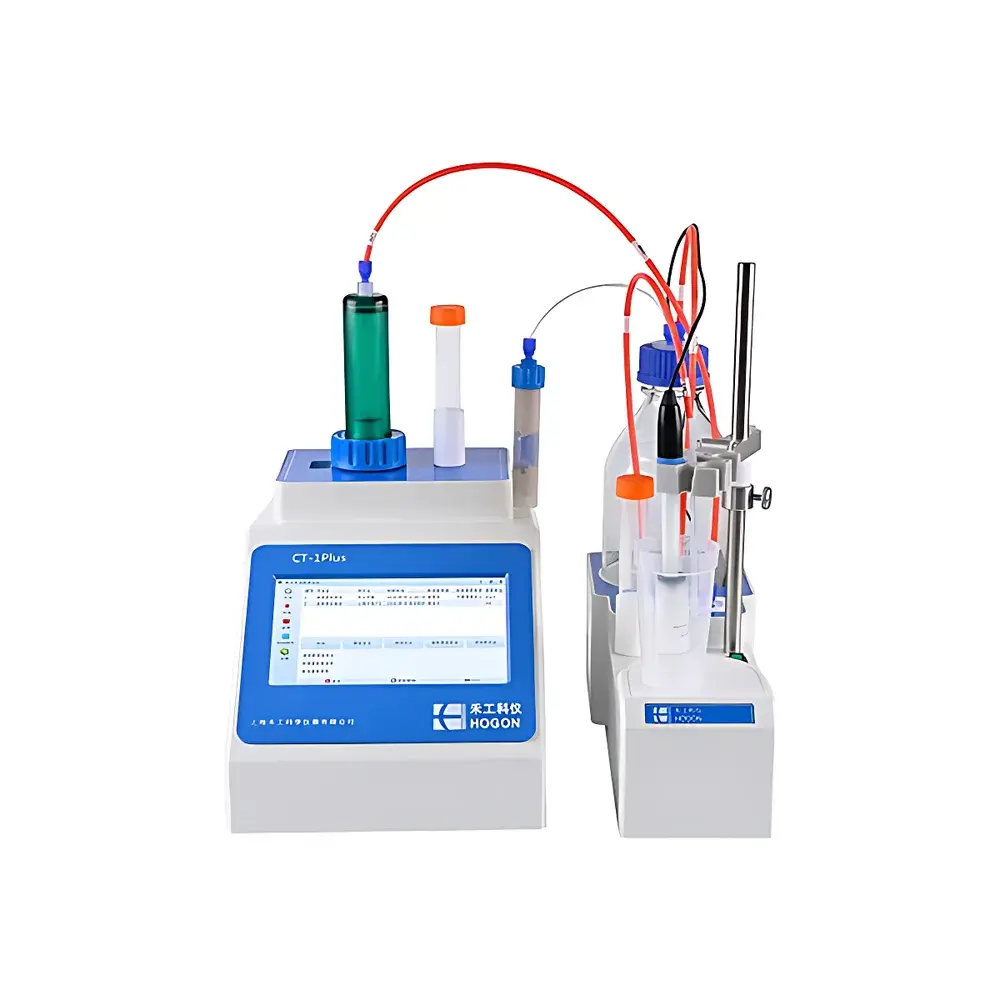
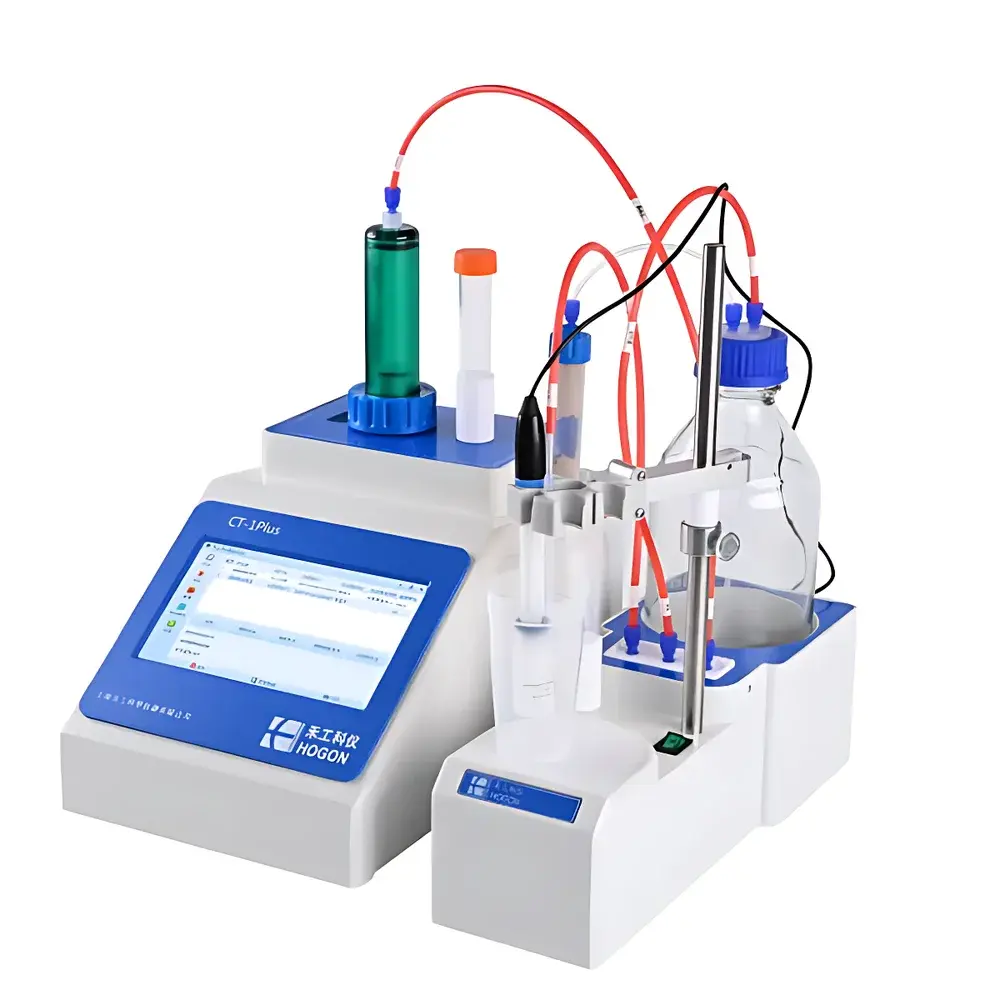
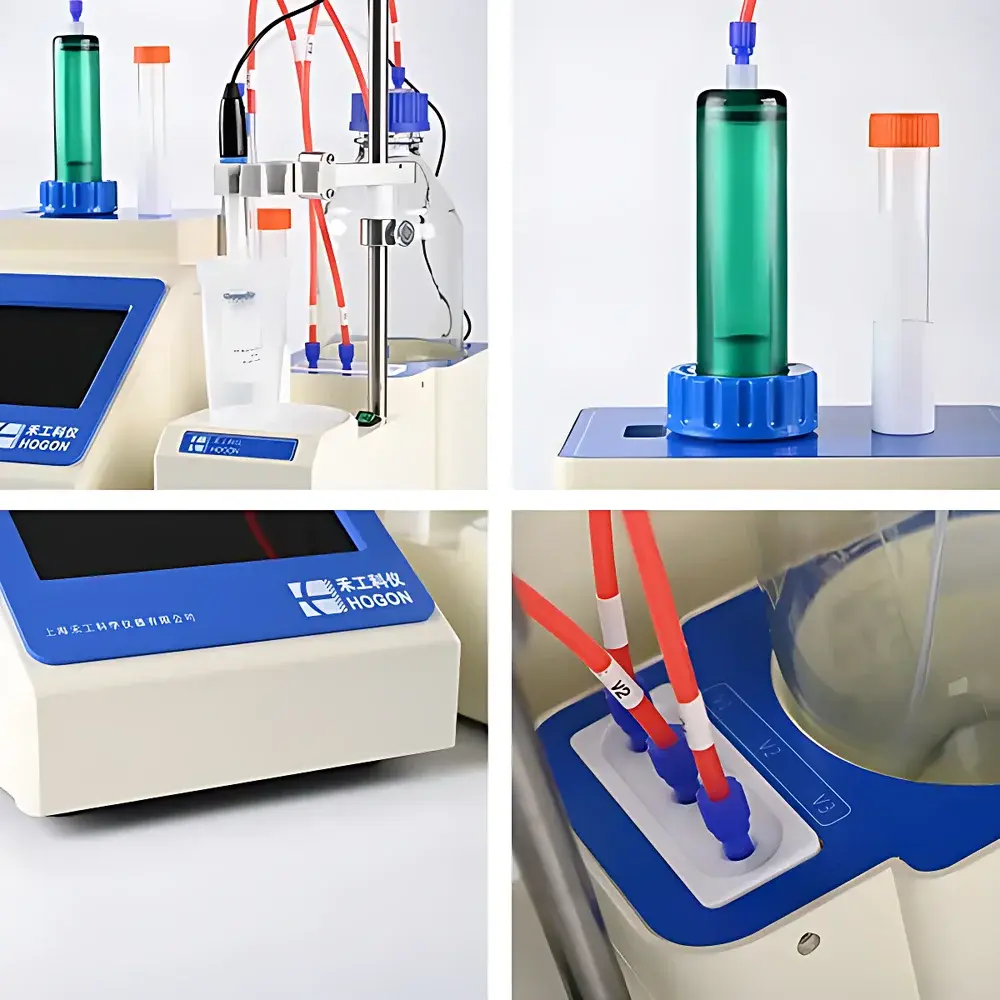
HOGON CT-1Plus Automatic Potentiometric Titrator for Fatty Acid Value Determination
| Brand | HOGON |
|---|---|
| Origin | Shanghai, China |
| Manufacturer Type | Direct Manufacturer |
| Product Category | Domestic |
| Model | CT-1Plus |
| Instrument Type | General-purpose Potentiometric Titrator |
| Application Scope | Universal |
| pH Measurement Range | 1–14 |
| Meter Accuracy | ±0.2 mV |
| Meter Resolution | 0.1 mV (within ±2000 mV range) |
| Burette Precision | 0.001 mL (20 mL standard burette) |
| Burette Resolution | 0.0005 mL (10 mL optional burette) |
| Electrode | pH-102 Composite Electrode |
| Endpoint Detection | First Derivative (dE/dV) Mode with Threshold = 200 |
| Sample Throughput | ≤2 min per test (including agitation, filtration, and titration) |
| Compliance | GB/T 15684–2015 |
Overview
The HOGON CT-1Plus Automatic Potentiometric Titrator is a dedicated analytical platform engineered for the precise, standardized determination of fatty acid value (FAV) in cereal grains—including paddy rice, maize, and wheat—according to GB/T 15684–2015. Fatty acid value quantifies free fatty acids liberated via lipid hydrolysis, serving as a critical indicator of grain oxidative deterioration during storage. Unlike classical visual endpoint detection using phenolphthalein, the CT-1Plus employs potentiometric titration with real-time potential monitoring (E vs. V), enabling objective, operator-independent endpoint identification based on the first derivative maximum (dE/dV). This electrochemical principle eliminates subjectivity inherent in colorimetric methods and ensures high reproducibility across laboratories and shifts. The instrument integrates a high-stability pH-102 composite electrode optimized for weakly acidic ethanol-based extraction media, a low-drift meter circuit with 0.1 mV resolution, and a dual-range precision burette system—standard 20 mL (0.001 mL increment) and optional 10 mL (0.0005 mL increment)—to accommodate both routine screening and high-accuracy verification protocols.
Key Features
- Automated Endpoint Recognition: Implements first-derivative (dE/dV) algorithm with user-adjustable threshold (default: 200), delivering robust endpoint detection even in low-slope titration curves typical of dilute KOH–ethanol titrations against grain extracts.
- High-Fidelity Electrochemical Measurement: Meter accuracy of ±0.2 mV and 0.1 mV resolution over ±2000 mV range ensure reliable potential tracking across pH 1–14, essential for detecting subtle inflection points in fatty acid titrations.
- Micro-Dosing Capability: Standard 20 mL burette achieves 0.001 mL dispensing precision; optional 10 mL burette extends resolution to 0.0005 mL, minimizing reagent consumption and improving volumetric accuracy for low-FAV samples.
- Preloaded Regulatory Method: Factory-configured GB/T 15684–2015 method includes automated agitation, filtration interface timing, blank correction logic (e.g., solvent ethanol background subtraction), and final FAV calculation per mg KOH/100 g sample.
- Robust Mechanical Architecture: Integrated magnetic stirrer with variable speed control, anti-drip burette tip design, and sealed titration vessel compartment minimize evaporation and contamination during ethanol-based extractions.
Sample Compatibility & Compliance
The CT-1Plus supports standardized FAV testing across major cereal commodities, including paddy rice (with moisture ≤14%), maize, and wheat. Sample preparation follows GB/T 15684–2015: 10 g ground sample extracted with 50 mL anhydrous ethanol under controlled agitation (10 min), followed by vacuum or gravity filtration prior to potentiometric titration with 0.0102 mol/L KOH in ethanol. The instrument’s compliance extends beyond method execution—it meets traceability requirements under ISO 22000 and GMP-aligned quality systems. All test parameters (burette volume, electrode potential, time stamp, operator ID, and calculated FAV) are timestamped and stored internally with audit-ready metadata. Data export is supported via USB to CSV or Excel formats, facilitating integration into LIMS environments and supporting FDA 21 CFR Part 11–compatible electronic record retention when paired with validated IT infrastructure.
Software & Data Management
The embedded firmware provides intuitive touchscreen navigation, multi-level user access control (administrator, technician, operator), and full method parameter logging—including initial potential, equivalence point volume, slope threshold, and blank correction value. Each assay generates a complete digital record containing raw E–V data points, derivative curve overlay, and final FAV result with uncertainty estimation derived from burette precision and electrode repeatability. Internal memory retains ≥10,000 test records with automatic overwrite protection for critical batches. Export functions include batch reports with statistical summaries (mean, SD, RSD%) and individual test traces. No proprietary software installation is required for basic operation; advanced reporting and LIMS synchronization utilize open-format exports compatible with third-party QA/QC platforms.
Applications
- Grain Storage Quality Monitoring: Enables rapid FAV screening at intake, in-storage, and pre-milling stages to assess oxidative stability and inform ventilation or cooling interventions.
- Procurement & Trade Compliance: Supports contractual FAV thresholds (e.g., ≤30 mg KOH/100 g for paddy rice “fit-for-storage” classification) with documented, auditable results acceptable to regulatory and commercial stakeholders.
- Research & Method Development: Flexible parameter adjustment allows adaptation to modified extraction solvents, alternative titrants, or non-standard grain matrices—facilitating validation studies for emerging cereals or processing by-products.
- Multi-Commodity Expansion: With minor protocol adjustments (e.g., extraction time, solvent ratio, KOH concentration), the platform accommodates FAV testing for sorghum, barley, and oilseed meals per AOAC or national adaptations.
FAQ
What standards does the CT-1Plus comply with for fatty acid value testing?
It is fully aligned with GB/T 15684–2015 and technically compatible with AOAC Official Method 944.12 and ISO 660:2020 for free fatty acid determination in oils and fats, though application-specific validation is recommended for non-cereal matrices.
Can the CT-1Plus be used for other titration applications beyond fatty acid value?
Yes—it is a general-purpose potentiometric titrator capable of acid–base, redox, precipitation, and complexometric titrations when equipped with appropriate electrodes (e.g., Pt, Ag, ion-selective) and reagents.
Is blank correction automated?
Yes. The instrument performs automatic solvent blank measurement prior to sample titration and subtracts the corresponding titrant volume from the gross endpoint volume.
How is data integrity ensured during long-term deployment?
All measurements are timestamped, logged with instrument serial number and firmware version, and protected against unauthorized deletion via password-secured administrator mode.
What maintenance is required for sustained accuracy?
Routine calibration includes daily electrode slope verification (≥95% theoretical Nernstian response) and quarterly burette volume verification using certified weights and Grade A volumetric glassware per ISO/IEC 17025 guidelines.




