
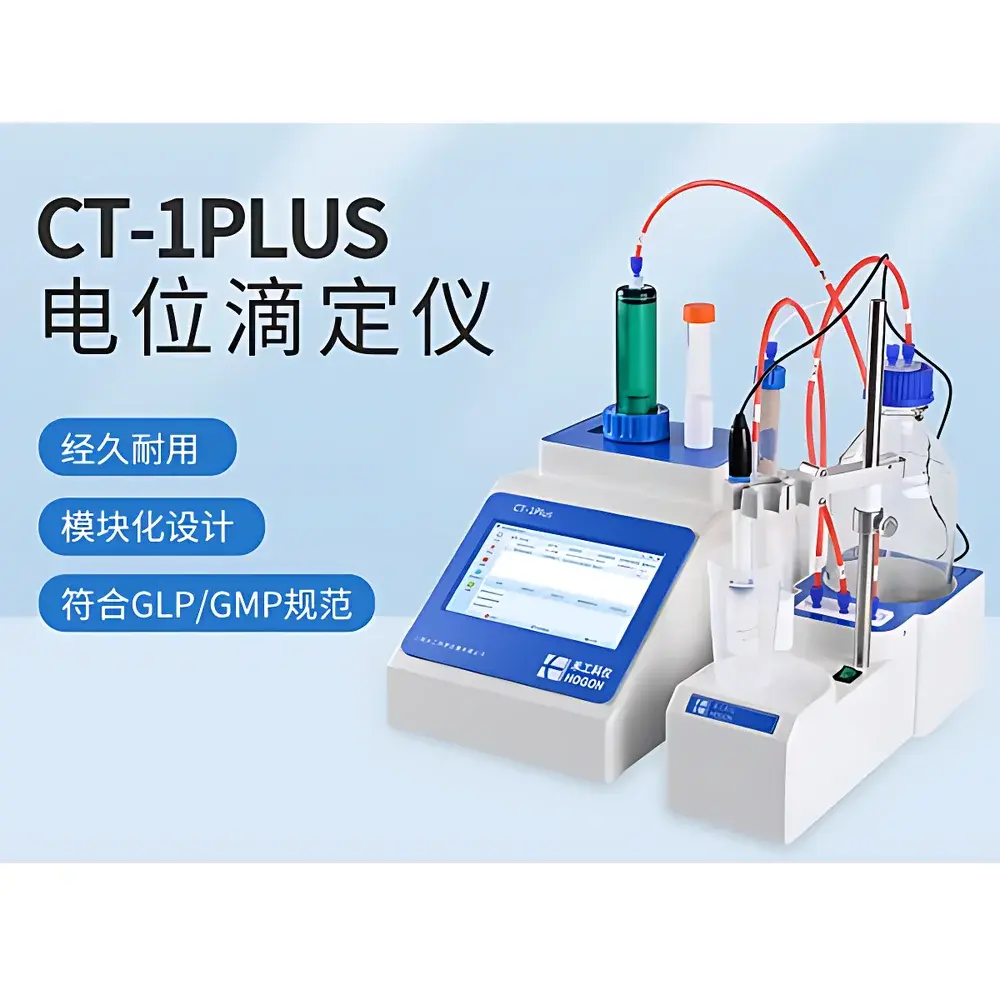
HOGON CT-1Plus Automatic Potentiometric Titrator for Mercaptan Sulfur Analysis in Kerosene, Gasoline, and Dye Solutions
| Brand | HOGON |
|---|---|
| Origin | Shanghai, China |
| Manufacturer Type | Direct Manufacturer |
| Instrument Type | Universal Automatic Potentiometric Titrator |
| Application Scope | General-purpose & Fuel-Specific Mercaptan Sulfur Quantification |
| pH Range | 1–14 |
| Potential Measurement Accuracy | ±0.2 mV |
| Potential Resolution | 0.1 mV (within ±2000 mV range) |
| Burette Precision | 0.001 mL (20 mL standard burette) |
| Burette Resolution | 0.0005 mL (10 mL optional burette) |
Overview
The HOGON CT-1Plus is a dedicated automatic potentiometric titrator engineered for the precise quantification of mercaptan sulfur (RSH) in hydrocarbon matrices—including kerosene, gasoline, aviation turbine fuel, and dye-containing petroleum products. It operates on the principle of potentiometric endpoint detection using a high-selectivity composite electrode system that monitors real-time potential shifts during silver nitrate (AgNO₃) titration. In this redox-based method, Ag⁺ ions selectively react with thiolate anions (RS⁻) to form insoluble silver mercaptides, generating a sharp, reproducible potential inflection point—accurately identified by the instrument’s adaptive derivative algorithm. Designed to meet the stringent metrological requirements of refinery QC labs and third-party testing facilities, the CT-1Plus delivers trace-level sulfur analysis (down to 0.0001 wt%) with robust inter-day repeatability (<2% RSD), fully compliant with ASTM D3227, GB/T 1792, IP 261, and ISO 8217 Annex A protocols.
Key Features
- High-fidelity potentiometric endpoint detection via dual-junction Ag/Ag₂S reference-composite electrode, minimizing junction potential drift and membrane fouling in low-polarity solvents.
- Modular dual-burette configuration supporting both standard (20 mL) and high-resolution (10 mL) titrant delivery—enabling sub-microliter dosing accuracy for ultra-low sulfur samples.
- Integrated blank correction algorithm: automatically measures and subtracts reagent blank contribution in real time, eliminating manual post-processing errors.
- Sealed titration cell design with inert gas purge port (N₂ or Ar compatible), preventing oxidation of thiols and minimizing operator exposure to volatile organic solvents and toxic AgNO₃ solutions.
- Micro-dosing technology reduces titrant consumption by ≥50% versus conventional manual methods—validated through lifecycle cost analysis across 10,000+ test cycles.
- Intuitive touchscreen interface with pre-loaded, editable titration methods—including ASTM D3227-compliant sequence, GB/T 1792 workflow, and user-defined multi-step protocols.
Sample Compatibility & Compliance
The CT-1Plus accommodates undiluted and solvent-diluted samples (e.g., in isopropanol/toluene mixtures per ASTM D3227), with sample mass ranging from 10 g to 100 g. Its electrochemical architecture maintains stable response across wide dielectric constant ranges (εr = 2–30), ensuring reliable performance with non-aqueous, low-conductivity fuels. All hardware and firmware comply with IEC 61000-6-3 (EMC) and IEC 61010-1 (safety). Data integrity meets GLP/GMP requirements: audit-trail-enabled method storage, electronic signatures, and tamper-evident PDF report generation (UVC-compatible, SHA-256 hashed) conforming to FDA 21 CFR Part 11 Annex 11 expectations.
Software & Data Management
The embedded HOGON TitraLink™ v3.2 software provides full method development, calibration management, and statistical reporting. Each assay generates a timestamped, digitally signed PDF report containing raw potential curves, first-derivative plots, equivalence point coordinates, blank-corrected result (wt%), RSD, and analyst ID. Reports are exportable via USB 2.0 to network drives or LIMS; no proprietary viewer required. Up to 10,000 method templates and 50,000 test records may be stored locally. Optional color-sensing module (CSM-1) extends functionality to photometric endpoints for non-electroactive analytes—using calibrated CMOS imaging and CIE L*a*b* color space thresholding per ASTM E308.
Applications
- Refinery quality control: rapid verification of mercaptan sulfur removal efficiency post-Merox or caustic wash units.
- Fuel certification labs: accredited testing for Jet A-1 (ASTM D1655), gasoline (ASTM D4814), and marine distillate (ISO 8217) compliance.
- R&D formulation screening: kinetic profiling of antioxidant-thiol interactions under accelerated aging conditions.
- Regulatory submission support: generation of auditable data packages for EPA Tier 3, EU EN 228, and China VI fuel standards.
- Contract testing organizations: high-throughput batch analysis (≥120 samples/8-h shift) with automated sample queueing and barcode integration.
FAQ
Does the CT-1Plus require daily electrode recalibration?
No—electrode stability is verified before each run via built-in reference potential check (±10 mV tolerance vs. Ag/AgCl standard); full calibration is recommended only after 50 assays or electrode replacement.
Can it analyze sulfur in dyed fuels without interference?
Yes—the composite electrode exhibits minimal spectral sensitivity; validation studies confirm <0.5% signal deviation across common petroleum dyes (Solvent Red 26, Solvent Blue 35) at concentrations up to 10 ppm.
Is method transfer supported from legacy manual titration SOPs?
Yes—TitraLink™ includes a “SOP Migration Wizard” that converts stepwise manual procedures into executable digital workflows, preserving original reaction stoichiometry and endpoint criteria.
What maintenance intervals are recommended for the fluidic system?
Burette piston seals and tubing should be inspected every 500 titrations; full fluidic recalibration is advised quarterly or after any solvent change involving chlorinated or high-viscosity media.
How is data integrity ensured during power interruption?
All active assays write to non-volatile memory every 2 seconds; upon restart, the system resumes from last validated equivalence point—no data loss or manual recovery required.




