
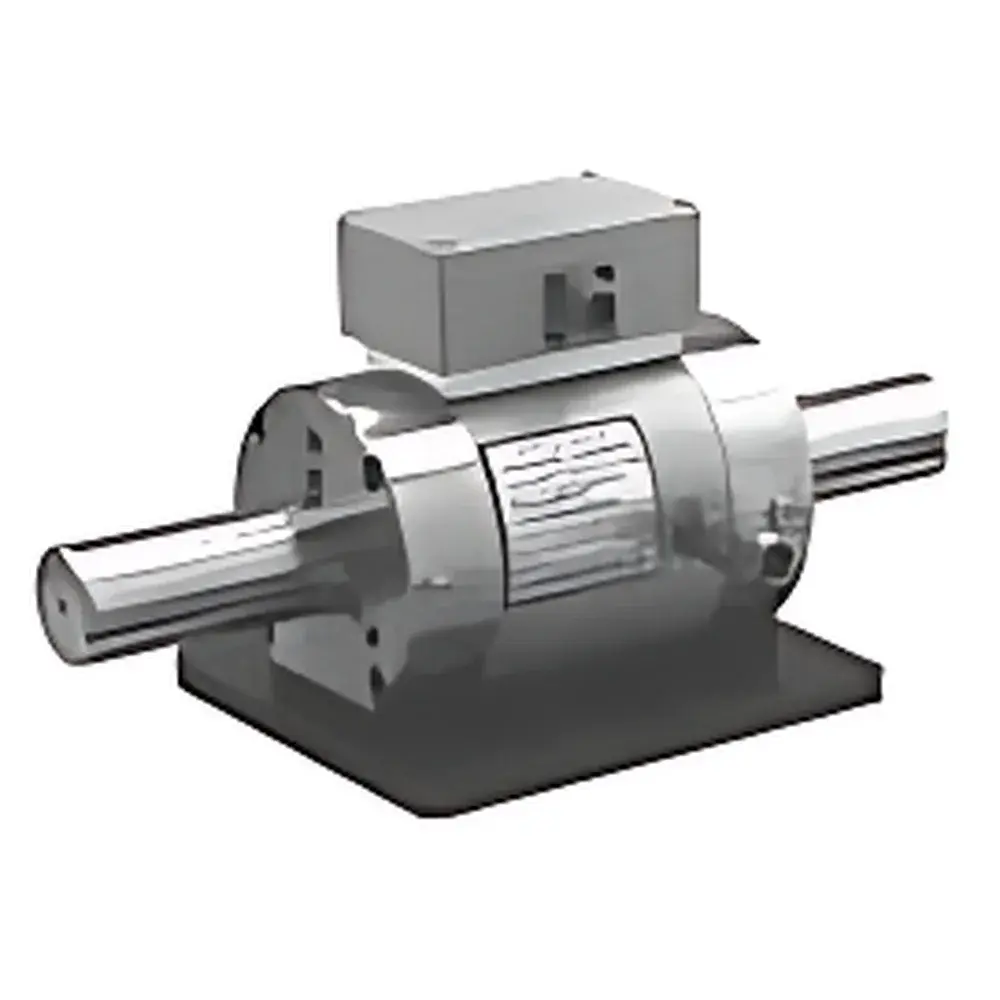
Honeywell 590 Non-Contact DC Torque Transducer – Intrinsically Safe Certified
| Origin | USA |
|---|---|
| Manufacturer Type | Authorized Distributor |
| Origin Category | Imported |
| Model | 590 |
| Pricing | Available Upon Request |
| Measurement Range | 4.52 N·m to 83,000 N·m |
| Output Signals | ±5 V DC, 4–20 mA, mV/V |
| Frequency Response | 0–500 Hz |
| Power Supply | 10.5–24 V DC (nominal 12 V DC battery compatible) |
| Accuracy (combined nonlinearity/hysteresis/nonrepeatability) | ≤±0.10 % FS |
| Thermal Zero Drift | ≤±0.0025 % FS/°F |
| Thermal Span Drift | ≤±0.0025 % RDG/°F |
| Compensated Temperature Range | +75 to +175 °F |
| Operating Temperature Range | −25 to +185 °F |
| Storage Temperature Range | −65 to +225 °F |
| Overrange Capability | ±33 % FS |
| Bandwidth Options | DC–500 Hz (high-frequency mode), DC–1 Hz (low-frequency mode) |
| Intrinsic Safety Certification | Compliant with IEC 60079-11 (Ed. 5.0) and UL 913 Class I, Div 1, Groups A, B, C, D |
Overview
The Honeywell 590 Non-Contact DC Torque Transducer is an intrinsically safe, high-fidelity rotational torque measurement system engineered for hazardous environments where explosive atmospheres may be present—such as oil & gas refineries, chemical processing plants, mining operations, and offshore platforms. Utilizing a contactless magnetoelastic sensing principle, the transducer measures torsional strain in rotating shafts without mechanical coupling, slip rings, or physical electrical connections across the rotating interface. This eliminates wear, signal degradation, and maintenance downtime associated with traditional potentiometric or strain-gauge-based torque sensors. The device operates on a stable DC excitation and delivers fully bi-directional output proportional to applied torque—enabling precise quantification of both clockwise (CW) and counterclockwise (CCW) loading conditions. Its intrinsic safety certification ensures compliance with global explosion-protection standards, allowing deployment in Zone 0/1 (IEC) and Class I, Division 1 (UL) locations without additional barrier systems. Designed for long-term metrological stability, the 590 series maintains ≤±0.10 % full-scale accuracy under combined error sources—including nonlinearity (≤±0.07 % FS), hysteresis (≤±0.07 % FS), and nonrepeatability (≤±0.03 % FS)—validated per ISO 17025-accredited calibration protocols traceable to NIST.
Key Features
- Intrinsically safe design certified to IEC 60079-11 (Ed. 5.0) and UL 913 for Class I, Div 1, Groups A–D environments
- Non-contact magnetoelastic sensing technology—no slip rings, no bearings, zero mechanical wear
- Dual ±5 V DC analog outputs (CW = +5 V, CCW = −5 V) plus optional 4–20 mA or mV/V configurations
- High torsional stiffness (>1 × 10⁶ N·m/rad typical) ensures minimal shaft deflection and dynamic fidelity
- Wide measurement range: 4.52 N·m to 83,000 N·m (40 lbf·in to 735,000 lbf·in), scalable via model-specific calibration
- 10× overload capability at full scale—engineered for transient shock loads during engine start-up, compressor cycling, or inertia reversal
- DC-coupled bandwidth options: 0–500 Hz (high-frequency mode) for vibration-rich applications; 0–1 Hz (low-frequency mode) for ultra-stable static torque monitoring
- Integrated signal conditioning—no external amplifier required—supports direct connection to PLCs, DAQ systems, or SCADA interfaces
- Operates from 10.5–24 V DC supply (including standard 12 V batteries), drawing only 85 mA nominal current
Sample Compatibility & Compliance
The Honeywell 590 is compatible with solid and hollow rotating shafts across multiple mounting configurations—including in-line shaft-mount and flange-mount variants. It accommodates both metric and imperial shaft diameters and integrates seamlessly into existing drivetrain architectures without requiring structural modification. All units are supplied with factory calibration certificates traceable to NIST, including thermal drift characterization over the compensated temperature range (+75 to +175 °F). The transducer meets applicable requirements for functional safety per IEC 61508 SIL 2 (hardware fault tolerance), and its documentation supports GLP/GMP audit readiness. While not FDA-regulated, its construction materials (316 stainless steel housing, aerospace-grade elastomers) comply with ASTM F899 for corrosion resistance and USP Class VI biocompatibility testing—making it suitable for clean-process industrial applications where material compatibility is critical.
Software & Data Management
The 590 transducer operates as a standalone analog sensor and does not require proprietary firmware or embedded software. However, its dual ±5 V outputs are fully compatible with industry-standard data acquisition platforms—including National Instruments CompactDAQ, Keysight DAQ970A, and Siemens SIMATIC S7-1500 analog input modules. When integrated into validated systems, the transducer supports 21 CFR Part 11-compliant data capture when paired with audit-trail-enabled software (e.g., LabVIEW with DIAdem, or MATLAB Production Server). Raw torque signals can be logged with timestamped metadata, and post-processing routines for peak-hold, RMS torque calculation, and torsional vibration spectrum analysis (via FFT) are routinely implemented in accordance with ISO 10816-3 for machinery condition monitoring.
Applications
- Real-time torque monitoring of diesel engines, reciprocating compressors, and single-cylinder power units in hazardous-area test cells
- Dynamic load profiling during motor start-stop cycles and regenerative braking events in explosion-proof electric drive systems
- Calibration reference standards for torque verification labs accredited to ISO/IEC 17025
- Torsional vibration analysis in pump-jack assemblies, offshore drilling top drives, and refinery blowers
- Field-deployable powertrain validation in mobile equipment—compatible with 12 V vehicle battery systems
- Long-duration reliability testing of gearboxes and couplings under cyclic torsional stress
FAQ
Is the 590 transducer certified for use in Zone 0 environments?
Yes—its intrinsic safety rating per IEC 60079-11 permits operation in Zone 0 (continuous hazard) and Zone 1 (likely hazard) gas groups IIA, IIB, and IIC.
Can the device measure static torque with zero rotation?
Yes—the magnetoelastic principle is independent of rotational speed; it functions equally well at 0 RPM and up to 20,000 RPM.
What is the recommended recalibration interval?
Honeywell recommends annual calibration under normal operating conditions; however, intervals may be extended to 24 months if supported by in-house verification per ISO 17025 Clause 7.7 and documented stability trending.
Does the unit support digital communication protocols such as CAN or Modbus?
No—the 590 provides analog-only outputs. For digital integration, external analog-to-digital converters with protocol gateways (e.g., Phoenix Contact ILME series) are recommended.
Are custom calibration ranges available?
Yes—Honeywell offers factory-configured calibration points within the 4.52–83,000 N·m span, including multi-point linearity verification and user-specified zero-offset compensation.
Related Products



