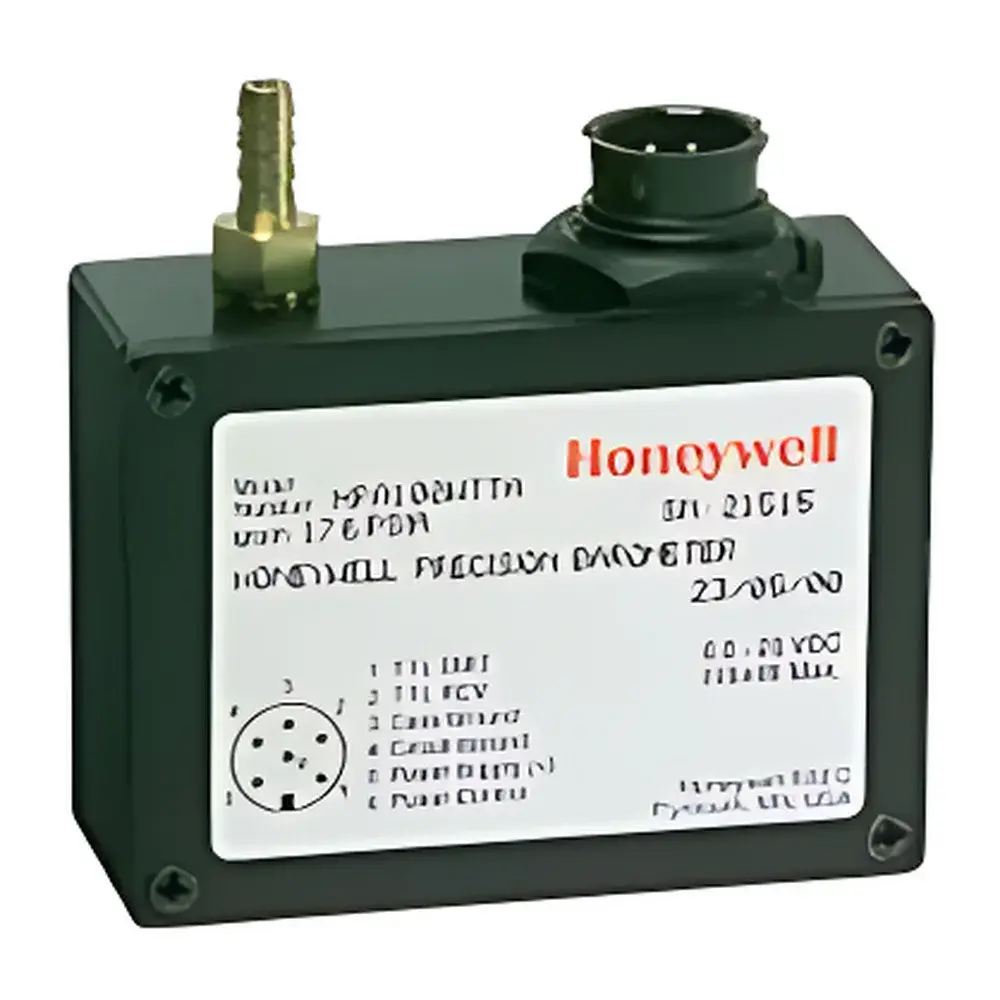
Honeywell HPA Precision Barometric Altimeter
| Brand | Honeywell |
|---|---|
| Model | HPA |
| Origin | USA |
| Type | Barometric Altimeter |
| Pressure Range | 0–17.6 psia |
| Operating Temperature | −40 °C to +85 °C |
| Accuracy | ±0.03 psia or ±0.06% FSO |
| Long-Term Drift | ≤0.02% FSO/year |
| Output Interface | TTL-compatible digital output |
| Form Factor | Compact, low-mass package |
| Compliance | RoHS-compliant, designed for aerospace and industrial altitude referencing applications |
Overview
The Honeywell HPA Precision Barometric Altimeter is an engineered pressure-sensing module optimized for high-reliability altitude determination in airborne, unmanned aerial systems (UAS), stratospheric balloons, and portable geodetic instrumentation. It operates on the fundamental physical principle that atmospheric static pressure decreases predictably with increasing geometric altitude—enabling precise barometric height estimation when calibrated against a known reference pressure (e.g., sea-level pressure or local QNH). Unlike optical or inertial altimeters, the HPA leverages absolute pressure measurement via a silicon-based piezoresistive sensing element, delivering stable, repeatable output across wide thermal gradients without mechanical moving parts. Its design prioritizes long-term metrological integrity: minimal hysteresis, low thermal coefficient of offset (<±0.01% FSO/°C), and intrinsic immunity to vibration-induced error—making it suitable for integration into Class I and II UAV platforms where size, weight, and power (SWaP) constraints are critical.
Key Features
- High-accuracy absolute pressure measurement over 0–17.6 psia (0–121.3 kPa), corresponding to operational altitudes up to approximately 50,000 ft (15.2 km) under standard atmospheric conditions (ISA).
- Two-tier accuracy specification: ±0.03 psia (±0.21 kPa) fixed error band or ±0.06% full-scale output (FSO), whichever is greater—ensuring consistent performance across the entire range.
- Thermal stability validated from −40 °C to +85 °C, with integrated temperature compensation enabling direct use in unheated avionics bays or outdoor environmental monitoring enclosures.
- Annual zero drift limited to ≤0.02% FSO/year, verified per MIL-STD-883H Test Method 1018.1, supporting extended calibration intervals in field-deployed systems.
- TTL-level digital output interface simplifies integration with microcontroller units (MCUs), FPGA-based flight controllers, or data acquisition systems—eliminating need for external ADCs or signal conditioning circuitry.
- Compact footprint (≤15 mm × 15 mm × 5 mm) and mass <2 g reduce payload impact and improve system-level dynamic response during rapid ascent/descent profiles.
Sample Compatibility & Compliance
The HPA is compatible with dry, non-corrosive ambient air and nitrogen environments. It is not rated for exposure to condensing humidity, halogenated solvents, or aggressive oxidizing agents. As a component-level sensor—not a finished instrument—it complies with RoHS Directive 2011/65/EU and REACH Regulation (EC) No. 1907/2006. While not certified as a standalone aviation-grade altimeter per DO-160G or TSO-C88c, its metrological characteristics align with requirements for auxiliary altitude reference in non-critical flight control loops and ground-based vertical profiling systems. Users integrating the HPA into safety-related systems must perform independent verification per ISO/IEC 17025:2017 and document traceability to NIST-traceable pressure standards.
Software & Data Management
The HPA outputs a logic-level digital signal synchronized to an external clock; no embedded firmware or onboard configuration registers are present. Integration requires host-side interpretation of pressure-to-altitude conversion using established models such as the U.S. Standard Atmosphere (1976) or ICAO ISA equations. For laboratory validation and production test, Honeywell provides a characterization dataset (including temperature-compensation coefficients and individual unit calibration reports) in CSV format. When deployed in GLP- or GMP-regulated environments, raw pressure values must be logged with timestamp, ambient temperature, and sensor serial number to satisfy audit requirements under 21 CFR Part 11 for electronic records and signatures.
Applications
- Barometric altitude hold and vertical velocity estimation in multirotor and fixed-wing UAVs.
- Altitude-triggered payload release mechanisms in high-altitude balloon experiments.
- Vertical position referencing in mobile LiDAR surveying platforms and autonomous ground vehicles navigating variable terrain.
- Environmental monitoring stations measuring elevation-dependent parameters (e.g., ozone concentration, solar irradiance attenuation).
- Calibration transfer standards for field-portable pressure calibrators used in metrology labs.
FAQ
Is the HPA suitable for certified aircraft installation?
No—the HPA is a component sensor intended for OEM integration and does not carry FAA TSO, EASA ETSO, or other airworthiness certification. It may serve as a secondary altitude source in experimental or non-certified platforms.
Does the device include built-in temperature compensation?
Yes—compensation is implemented at the die level using laser-trimmed resistor networks, eliminating requirement for external temperature sensors or software correction tables.
Can the HPA be used underwater or in vacuum environments?
No—it is rated only for ambient atmospheric exposure. Submersion or operation below 0 psia (absolute) will damage the sensing diaphragm.
What is the recommended warm-up time before achieving specified accuracy?
Stabilization occurs within 100 ms after power-on; full thermal equilibrium under extreme ambient transitions may require up to 2 seconds.
Is NIST-traceable calibration documentation available?
Yes—each unit ships with a manufacturer’s calibration certificate listing pressure points, temperature points, and uncertainty budgets referenced to NIST SRM 2085.