
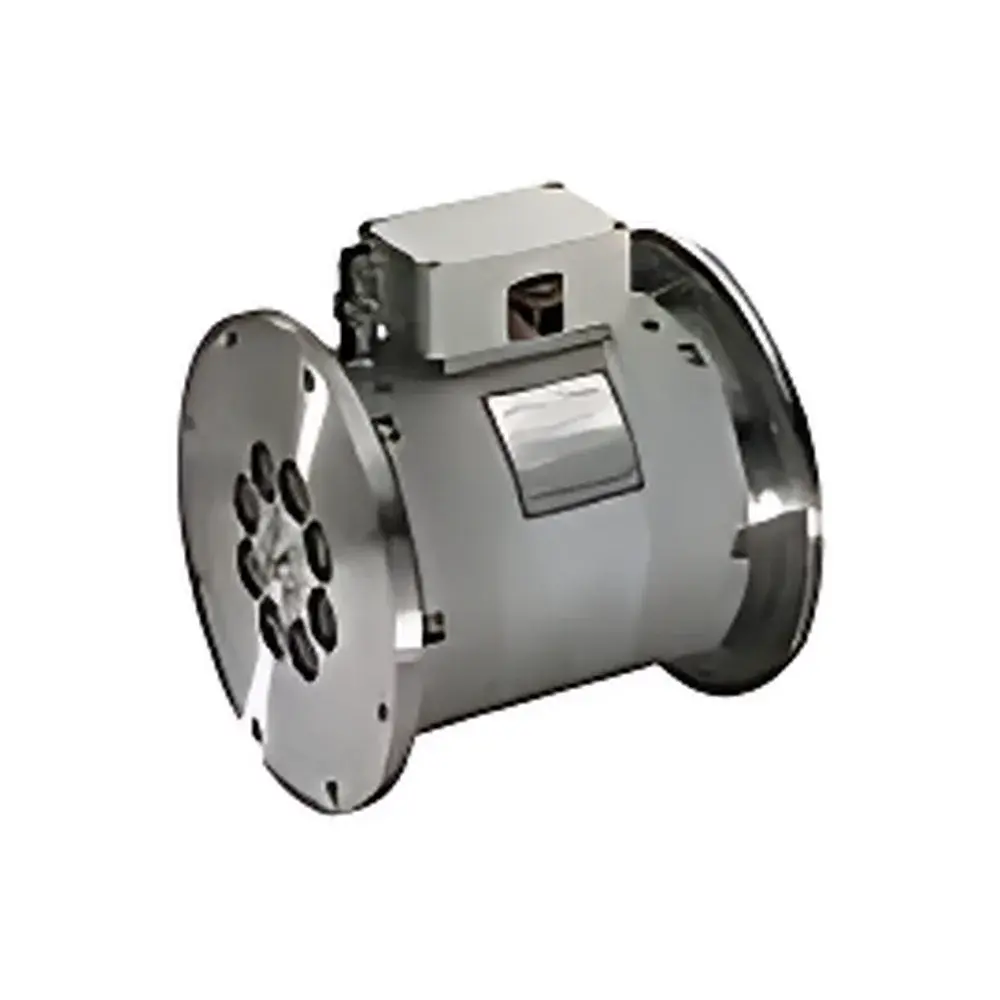
Honeywell Sensing 480 Non-Contact DC Torque Sensor
| Origin | USA |
|---|---|
| Distribution Model | Authorized Distributor |
| Import Status | Imported |
| Model | 480 |
| Pricing | Available Upon Request |
| Torque Range | 0.071–452,400 N·m |
| Overload Capacity | 200% FS |
| Output Signals | ±5 V DC, ±10 V DC |
| Frequency Response | 1–500 Hz |
| Accuracy (Combined) | ≤±0.15% FS (Standard), ≤±0.08% FS (High-Precision Variant) |
| Thermal Zero Drift | ≤±0.003% FS/°F (Standard), ≤±0.0015% FS/°F (High-Precision Variant) |
| Compensated Temperature Range | +75 to +175 °F |
| Operating Temperature Range | −25 to +185 °F |
| Storage Temperature Range | −65 to +225 °F |
| Power Supply | 10.5–24 V DC @ 85 mA nominal |
| Bandwidth | DC to 500 Hz (high-frequency mode), DC to 1 Hz (low-frequency mode) |
| Zero Balance | ≤±1% FS |
| Rotational Effect on Zero | ≤±0.10% FS (Standard), ≤±0.03% FS (High-Precision Variant) |
| Calibration Traceability | NIST-traceable at 75 °F |
Overview
The Honeywell Sensing 480 Non-Contact DC Torque Sensor is an industrial-grade, statically and dynamically rated torque transducer engineered for high-fidelity measurement in demanding mechanical powertrain applications. Utilizing a non-contact rotary transformer architecture with strain-gaged stainless steel sensing elements, the 480 eliminates slip rings, brushes, and associated wear mechanisms—ensuring long-term metrological stability and immunity to electromagnetic interference (EMI), lubricant contamination, vibration, and magnetic fields. Its core measurement principle relies on Wheatstone bridge-based strain detection within a torsionally optimized shaft, with bending and axial thrust effects actively canceled via symmetric gage placement and mechanical design. The sensor operates continuously from a single unregulated DC supply (10.5–24 V), making it compatible with battery-powered test benches, mobile equipment, and embedded control systems. Designed for integration between driver and load—such as motors, gearboxes, or dynamometers—the 480 delivers true bidirectional torque output across its full range (0.071–452,400 N·m), supporting both static calibration and high-bandwidth dynamic profiling up to 500 Hz.
Key Features
- Non-contact signal transmission via robust, ferrite-free rotary transformers—no wear, no EMI generation, no maintenance intervals
- Dual ±5 V DC analog outputs (clockwise/counterclockwise polarity) and optional ±10 V DC variants, directly interfaceable with PLCs, DAQ systems, and PC-based acquisition hardware
- Integrated signal conditioning eliminates need for external amplifiers; outputs are fully ratiometric and temperature-compensated
- 200% overrange capability with guaranteed linearity recovery, enabling safe operation during transient overload events
- Wide compensated thermal operating range (+75 to +175 °F) and extended functional range (−25 to +185 °F) for use in engine test cells, wind turbine drivetrains, and marine propulsion systems
- Configurable mounting options: shaft-style (cost-optimized, float- or foot-mounted) and flanged-style (compact axial footprint, high torsional stiffness)
- NIST-traceable calibration performed at 75 °F with uncertainty ≤±0.05% FS (standard) or ≤±0.02% FS (high-precision variant)
Sample Compatibility & Compliance
The 480 is compatible with rotating shafts across diverse mechanical configurations—including solid and hollow shafts, keyed and keyless couplings, and inline or reaction-mount arrangements. Its strain-gaged stainless steel construction meets ASTM A276 Type 316 requirements for corrosion resistance in humid or saline environments. The sensor conforms to IEC 61000-4 electromagnetic compatibility standards for industrial equipment, including immunity to radiated RF fields (10 V/m, 80 MHz–2 GHz) and fast transient bursts (±2 kV). While not intrinsically rated for hazardous locations, it may be deployed in Class I, Division 2 environments when installed per NEC Article 501. All units ship with calibration certificates traceable to NIST under ISO/IEC 17025-accredited processes. For regulated industries (e.g., aerospace MRO, automotive Tier-1 validation), the 480 supports GLP/GMP-aligned documentation packages—including audit-ready calibration records, uncertainty budgets, and as-found/as-left reports.
Software & Data Management
The 480 requires no proprietary software for basic operation—its analog outputs integrate seamlessly into standard industrial data ecosystems. For advanced analysis, Honeywell provides optional configuration utilities compatible with Windows-based platforms that support scaling, offset adjustment, and real-time waveform visualization. When paired with compliant DAQ hardware (e.g., National Instruments PXI or Keysight DAQ970A), the sensor supports FDA 21 CFR Part 11-compliant data acquisition workflows, including electronic signatures, audit trails, and secure user access controls. Raw voltage outputs maintain full resolution across the entire bandwidth, enabling post-processing of torque harmonics, ripple analysis, and transient event capture without aliasing. Optional firmware updates (delivered via USB-C programming interface) allow field recalibration verification and parameter reconfiguration without sensor removal.
Applications
- Engine and motor dynamometer testing—static torque mapping, efficiency characterization, and transient response evaluation
- Wind turbine drivetrain monitoring—main shaft torque validation, gearbox health assessment, and yaw/pitch actuator feedback
- Aerospace propulsion system qualification—turboshaft engine torque certification, APUs, and electric taxi systems
- Industrial automation—torque-controlled assembly stations, robotic joint feedback, and conveyor drive optimization
- Marine and rail propulsion—propeller shaft monitoring, diesel-electric hybrid driveline balancing, and regenerative braking validation
- R&D laboratories conducting ISO 5167-based flow meter calibration, ASTM E290 tensile-to-torque correlation studies, and USP analytical instrument qualification
FAQ
Is the 480 suitable for measuring both static and dynamic torque?
Yes. Its strain-gage architecture and DC-coupled signal path enable accurate measurement of zero-speed (static) torque as well as high-frequency dynamic events up to 500 Hz.
Does the sensor require periodic recalibration?
Per ISO 9001 and internal Honeywell recommendations, annual recalibration is advised for critical applications; however, its thermal and long-term stability specifications (≤±0.10% FS over 6 months) support extended calibration intervals in controlled environments.
Can the 480 be used in vacuum or high-pressure environments?
The standard 480 is rated for ambient atmospheric operation. Custom hermetic variants with welded housings and vacuum-compatible materials are available under engineering consultation.
What mounting configurations are supported?
Two primary variants: shaft-style (for inline installation with flexible coupling accommodation) and flanged-style (for rigid, space-constrained mounting with minimal axial deflection).
Is speed measurement available as an integrated function?
Speed sensing is optional and implemented via a separate Hall-effect or optical encoder module mounted coaxially; torque and speed data are synchronized via common timebase in compatible DAQ systems.



