
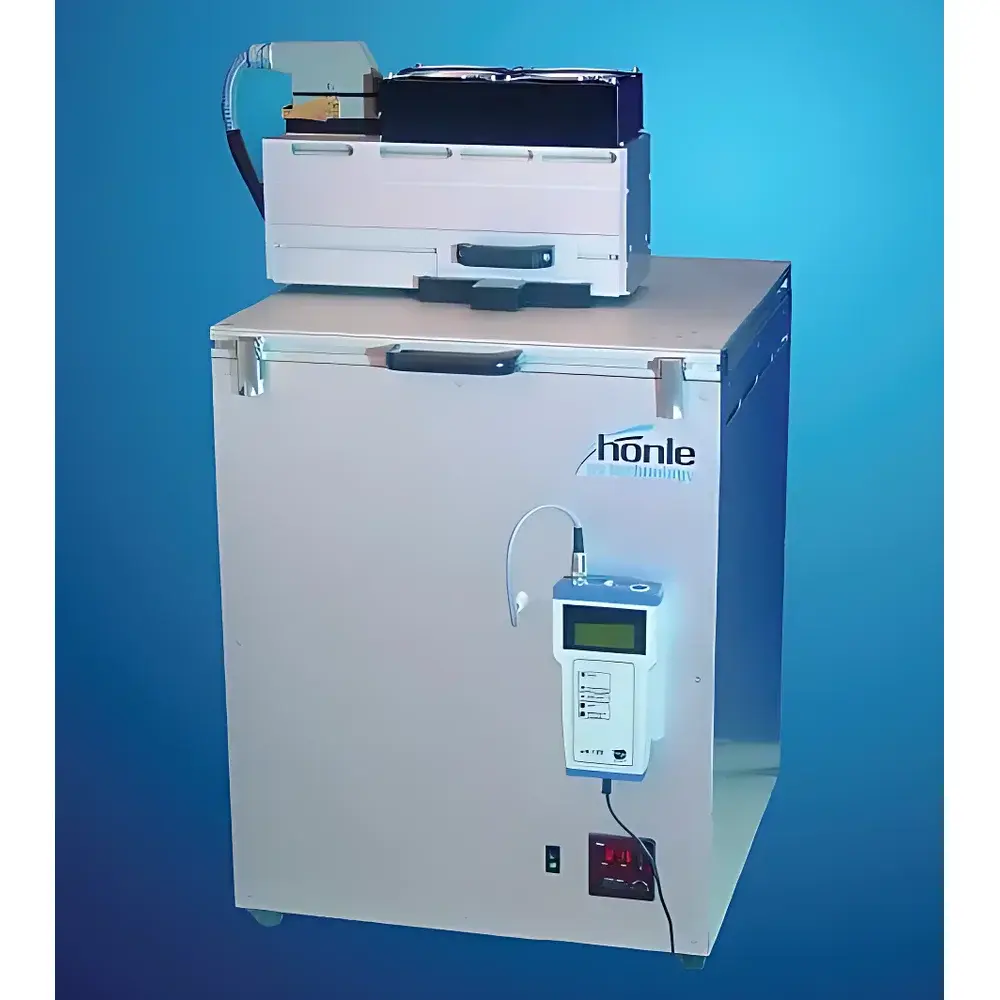
Hönle UVACUBE Inert UV Curing Chamber
| Brand | Hönle |
|---|---|
| Origin | Germany |
| Model | UVACUBE Inert |
| Chamber Dimensions (W×H×D) | 450 × 450 × 450 mm |
| External Dimensions (W×H×D) | 530 × 920 × 530 mm |
| Door Opening (W×H) | 450 × 450 mm |
| Atmosphere | CO₂-controlled inert environment |
| Residual Oxygen Monitoring | Continuous in-situ measurement |
| UV Intensity Options | Multiple selectable irradiance levels |
| Lamp/Filter Configurations | Modular UV lamp and optical filter combinations |
| Safety | Interlocked light-shielded door and shutter with audible end-of-cycle signal |
| Optional | Integrated height-adjustable worktable |
Overview
The Hönle UVACUBE Inert is a high-precision, industrial-grade UV curing chamber engineered for reproducible, oxygen-sensitive photopolymerization processes. Unlike conventional air-based UV systems, the UVACUBE Inert maintains a controlled CO₂-rich inert atmosphere—eliminating oxidative inhibition of free-radical polymerization and enabling full-depth, high-fidelity curing of acrylate-based coatings, adhesives, and sealants in complex 3D geometries. Its design adheres to fundamental photochemical principles: by suppressing ambient O₂ diffusion into the reaction zone (monitored continuously via integrated electrochemical oxygen sensor), the system ensures rapid and uniform radical initiation across substrates with high aspect ratios or shadowed features. This capability is critical for applications demanding high crosslink density, mechanical integrity, and long-term stability—particularly in microfluidic device fabrication, optical bonding, and functional thin-film encapsulation.
Key Features
- Inert atmosphere control via regulated CO₂ purge—reducing residual oxygen to sub-100 ppm levels with real-time feedback monitoring
- Modular UV lamp architecture supporting multiple spectral outputs (e.g., 254 nm, 365 nm, 385 nm, 405 nm) paired with precision bandpass or longpass filters for application-specific photoinitiator activation
- Shutter-integrated timer with ±0.1 s resolution and acoustic confirmation signal for repeatable exposure dosimetry
- Interlocked, light-tight access door and internal shutter meeting IEC 60825-1 Class 3R laser safety requirements for UV radiation containment
- Robust stainless-steel chamber interior with reflective aluminum-coated walls to maximize UV photon utilization efficiency
- Optional height-adjustable electric worktable (EN 13131-1 compliant) enabling ergonomic integration into automated lab or pilot-line workflows
Sample Compatibility & Compliance
The UVACUBE Inert accommodates substrates up to 450 mm × 450 mm × 450 mm, including glass slides, silicon wafers, polymer microplates, injection-molded housings, and flexible printed circuits. Its inert CO₂ environment prevents yellowing, surface oxidation, or incomplete cure at interface boundaries—making it suitable for ISO 10993-compliant biomaterial coating validation and ASTM D4297-18 adhesion testing protocols. The system operates within defined UV exposure limits per ACGIH TLV® guidelines and supports audit-ready documentation for GLP and GMP environments when paired with optional Hönle UV-DataLogger software (21 CFR Part 11 compliant with electronic signature and audit trail functionality).
Software & Data Management
While the base UVACUBE Inert operates via intuitive front-panel controls, optional Hönle UV-DataLogger software enables full traceability: exposure time, lamp intensity, chamber O₂ concentration, and cycle timestamps are logged to encrypted CSV or SQL databases. The software supports user-defined recipe libraries with parameter locking, role-based access control, and exportable reports aligned with ISO/IEC 17025 calibration record requirements. All firmware updates are digitally signed and validated to ensure system integrity across regulatory inspections.
Applications
- Curing of low-VOC UV inks and protective lacquers on automotive trim and medical device housings
- Encapsulation of MEMS sensors and OLED displays requiring pinhole-free, low-stress barrier layers
- Photopolymerization of hydrogel scaffolds for tissue engineering under sterile, O₂-controlled conditions
- Optical adhesive bonding of camera lens assemblies where refractive index matching and interfacial void elimination are critical
- Rapid prototyping of microfluidic chips using thiol-ene or norbornene-based resins sensitive to atmospheric quenching
FAQ
What inert gas does the UVACUBE Inert use, and why CO₂ instead of nitrogen?
The system uses CO₂ as the primary inerting gas due to its higher density (1.98 kg/m³ vs. N₂’s 1.25 kg/m³), which improves blanket stability over vertical substrates and reduces purge volume requirements—lowering operational cost and environmental footprint.
Can the UVACUBE Inert be integrated into an automated production line?
Yes—via optional digital I/O interface (24 V DC, relay outputs, RS-485 Modbus RTU) for synchronization with conveyor systems, robotic handlers, or MES platforms.
Is UV spectral output calibrated and traceable to national standards?
All lamp/filter configurations are supplied with factory calibration certificates traceable to PTB (Physikalisch-Technische Bundesanstalt), Germany, including spectral irradiance (W/m²/nm) and radiometric dose (J/cm²) uncertainty budgets.
How frequently must the oxygen sensor be recalibrated?
The electrochemical O₂ sensor requires annual verification against certified zero-air and span-gas standards; field recalibration is supported via Hönle Service Mode without disassembly.
Does the system meet CE marking requirements for electromagnetic compatibility and machinery safety?
Yes—the UVACUBE Inert carries full CE marking under Directive 2006/42/EC (Machinery), 2014/30/EU (EMC), and 2014/35/EU (LVD), with test reports available upon request.





