
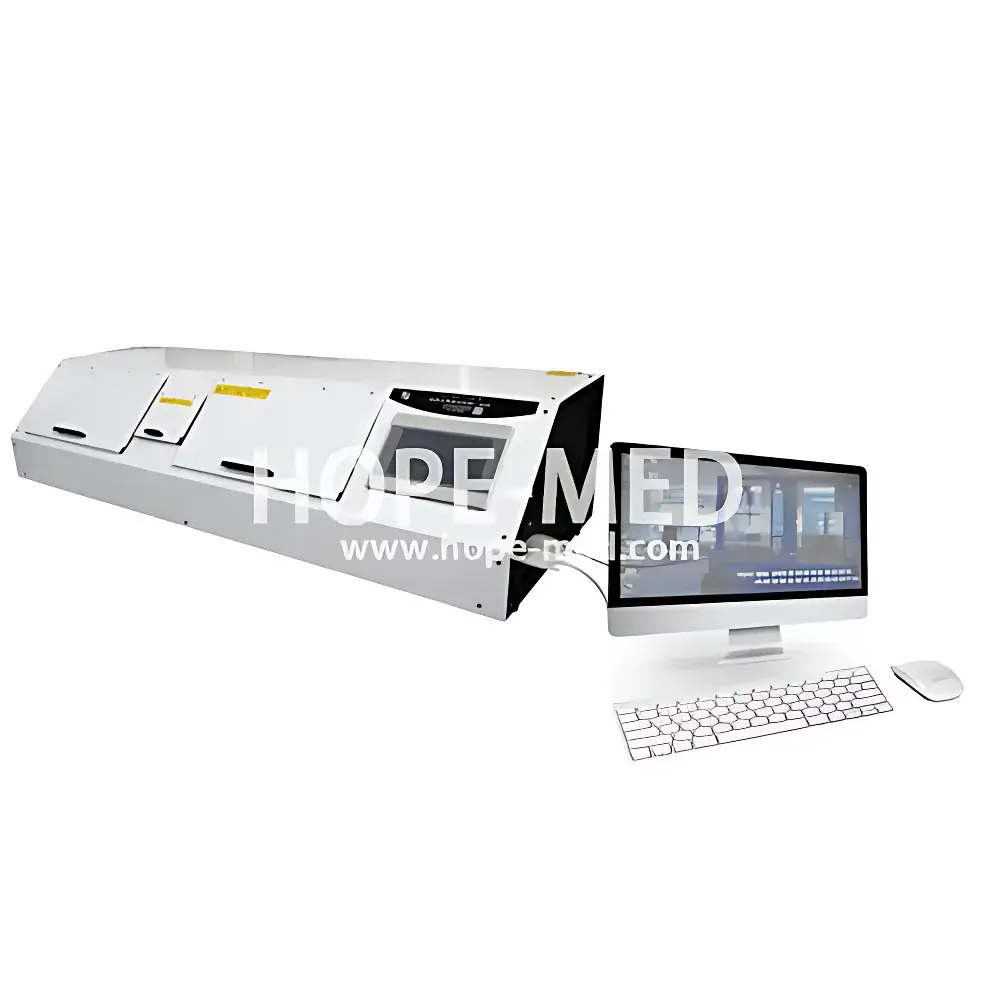

HOPE-MED 8130C Phototoxicity Testing Instrument
| Brand | HOPE-MED |
|---|---|
| Origin | Tianjin, China |
| Manufacturer Type | Authorized Distributor |
| Product Category | Domestic |
| Model | HOPE-MED 8130C |
| Light Source Type | UVA-emitting broadband source (320–400 nm) |
| Irradiation Mode | Internal irradiation chamber |
| Sample Capacity | Up to 8 rodents (guinea pigs or rats) per run |
| Timer Range | Programmable exposure and UV disinfection cycles |
| Chamber Sealing | Light-tight enclosure with optical safety interlock |
| Viewing Window | UV-filtered acrylic viewport compliant with IEC 62471 photobiological safety requirements |
Overview
The HOPE-MED 8130C Phototoxicity Testing Instrument is a purpose-built, regulatory-aligned preclinical testing system engineered for standardized in vivo phototoxicity assessment in accordance with OECD Test Guideline 432 (In Vitro 3T3 NRU Phototoxicity Test) and supplementary principles outlined in ISO 10993-10:2023 (Biological evaluation of medical devices — Part 10: Tests for irritation and skin sensitization). While primarily designed for rodent models—including guinea pigs and rats—the instrument supports controlled UVA irradiation (320–400 nm) under reproducible dosimetric conditions. Its internal irradiation architecture eliminates ambient light interference and ensures spatial uniformity across the exposure chamber, enabling consistent radiant exposure (measured in J/cm²) across multiple test subjects simultaneously. The system operates on photobiological dose control principles—linking spectral irradiance, exposure duration, and biological endpoint quantification—making it suitable for toxicological screening of pharmaceuticals, topical cosmetics, medical device coatings, and occupational chemical formulations.
Key Features
- Integrated UVA broadband light source with stable spectral output calibrated to ISO/CIE reference curves for phototoxic action spectrum weighting
- Light-tight exposure chamber featuring mechanical interlock and UV-blocking viewing window (OD ≥ 4 at 315–400 nm), certified per IEC 62471 Risk Group 1 classification
- Programmable dual-timer system supporting independent configuration of phototoxic exposure duration and post-exposure UV chamber disinfection cycles
- Modular animal tray design accommodating up to eight individually restrained rodents with anatomically aligned dorsal exposure zones
- Uniform irradiance distribution (±5% deviation across active area) verified by NIST-traceable radiometric mapping
- Front-access service panel and smooth-chamber interior enabling rapid decontamination and residue-free cleaning between studies
Sample Compatibility & Compliance
The HOPE-MED 8130C is validated for use with standard laboratory rodent models including Hartley guinea pigs and Sprague-Dawley rats, with adjustable restraint fixtures ensuring consistent dorsal skin positioning relative to the irradiation plane. Chamber dimensions support both single-dose acute exposure protocols and multi-session cumulative phototoxicity regimens. All operational parameters—including irradiance stability, timer accuracy, and interlock response latency—are documented in the instrument’s Factory Acceptance Test (FAT) report. The system supports GLP-compliant study execution when paired with electronic lab notebook (ELN) integration and audit-trail-enabled data logging. It meets essential requirements of ISO/IEC 17025 for test equipment used in accredited toxicology laboratories and aligns with USP and EP 2.6.27 phototoxicity assay prerequisites.
Software & Data Management
The instrument operates via embedded microcontroller firmware with no external PC dependency; all user inputs—including exposure time, disinfection interval, and session counter—are stored in non-volatile memory with timestamped event logging. Optional RS-232 or USB-C interface enables export of irradiation logs (date/time stamp, set duration, actual measured exposure, interlock status) for inclusion in regulatory submission dossiers. Data output conforms to ASTM E2581-22 (Standard Practice for Recording and Reporting Photobiological Test Data) metadata structure. Audit trail functionality records operator ID (via optional RFID badge reader), parameter changes, and error events—fully traceable for FDA 21 CFR Part 11 compliance when deployed in GxP environments.
Applications
- Regulatory phototoxicity screening of dermal drug candidates under ICH S10 guidance
- Safety evaluation of UV-filtered cosmetic formulations, sunscreens, and fragrance ingredients
- Phototoxic hazard assessment of medical device leachables and polymer degradation products
- Occupational health studies on photosensitizing industrial chemicals (e.g., polycyclic aromatic hydrocarbons, certain antibiotics)
- Academic research in cutaneous photobiology, including mechanisms of UVA-induced oxidative stress and cytokine release
- Validation of alternative in vitro phototoxicity models using in vivo correlation benchmarks
FAQ
What wavelength range does the HOPE-MED 8130C emit, and is spectral output certified?
The instrument delivers broadband UVA radiation (320–400 nm) with peak intensity near 365 nm. Spectral power distribution is characterized annually using a calibrated spectroradiometer traceable to NIM (China National Institute of Metrology).
Can the system be used for ISO 10993-10-compliant biocompatibility testing?
Yes—when operated within defined exposure parameters (e.g., 5 J/cm² ±10%, 30-min post-irradiation observation window), it fulfills the irradiation hardware requirements specified in Annex A of ISO 10993-10:2023.
Is the irradiance uniformity validated across the full exposure area?
Yes—uniformity mapping is performed during factory calibration and verified annually. Measured deviation remains ≤ ±5% over the central 80% of the chamber floor area.
Does the instrument support 21 CFR Part 11 compliance for electronic records?
With optional RFID authentication module and ELN-integrated data export, full Part 11 compliance—including electronic signatures, audit trails, and record retention—is achievable in validated GxP deployments.
What maintenance intervals are recommended for the UVA source and optical components?
Lamp replacement is advised every 1,000 operating hours or annually, whichever occurs first. Quartz window cleaning and interlock verification are required prior to each study series.



