
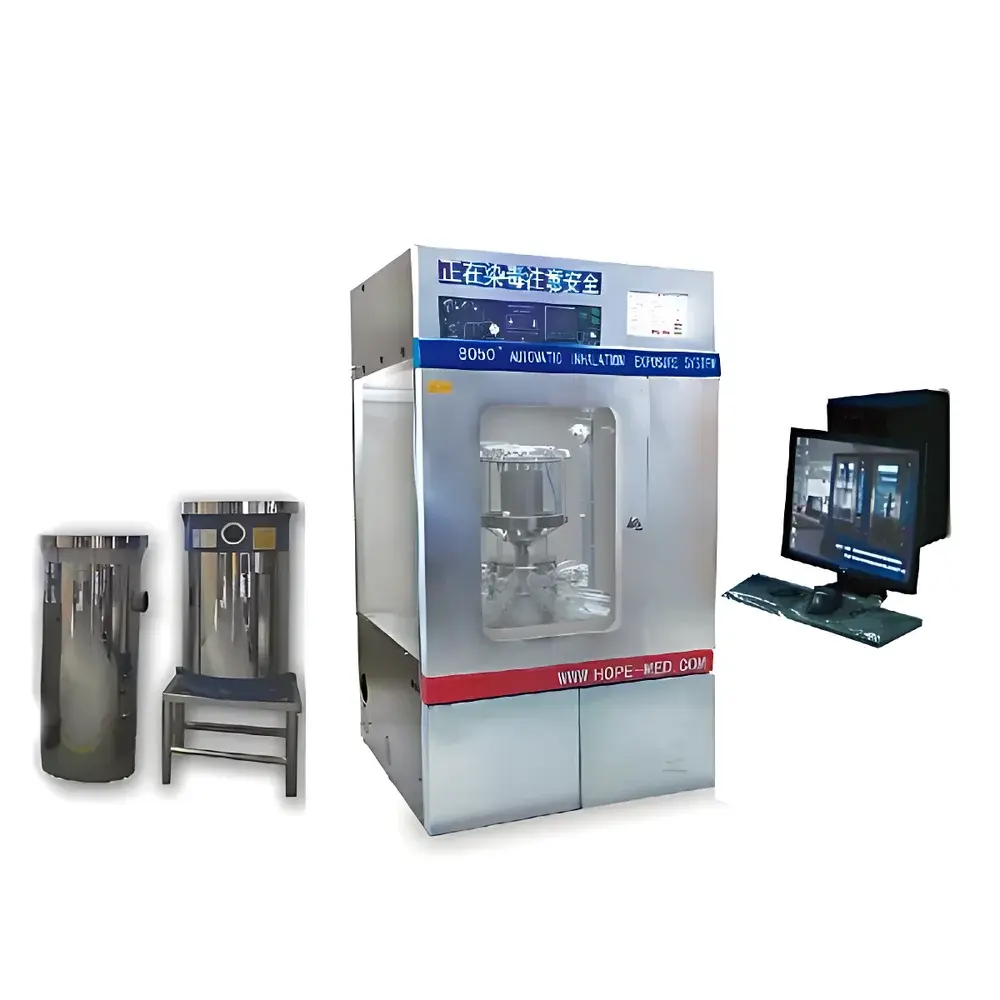
HOPE-MED HOPE-MED8050 Dynamic Nose-Only Inhalation Exposure Chamber for Small Rodents
| Brand | HOPE-MED |
|---|---|
| Model | HOPE-MED8050 |
| Origin | Tianjin, China |
| Chamber Type | Dynamic, Nose-Only, Flow-Through |
| Aerosol Delivery Mode | Liquid aerosol (nebulized), solid particulate, or vapor/gas |
| Particle Size Distribution | ≥99% <10 µm |
| Inter-animal & Inter-tier Aerosol Uniformity | ≤10% CV |
| Control Interface | Integrated industrial touchscreen HMI + optional PC-based control software |
| Regulatory Compliance | Designed to support OECD 412, 413, 436 |
Overview
The HOPE-MED HOPE-MED8050 is a dynamic, nose-only inhalation exposure chamber engineered for precise, reproducible, and regulatory-compliant toxicological assessment in small rodents—primarily mice and rats. It operates on the principle of continuous-flow, single-pass aerosol delivery, eliminating recirculation and ensuring each animal receives a defined, time-resolved dose without cross-contamination or secondary inhalation of exhaled or deposited material. The system maintains laminar, unidirectional airflow across individually isolated nose-only ports, minimizing turbulence-induced particle coagulation or sedimentation. Its design conforms to internationally recognized test guidelines—including OECD Test Guidelines 412 (subacute inhalation), 413 (subchronic inhalation), and 436 (inhalation toxicity of nanomaterials)—and supports full adherence to Good Laboratory Practice (GLP) requirements for audit readiness, traceability, and data integrity.
Key Features
- Dynamic flow-through architecture with real-time air exchange control, enabling stable exposure concentrations over durations ranging from acute (≤24 h) to chronic (≥6 months) studies.
- Nose-only restraint system with adjustable, ergonomic animal holders accommodating 10–20 adult mice or 5–10 rats per tier, scalable across up to three independent exposure tiers.
- Integrated ultrasonic or jet nebulization module optimized for liquid aerosols, delivering respirable particles with mass median aerodynamic diameter (MMAD) ≤4 µm and geometric standard deviation (GSD) between 1.5 and 3.0—meeting inhalable and thoracic deposition criteria per ISO 85042 and US EPA inhalation dosimetry models.
- Automated chamber wash-down cycle using programmable compressed-air purging and HEPA-filtered exhaust recovery, reducing carryover between exposures and supporting multi-dose or multi-compound study designs.
- Dual-control operation: standalone operation via ruggedized industrial touchscreen HMI with embedded logic controller, or remote orchestration via Ethernet-connected PC with configurable exposure profiles (ramp-up, steady-state, taper-down).
- Real-time environmental monitoring: integrated sensors for temperature (±0.5 °C), relative humidity (±3% RH), static pressure differential (±0.1 Pa), and total airflow (±1.5% FS), all logged with timestamped metadata.
Sample Compatibility & Compliance
The HOPE-MED8050 accommodates gaseous agents (e.g., chlorine, ozone, VOCs), liquid aerosols (e.g., pharmaceutical suspensions, pesticide emulsions), and dry powders (e.g., metal oxides, polymer nanoparticles) when paired with compatible generation systems (e.g., collision nebulizers, fluidized bed aerosol generators). All wetted surfaces are constructed from electropolished 316L stainless steel and FDA-compliant fluoropolymers, ensuring chemical resistance and ease of decontamination. The system is validated for use under GLP environments, with full documentation packages available—including Installation Qualification (IQ), Operational Qualification (OQ), and Performance Qualification (PQ) protocols aligned with ISO/IEC 17025 and FDA 21 CFR Part 58 expectations. Aerosol uniformity validation per ASTM E1718 Annex A4 confirms ≤10% coefficient of variation (CV) in delivered dose across all animal ports within a tier and between tiers.
Software & Data Management
Control and data acquisition are managed through HOPE-MED’s ExposureSuite™ v3.x software (Windows 10/11 compatible), featuring role-based user access, electronic signatures, and full 21 CFR Part 11 compliance—including audit trail logging, data immutability, and secure backup export (CSV, PDF, XML). Exposure profiles are defined using intuitive graphical timeline editors, with automatic synchronization to environmental sensor streams and external analyzers (e.g., SMPS, APS, GC-MS). Raw data files are stored in vendor-neutral HDF5 format, enabling third-party integration with LIMS platforms (e.g., LabVantage, STARLIMS) and statistical analysis tools (R, Python pandas).
Applications
- Pulmonary toxicology screening of inhaled therapeutics, excipients, and contaminants per ICH S7A and S7B.
- Nanomaterial safety assessment under OECD TG 436 and ISO/TR 16193, including deposition modeling and clearance kinetics.
- Respiratory sensitization evaluation (e.g., toluene diisocyanate, nickel sulfate) using murine models per OECD TG 429 modifications.
- Inhalation PK/PD studies integrating bronchoalveolar lavage (BAL), histopathology, and qPCR endpoints.
- Environmental health research on urban particulate matter (PM2.5, PM10) and combustion-derived aerosols.
FAQ
What exposure durations does the HOPE-MED8050 support?
It supports exposures from 15 minutes (acute challenge) to continuous 6-month regimens (chronic), with programmable rest periods and staggered dosing schedules.
Can it be used for whole-body exposure?
No—it is strictly configured for nose-only exposure to ensure precise dosimetry and eliminate dermal/ingestion confounders.
Is aerosol concentration monitored in real time during exposure?
Yes—when interfaced with optional photometric (e.g., TSI 3563) or gravimetric (e.g., TEOM) monitors, concentration feedback can trigger closed-loop flow modulation.
Does the system meet ISO 10993-12 requirements for medical device biocompatibility testing?
Yes—the chamber’s materials, cleaning validation, and aerosol delivery fidelity align with ISO 10993-12 Annex C for inhalation route characterization.
What calibration standards are provided with the system?
NIST-traceable anemometer and hygrometer calibrations are included at shipment; aerosol size distribution validation uses PSL reference particles certified per ISO 21501-4.
Related Products





