
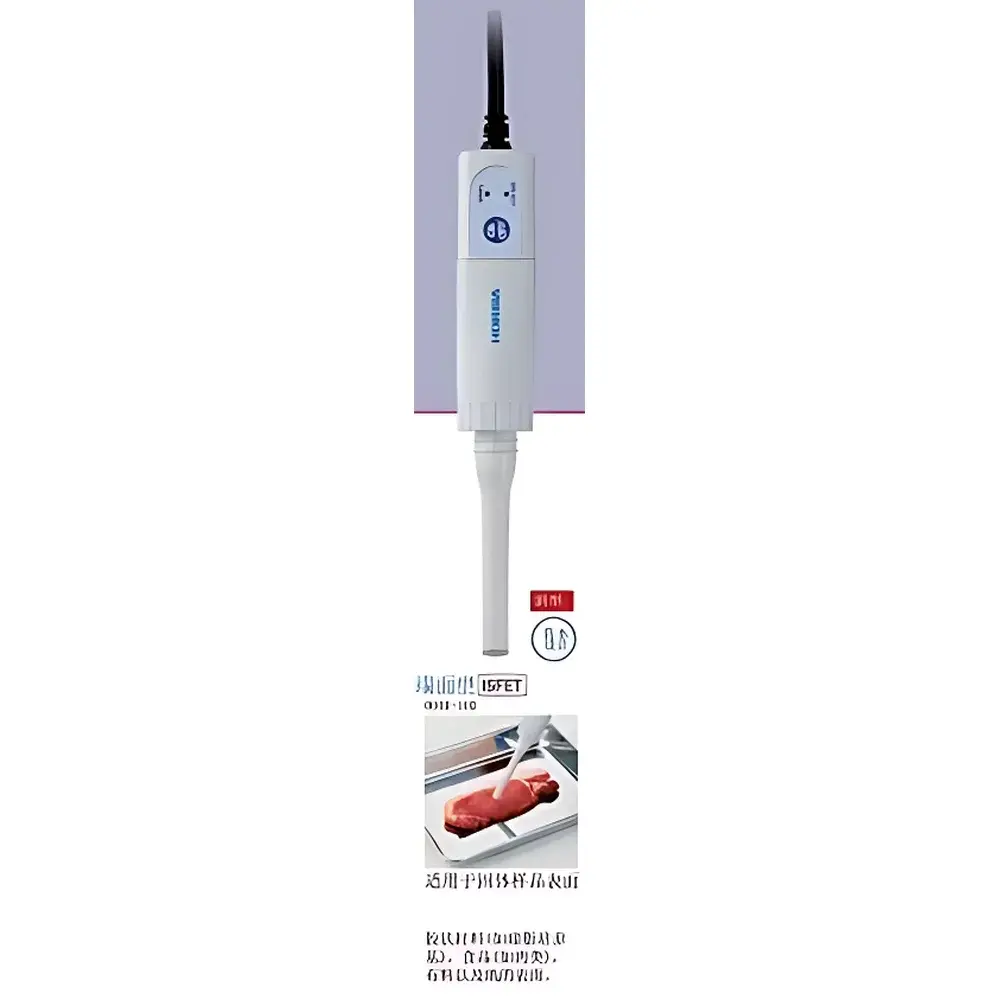
HORIBA 0040-10D Flat-Surface ISFET pH Electrode
| Brand | HORIBA |
|---|---|
| Origin | Japan |
| Model | 0040-10D |
| Temperature Range | 0–60 °C |
| pH Range | 0–14 |
| Electrode Type | Solid-State ISFET (Ion-Sensitive Field-Effect Transistor) |
| Sensing Surface | Flat-tip, <100 µm gap between sensor surface and protective sleeve |
| Compliance | Designed for GLP/GMP-relevant environments |
Overview
The HORIBA 0040-10D is a solid-state, flat-surface ISFET (Ion-Sensitive Field-Effect Transistor) pH electrode engineered for high-reliability, low-maintenance measurements in demanding analytical and industrial applications. Unlike conventional glass membrane electrodes, the 0040-10D employs semiconductor-based sensing technology—where hydrogen ion activity modulates the gate potential of a silicon nitride–coated FET structure—enabling direct, drift-resistant voltage output proportional to pH. Its flat-tip geometry eliminates air bubble entrapment at the sensing interface and permits stable contact with heterogeneous surfaces, including semi-solid matrices, gels, thin liquid films, and micro-volume droplets (≥5 µL). The device operates across the full aqueous pH range (0–14) within 0–60 °C, with integrated temperature compensation via optional or co-located Pt1000 thermistor support (e.g., HORIBA 4163-10T). Designed and manufactured in Japan under strict JIS Q 9001 quality control, the 0040-10D meets structural durability requirements exceeding JIS Z 8809 mechanical strength benchmarks by >10×.
Key Features
- Flat-surface ISFET sensor with <100 µm clearance between active gate and protective sleeve—enables surface pH mapping of solids, pastes, and minimal-volume samples without hydrostatic pressure artifacts.
- Patented anti-static circuit architecture incorporating HORIBA’s proprietary semiconductor shielding design—eliminates electrostatic discharge (ESD) susceptibility common to conventional ISFETs, ensuring signal integrity in dry-handling or low-humidity lab environments.
- Chemically inert, non-glass sensing element—immune to breakage, alkali leaching, or hydrolysis-induced drift; suitable for repeated cleaning with soft-bristled brushes and storage in ambient dry conditions (no KCl soaking required).
- Stable reference system utilizing cation-conductive hollow-fiber membrane—reduces Ag⁺/AgCl complex precipitation at the liquid junction by three orders of magnitude versus conventional double-junction designs, maintaining long-term reference potential stability (<±0.5 mV/month typical drift).
- Robust polypropylene body with IP67-rated connector housing—compatible with benchtop meters (e.g., HORIBA LAQUA twin series), process transmitters, and OEM data acquisition systems via standard BNC or DIN 19253 interfaces.
Sample Compatibility & Compliance
The 0040-10D is validated for use with low-conductivity aqueous solutions (≥10 µS/cm), non-aqueous media (e.g., ethanol/water mixtures ≤80% v/v), slurries, food surfaces (cheese rinds, meat cuts), pharmaceutical tablet coatings, and hydrogel-based biomaterials. It complies with measurement traceability frameworks aligned with ISO/IEC 17025:2017 for calibration verification and supports audit-ready documentation under FDA 21 CFR Part 11 when paired with compliant data loggers (e.g., HORIBA DataStream Pro v3.2+ with electronic signature and change-tracking). Its design satisfies critical parameters outlined in ASTM D1293 (pH of water), ISO 10523 (water quality—pH determination), and USP (pH measurement in pharmaceutical preparations), including response time (t₉₀ ≤ 15 s in buffer), repeatability (±0.02 pH), and thermal hysteresis (<0.01 pH over 0–60 °C cycle).
Software & Data Management
When interfaced with HORIBA’s LAQUA Connect software or third-party SCADA-compatible platforms (via Modbus RTU or analog 4–20 mA output), the 0040-10D supports automated calibration logging, slope/offset trending, and drift diagnostics. All measurement sessions—including calibration timestamps, buffer IDs, temperature readings, and user annotations—are stored with immutable audit trails meeting ALCOA+ principles (Attributable, Legible, Contemporaneous, Original, Accurate, Complete, Consistent, Enduring, Available). Firmware updates preserve backward compatibility with legacy meter firmware (v2.10+), and configuration profiles can be exported/imported as encrypted .cfg files for cross-lab method harmonization.
Applications
- Surface pH profiling of edible films, wound dressings, and polymer-coated implants in R&D labs.
- In-line monitoring of fermentation broth pH during bioprocess scale-up (when mounted in sanitary tri-clamp adapters).
- Quality control of topical dermatological formulations where conventional glass electrodes risk contamination or sample disturbance.
- Educational laboratories requiring rugged, student-safe pH sensors for fieldwork or classroom experiments involving soil moisture, leaf surfaces, or food acidity screening.
- Environmental testing of sediment pore water and biofilm interfaces where minimal invasiveness and bubble-free contact are essential.
FAQ
Can the 0040-10D be used in non-aqueous solvents?
Yes—validated for ethanol/water, methanol/water, and acetone/water mixtures up to 80% organic content; avoid pure non-polar solvents (e.g., hexane, toluene) due to insufficient ionic activity.
Does it require storage in KCl solution?
No—unlike glass electrodes, the ISFET sensor may be stored dry at room temperature; prolonged exposure to desiccants is not recommended.
What is the expected service life under routine laboratory use?
Typical operational lifespan exceeds 24 months with daily calibration and gentle mechanical cleaning; performance validation against NIST-traceable buffers is recommended every 90 days.
Is it compatible with non-HORIBA meters?
Yes—functions with any pH meter supporting high-impedance (≥10¹² Ω) input and standard mV/pH scaling; verify compatibility with your instrument’s manual prior to integration.
Can it measure pH of solid surfaces directly?
Yes—the flat tip enables reproducible contact with hydrated solid phases (e.g., agar plates, tofu, hydrogels); ensure surface moisture content ≥15% w/w for reliable H⁺ activity detection.




