
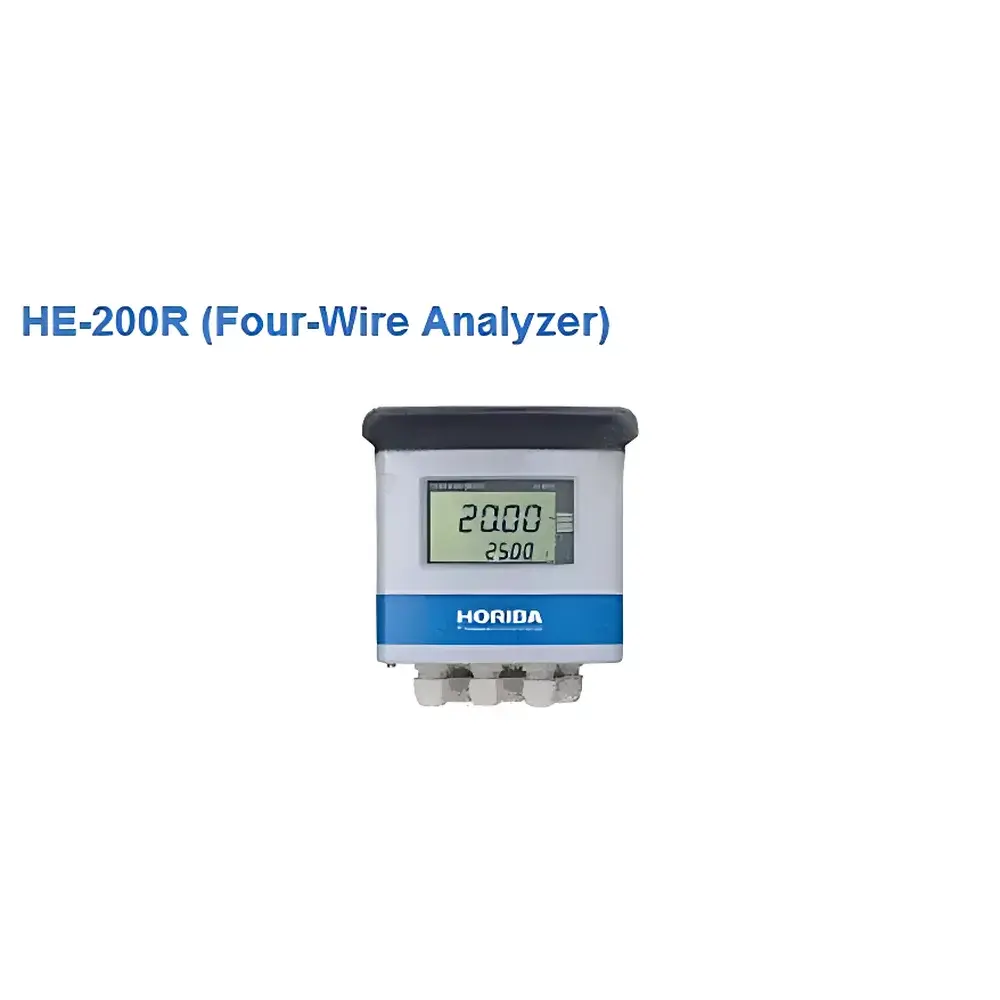
HORIBA HE-200R Industrial Online Resistivity Monitor
| Brand | HORIBA |
|---|---|
| Origin | Japan |
| Model | HE-200R |
| Measurement Principle | Two-Electrode Conductivity Method (Inverse Calculation for Resistivity) |
| Resistivity Range | 0.000–2.000 MΩ·cm (with K=0.01/cm electrode), 0.00–20.00 kΩ·cm, 0.0–200.0 kΩ·cm |
| Temperature Range | 0–100 °C |
| Temperature Compensation | Pt1000 sensor (0 °C reference), 0–100 °C range |
| Accuracy (Resistivity) | ±0.01 MΩ·cm max (at reference temperature, standard units) |
| Accuracy (Temperature) | ±0.02 °C max |
| Repeatability (Resistivity) | ±0.1% FS |
| Linearity (Resistivity) | ±0.5% FS |
| Output | Isolated 4–20 mA (2 points), SPDT relay outputs (3 points), dry-contact input (1 point) |
| Communication | RS-485 (2-wire, input/output isolated) |
| Enclosure Rating | IP65 |
| Compliance | CE, FCC, RoHS, WEEE |
| Power Supply | 90–264 V AC, 50/60 Hz, ≤15 VA |
| Operating Ambient | −20 to +55 °C |
| Weight | ~4.5 kg |
| Sensor Compatibility | ERF-series resistivity sensors (K=0.01 cm⁻¹) |
| Calibration | Electrode constant entry, single-point temperature calibration, atmospheric or saturated solution reference modes |
| Special Functions | Ultrapure water resistivity mode, trim adjustment, real-time self-diagnosis (electrode fault, analyzer error) |
Overview
The HORIBA HE-200R is an industrial-grade, outdoor-rated online resistivity monitor engineered for continuous, high-stability measurement of ultrapure and process water in demanding manufacturing and environmental monitoring applications. It operates on the two-electrode conductance principle—measuring electrical conductivity and computing resistivity inversely using a precisely defined cell constant (K = 0.01 cm⁻¹). This method ensures traceable, reproducible results across low-conductivity regimes where conventional four-electrode systems are unnecessary, yet accuracy and long-term drift resistance remain critical. Designed as part of HORIBA’s H-1 series of field-deployable analyzers, the HE-200R integrates seamlessly into automated water quality control loops—particularly in semiconductor fabrication, pharmaceutical water-for-injection (WFI) systems, power plant condensate monitoring, and municipal advanced treatment facilities. Its robust aluminum housing, IP65 ingress protection, and −20 to +55 °C operational envelope support unattended installation on utility poles, process skids, or exterior walls without climate-controlled enclosures.
Key Features
- Field-hardened construction with die-cast aluminum enclosure and SUS304 mounting hardware, certified to IP65 for dust-tight and low-pressure water jet resistance.
- Dual-mode resistivity display: automatic range switching between MΩ·cm (0.000–2.000), kΩ·cm (0.00–20.00), and extended kΩ·cm (0.0–200.0), optimized for both ultrapure water (≥18.2 MΩ·cm at 25 °C) and industrial process streams.
- Integrated Pt1000 temperature sensing (0 °C reference) with full 0–100 °C compensation, enabling ASTM D1125-compliant resistivity normalization to 25 °C when required.
- Real-time self-diagnostic engine continuously monitors electrode integrity, signal stability, and internal circuit health—flagging anomalies such as coating, open-circuit, or calibration drift before measurement deviation exceeds specification limits.
- Three configurable SPDT relay outputs support independent high/low alarms, system fault signaling (e.g., sensor disconnection or analyzer failure), and interlock integration with PLCs or SCADA systems.
- RS-485 Modbus RTU interface (2-wire, galvanically isolated I/O) enables centralized data acquisition, remote configuration, and audit-trail-capable logging—compatible with FDA 21 CFR Part 11–compliant data historians when deployed with appropriate software infrastructure.
Sample Compatibility & Compliance
The HE-200R is validated for use with HORIBA’s ERF-series resistivity electrodes (K = 0.01 cm⁻¹), specifically designed for low-conductivity liquids including deionized water, reverse osmosis permeate, boiler feedwater, and clean steam condensate. It meets electromagnetic compatibility requirements per FCC Part 15 Class A and EU EMC Directive 2014/30/EU, carries CE marking for safe operation within the European Economic Area, and conforms to RoHS 2011/65/EU and WEEE 2012/19/EU directives. While not a GLP/GMP-certified instrument out-of-the-box, its calibration traceability (via documented electrode constant entry and temperature reference validation), alarm event logging, and output isolation support qualification under ISO/IEC 17025 and USP water quality testing frameworks when integrated into validated system architectures.
Software & Data Management
No proprietary PC software is bundled; configuration and monitoring rely on industry-standard protocols. Device parameters—including electrode constant, temperature offset, alarm thresholds, and relay logic—are set via front-panel keypad or remotely via Modbus register mapping (Function Codes 03h/06h/10h). All relay state changes, calibration timestamps, and diagnostic events are timestamped and retained in non-volatile memory. The isolated 4–20 mA analog outputs (two channels) transmit linearized resistivity and temperature values simultaneously to DCS or PLC systems, supporting redundant trending and SPC charting. For regulatory environments, third-party SCADA platforms (e.g., Ignition, Siemens Desigo CC, or Emerson DeltaV) can be configured to enforce electronic signatures, audit trails, and change-control workflows around parameter modifications.
Applications
- Semiconductor fab UPW (ultrapure water) distribution loop monitoring, meeting SEMI F63 specifications for resistivity stability and detection of ionic contamination events.
- Pharmaceutical purified water (PW) and water-for-injection (WFI) systems per USP , where resistivity serves as a primary indicator of organic and ionic impurity load.
- Power generation cycle chemistry—monitoring condensate polishers and feedwater systems to detect condenser tube leaks or resin exhaustion.
- Municipal advanced treatment plants performing tertiary filtration and membrane-based reuse, verifying post-RO resistivity prior to disinfection or distribution.
- Chemical and biotech process water recirculation networks, ensuring consistent solvent purity and minimizing batch-to-batch variability.
FAQ
What electrode constant is supported by the HE-200R?
The HE-200R is factory-configured and calibrated for use exclusively with ERF-series sensors having a cell constant of 0.01 cm⁻¹. Substitution with other K-values invalidates accuracy specifications and voids calibration traceability.
Does the HE-200R perform automatic temperature compensation?
Yes—it uses a built-in Pt1000 sensor (0 °C reference) to measure sample temperature in real time and applies NIST-traceable polynomial compensation to resistivity readings across the full 0–100 °C range.
Can the HE-200R be used for conductivity measurement?
No—the HE-200R computes and displays resistivity only. For direct conductivity measurement, HORIBA’s HE-200C or standalone LAQUA twin series instruments are recommended.
Is the 4–20 mA output intrinsically safe?
No—the outputs are isolated but not intrinsically safe rated. Installation in hazardous areas requires external barriers compliant with IEC 60079-11 or ATEX directives.
How is calibration verified in routine operation?
Calibration verification is performed by comparing the analyzer’s temperature reading against a certified reference thermometer and confirming resistivity response using a stable, traceable standard solution (e.g., 1413 µS/cm KCl at 25 °C, converted to equivalent resistivity). Field recalibration requires electrode constant re-entry and temperature offset adjustment.







