
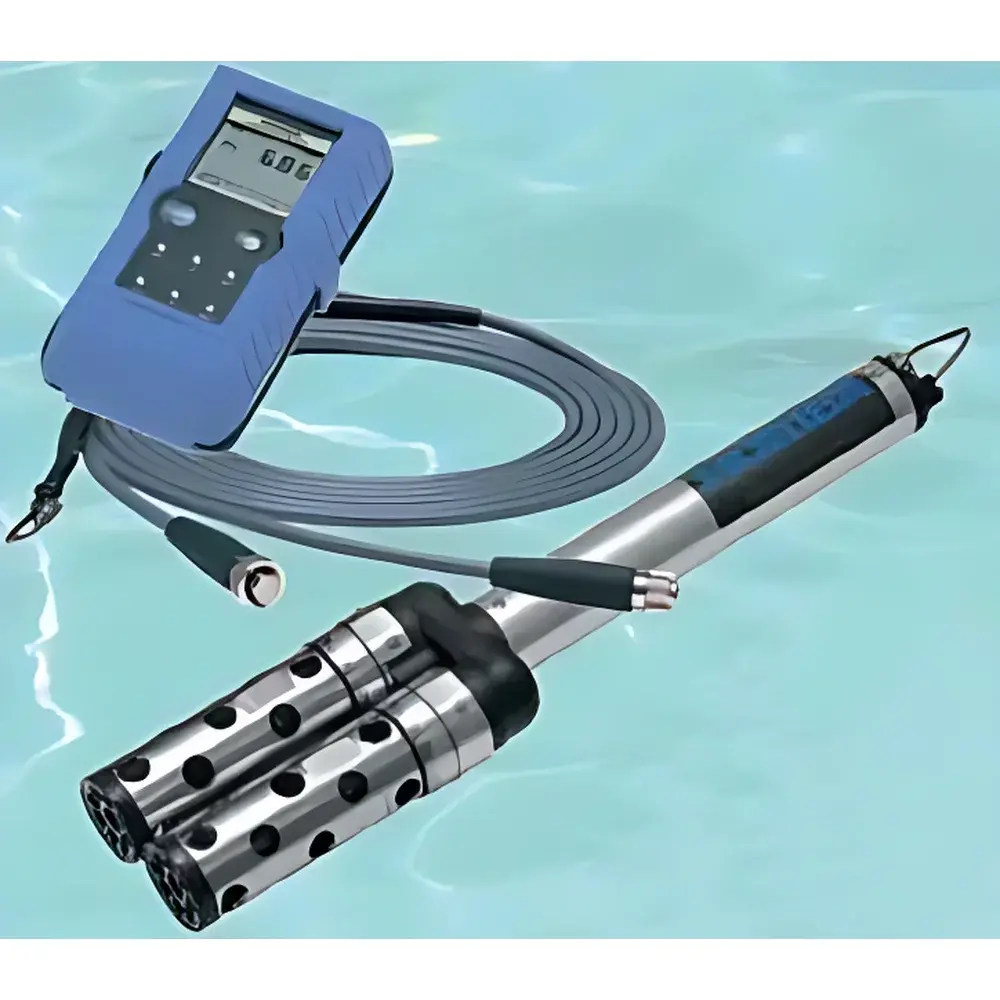
HORIBA W-20XD Portable Multi-Parameter Water Quality Analyzer with Ion Detection
| Brand | HORIBA |
|---|---|
| Origin | Japan |
| Model | W-20XD |
| Instrument Type | Portable/Handheld Water Quality Analyzer |
| Depth Rating | Up to 100 m |
| Data Logging Duration | 30 days (15-min interval) |
| Simultaneous Parameters | Up to 13 (pH, DO, EC, Salinity, TDS, Seawater Density σt, Temperature, Turbidity, Depth, ORP, and optional ion-specific electrodes) |
| IP Rating | IP67 (Control Unit) |
| Measurement Principle | Glass electrode (pH), Membrane-covered galvanic cell (DO), AC 4-electrode (EC), Pressure transducer (Depth), Thermistor (Temperature), Nephelometric (Turbidity), Platinum electrode (ORP), Ion-selective electrodes (NO₃⁻, Cl⁻, Ca²⁺, F⁻, K⁺, NH₃) |
Overview
The HORIBA W-20XD is a rugged, submersible, portable multi-parameter water quality analyzer engineered for long-term, unattended field monitoring in diverse aquatic environments—including rivers, lakes, reservoirs, coastal zones, groundwater wells, municipal wastewater outfalls, industrial effluents, and aquaculture systems. Designed around a modular architecture, the system separates the pressure-rated probe assembly (rated to 100 m depth) from the IP67-rated control unit, enabling flexible deployment configurations—either as a handheld survey instrument or as an autonomous data logger. Its core measurement principles adhere to internationally recognized electrochemical and physical standards: pH is determined via temperature-compensated glass electrode potentiometry (ASTM D1293); dissolved oxygen employs a membrane-covered galvanic cell with automatic salinity and temperature compensation (ISO 5814); conductivity utilizes AC 4-electrode technology to minimize polarization and fouling effects (ISO 7888); turbidity follows nephelometric detection per ISO 7027; and depth is derived from high-stability piezoresistive pressure sensing. The W-20XD supports both real-time telemetry and post-deployment data retrieval via microSD card, making it suitable for GLP-compliant environmental surveillance programs requiring traceable, time-stamped records.
Key Features
- Submersible probe rated to 100 m depth with integrated pressure sensor and corrosion-resistant titanium housing for marine-grade durability
- Autonomous 30-day data logging at user-defined intervals (default 15-minute sampling), storing up to 2,880 records internally without external power or communication
- Modular probe configuration supporting up to 13 simultaneous parameters—including pH, dissolved oxygen (DO), electrical conductivity (EC), salinity, total dissolved solids (TDS), seawater density (σt), temperature, turbidity (NTU), depth, oxidation-reduction potential (ORP), and six optional ion-selective electrodes (NO₃⁻, Cl⁻, Ca²⁺, F⁻, K⁺, NH₃)
- Automatic temperature compensation across all applicable sensors, with thermistor-based temperature measurement (0–55 °C, ±1.0 °C accuracy)
- Self-diagnostic routines and on-board auto-calibration support for pH (2-point) and conductivity (auto-ranging), reducing field maintenance burden
- IP67-rated control unit with backlit LCD display, intuitive menu navigation, and USB/microSD interface for firmware updates and data export
Sample Compatibility & Compliance
The W-20XD is validated for use in freshwater, brackish water, seawater, and wastewater matrices within defined physicochemical ranges (e.g., pH 3–11 for Cl⁻, pH 12+ for NH₃). Its ion-selective electrode modules comply with ISE performance guidelines outlined in ASTM D6672 and ISO 10523. The instrument meets CE marking requirements for electromagnetic compatibility (EMC Directive 2014/30/EU) and low-voltage safety (LVD Directive 2014/35/EU). While not FDA 21 CFR Part 11–certified out-of-the-box, its audit-trail-capable data files (CSV + metadata header) support integration into validated laboratory information management systems (LIMS) under ISO/IEC 17025 or EPA Method 1600-series frameworks. Calibration verification logs, operator ID tagging, and timestamped raw measurements facilitate regulatory reporting under EU Water Framework Directive (WFD) and US Clean Water Act (CWA) monitoring protocols.
Software & Data Management
Data acquisition and configuration are managed via HORIBA’s proprietary W-Quality Suite software (Windows-compatible), which enables probe setup, calibration curve import, interval programming, and post-hoc correction of conductivity-to-salinity/TDS conversions using configurable coefficients. Exported datasets include full parameter arrays with UTC timestamps, sensor status flags (e.g., “electrode stable”, “membrane dry”), and diagnostic codes. All stored records retain native engineering units and uncertainty annotations per parameter specification. For remote deployments, optional GSM/GPRS telemetry modules allow scheduled data push to secure cloud servers—supporting TLS 1.2 encryption and role-based access control. Raw .csv outputs conform to EPA STORET and WQX schema conventions, ensuring interoperability with national water quality databases.
Applications
- Long-term ecological monitoring of stratified lake and reservoir profiles, including hypolimnetic oxygen depletion tracking
- Coastal zone management: salinity intrusion mapping, nutrient loading assessment (via NO₃⁻/NH₃), and eutrophication early warning
- Industrial compliance monitoring: continuous discharge verification against NPDES permit limits for pH, DO, conductivity, and specific ions
- Aquaculture site optimization: real-time feedback on dissolved oxygen minima, ammonia toxicity thresholds, and calcium saturation for shellfish hatcheries
- Groundwater vulnerability studies: redox profiling (ORP + DO + NO₃⁻) to delineate denitrification zones in agricultural aquifers
- Emergency response: rapid deployment for post-spill or flood-event characterization of turbidity spikes, chloride anomalies, and pH excursions
FAQ
What is the maximum operational depth for the W-20XD probe?
The probe assembly is rated for continuous operation at depths up to 100 meters, with pressure transducer accuracy maintained within ±5% of full scale.
Can the W-20XD perform simultaneous ion measurements without manual reconfiguration?
Yes—when equipped with multi-ion probe variants (e.g., W-23XD), up to six ion-selective electrodes operate concurrently with core parameters, each with independent calibration and drift compensation algorithms.
Is external power required during 30-day autonomous logging?
No—the probe’s internal lithium-thionyl chloride battery powers all sensors and memory for the full 30-day cycle at 15-minute intervals; no external cables or chargers are needed during deployment.
How is data integrity ensured during extended submersion?
All memory writes are atomic and timestamped; cyclic redundancy checks (CRC-32) validate each record upon readout, and the file system includes wear-leveling to extend microSD lifespan beyond 10,000 write cycles.
Does the system support GLP-compliant calibration documentation?
Yes—calibration events (date, time, standard values, operator ID, electrode slope/mV/pH) are embedded in every data file header and can be exported as PDF audit reports via W-Quality Suite.
Related Products







