
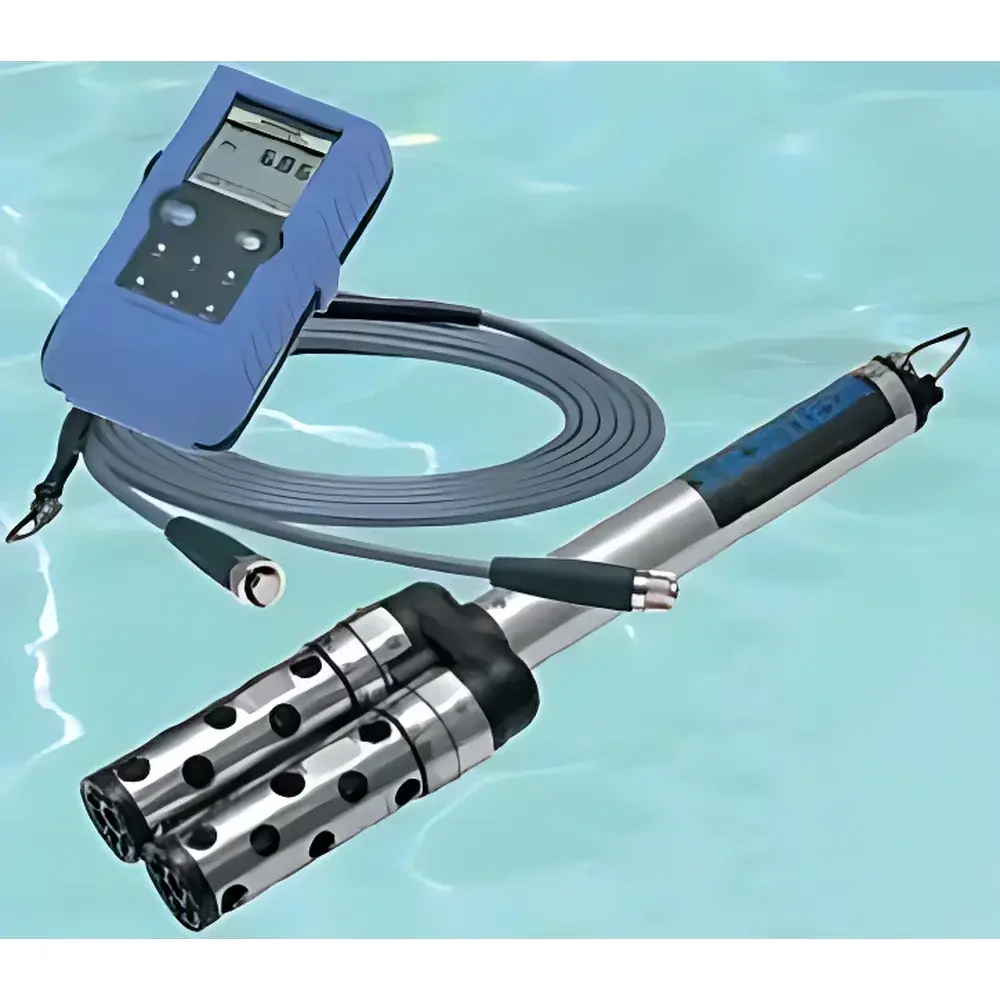
HORIBA W-20XD Series Multi-Parameter In-Situ Water Quality Monitor
| Brand | HORIBA |
|---|---|
| Origin | Japan |
| Product Type | In-situ, autonomous water quality monitoring system |
| Model | W-20XD Series (including W-22XD and W-23XD variants) |
| Measurement Depth | Up to 100 m |
| Operating Temperature | 0–55 °C |
| Storage Temperature | −5–60 °C |
| IP Rating | IP67 (control unit) |
| Data Logging Capacity | 2,880 records (30 days at 15-min intervals) |
| Simultaneous Parameters | Up to 13 (W-23XD) |
| Key Measured Parameters | pH, Dissolved Oxygen (DO), Electrical Conductivity (EC), Salinity, Total Dissolved Solids (TDS), Seawater Specific Gravity (δt), Turbidity, Water Depth (pressure-based), Temperature, ORP, and optional ion-selective electrodes (NO₃⁻, Cl⁻, Ca²⁺, F⁻, K⁺, NH₃) |
Overview
The HORIBA W-20XD Series is an autonomous, submersible multi-parameter water quality monitoring platform engineered for long-term, unattended in-situ deployment in diverse aquatic environments—including rivers, lakes, reservoirs, coastal zones, groundwater wells, municipal wastewater outfalls, industrial effluents, aquaculture systems, and agricultural runoff channels. Designed with field robustness as a foundational requirement, the system integrates precision electrochemical, optical, and pressure-based sensing technologies within a single compact probe assembly. Its core architecture follows a self-contained, battery-powered operational paradigm: once deployed—without external cabling or real-time telemetry—the W-20XD operates continuously for up to 30 days, acquiring and internally storing high-resolution measurements at user-configurable intervals (default: 15 minutes). All sensors are calibrated in accordance with internationally recognized reference methods: pH via glass electrode (ISO 10523), DO via membrane-covered galvanic cell (ISO 5814), conductivity via AC four-electrode technique (ISO 7888), turbidity via combined transmission/scattering (ISO 7027-1), and depth via piezoresistive pressure transduction (IEC 61000-6-4 compliant). The system’s mechanical design meets JIS C 0920 IP67 for the control unit and incorporates pressure-compensated sensor housings rated for continuous operation at 100 m hydrostatic depth—enabling reliable data acquisition in both freshwater and full-strength seawater.
Key Features
- Autonomous 30-day operation on internal rechargeable battery—no external power or data cables required during deployment.
- Integrated data logger with non-volatile memory storing up to 2,880 timestamped records (sufficient for 30 days at 15-minute intervals).
- Pressure-rated probe housing certified for continuous immersion at depths up to 100 meters; optimized for marine, lacustrine, and deep-well applications.
- Multi-sensor fusion architecture supporting simultaneous measurement of up to 13 parameters (W-23XD) or 10 parameters (W-22XD), minimizing spatial and temporal sampling bias.
- Automatic temperature compensation across all electrochemical and optical sensors, referenced to NIST-traceable thermistor calibration curves.
- Onboard two-point pH calibration capability with user-accessible buffer recognition logic; supports automated drift correction routines per ISO/IEC 17025-compliant QA protocols.
- Modular probe configuration: base sensors (pH, DO, EC, temperature, turbidity, depth) are standard; ion-selective electrodes (NO₃⁻, Cl⁻, Ca²⁺, F⁻, K⁺, NH₃) are field-installable options requiring separate certification and validation.
- Ruggedized mechanical construction with corrosion-resistant titanium and PEEK components; impact-tested per MIL-STD-810G for shock and vibration resilience.
Sample Compatibility & Compliance
The W-20XD Series is validated for use in natural waters (fresh, brackish, and marine), treated and untreated wastewater streams, groundwater, and process water in regulated industrial settings. Sensor performance adheres to applicable ASTM, ISO, and EN standards—including ASTM D1293 (pH), ASTM D888 (DO), ISO 7888 (conductivity), ISO 7027-1 (turbidity), and ISO 10523 (electrochemical pH measurement). For regulatory reporting under EPA Method 160.1 (inorganic ions) or USP (conductivity), users must perform method-specific verification including matrix spike recovery, limit of detection (LOD) assessment, and inter-laboratory comparison per CLSI EP17-A2. The system’s data integrity framework supports audit-ready logging: each record includes sensor ID, firmware version, timestamp (UTC), raw analog counts, compensated values, QC flags, and checksum metadata. While the W-20XD itself does not provide FDA 21 CFR Part 11-compliant electronic signatures, its exported CSV/ASCII datasets are compatible with LIMS platforms that implement full ALCOA+ governance (Attributable, Legible, Contemporaneous, Original, Accurate, Complete, Consistent, Enduring, Available).
Software & Data Management
Data retrieval is performed post-deployment via USB-C interface using HORIBA’s proprietary W-Quality Manager desktop application (Windows 10/11, 64-bit). The software enables visualization of time-series trends, statistical summaries (min/max/mean/stdev), sensor health diagnostics (e.g., membrane resistance, electrode impedance), and export to CSV, Excel, or XML formats compliant with WQX (Water Quality Exchange) schema v3.0. Raw sensor outputs are stored with 16-bit resolution; all compensated values are calculated using factory-validated polynomial coefficients traceable to NMIJ (National Metrology Institute of Japan) reference standards. Firmware updates are delivered through digitally signed packages with SHA-256 hash verification. No cloud connectivity or remote firmware update capability is embedded—ensuring air-gapped security for sensitive environmental monitoring sites subject to ITAR or national data sovereignty requirements.
Applications
- Long-term limnological studies tracking seasonal eutrophication dynamics in stratified lakes and reservoirs.
- Regulatory compliance monitoring of effluent discharge points under NPDES permits (US) or IED directives (EU).
- Early-warning detection of hypoxia events in aquaculture ponds and mariculture zones.
- Baseline characterization of groundwater quality prior to remediation or land-use change assessments.
- Calibration and validation of satellite-derived water quality products (e.g., Sentinel-3 OLCI turbidity or chlorophyll-a algorithms).
- Real-time salinity intrusion mapping in estuarine transition zones impacted by sea-level rise.
- Corrosion potential evaluation in cooling water circuits using simultaneous ORP, chloride, and conductivity metrics.
FAQ
What is the maximum recommended deployment duration without maintenance?
The W-20XD is rated for continuous autonomous operation up to 30 days at 15-minute measurement intervals. Beyond this, biofouling mitigation (e.g., copper alloy guard rings, optional wiper mechanisms) and battery capacity degradation must be evaluated per site-specific conditions.
Can the system be used in full-strength seawater (35 ppt)?
Yes. All base sensors—including the pressure transducer, conductivity cell, and DO membrane—are validated for stable operation across the full oceanic salinity range (0–40 ppt), with automatic salinity compensation applied to DO and density calculations.
Is calibration traceable to national metrology institutes?
Factory calibrations are performed against NMIJ-certified reference solutions and standards; calibration certificates include uncertainty budgets per ISO/IEC 17025. Field recalibration requires NIST-traceable buffers and gases, documented per SOP QM-012.
How is data integrity ensured during extended submersion?
The probe employs write-protected flash memory with cyclic redundancy checking (CRC-32) on every record; the control unit logs power-on reset events, voltage sags, and thermal excursions—all accessible in diagnostic mode.
Are ion-selective electrodes supplied with certified reference materials?
No. Each ISE module ships with manufacturer-provided slope and offset specifications; users must validate performance using matrix-matched certified reference materials (CRMs) from NIST, BAM, or LGC prior to regulatory use.







