
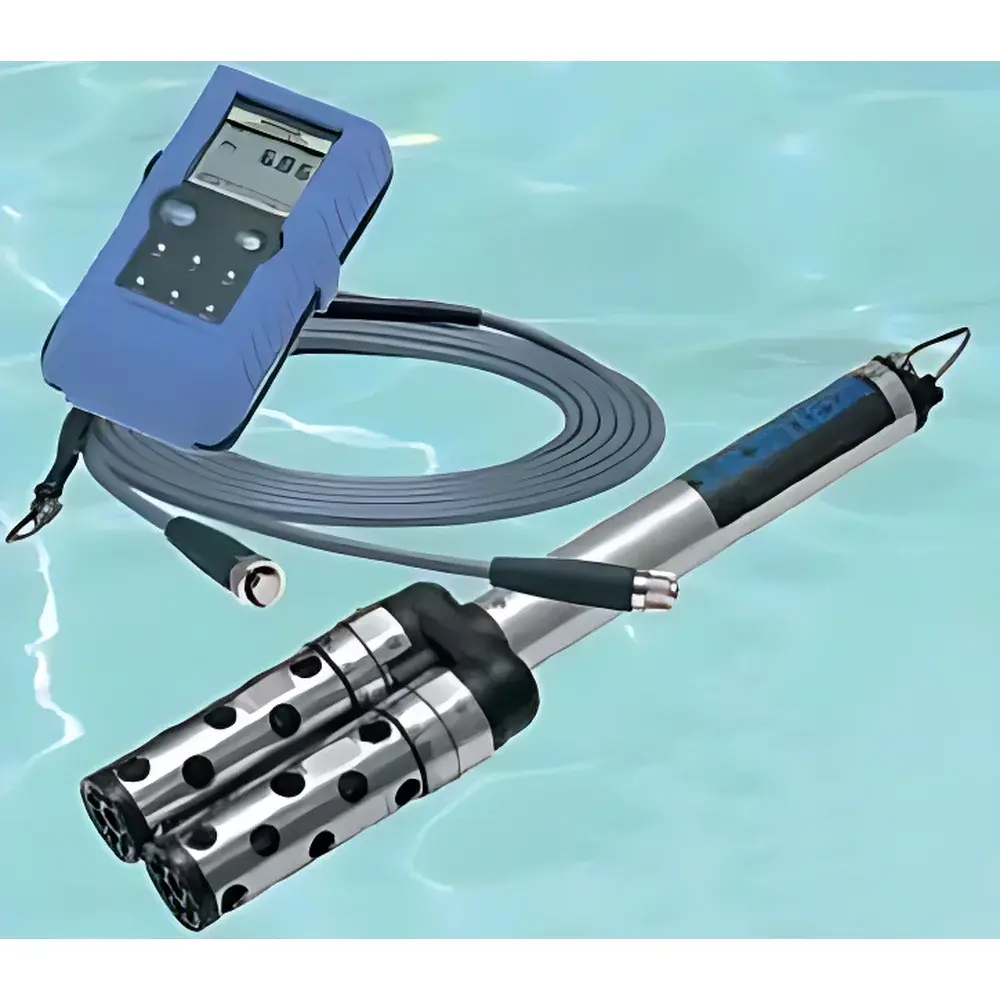
HORIBA W-20XD Series Multi-Parameter Water Quality Monitoring System
| Brand | HORIBA |
|---|---|
| Origin | Japan |
| Model | W-20XD Series |
| Instrument Type | Online Water Quality Analyzer |
| Operating Depth | Up to 100 m |
| Data Logging Duration | 30 days (2880 records, 15-min interval) |
| IP Rating | IP67 (Control Unit) |
| Simultaneous Parameters | Up to 13 (pH, DO, EC, Salinity, TDS, Seawater Specific Gravity, Turbidity, Depth, Temperature, ORP, and Select Ions) |
| Measurement Principles | Glass Electrode (pH), Membrane-Based Galvanic Cell (DO), AC 4-Electrode (EC), Thermistor (Temperature), Pressure Transducer (Depth), Optical Transmission/Scattering (Turbidity), Platinum Electrode (ORP), Ion-Selective Electrodes (NO₃⁻, Cl⁻, Ca²⁺, F⁻, K⁺, NH₃) |
Overview
The HORIBA W-20XD Series is a rugged, submersible multi-parameter water quality monitoring system engineered for long-term, unattended deployment in demanding aquatic environments—including rivers, lakes, reservoirs, coastal zones, groundwater wells, municipal wastewater outfalls, industrial effluent streams, and aquaculture facilities. Designed and manufactured in Japan, the system operates on a modular architecture centered around a waterproof (IP67-rated) control unit and interchangeable sensor probes. Its core measurement methodology integrates electrochemical, optical, and physical transduction principles: pH is measured via temperature-compensated glass electrode potentiometry; dissolved oxygen (DO) employs a membrane-covered galvanic cell with automatic salinity and temperature compensation; conductivity utilizes an AC-driven four-electrode configuration to minimize polarization errors and enable high-accuracy measurements across wide salinity ranges (0–9.99 S/m); turbidity follows ISO 7027-compliant transmission and scattering optics; depth is derived from absolute pressure sensing calibrated to seawater or freshwater density models; and ion concentrations (NO₃⁻, Cl⁻, Ca²⁺, F⁻, K⁺, NH₃) are quantified using selective membrane electrodes with configurable calibration protocols. All sensors are housed in a shock-resistant, pressure-rated probe assembly capable of continuous operation at depths up to 100 meters—validated under static hydrostatic load per JIS B 8201 and IEC 60529 standards.
Key Features
- Autonomous 30-day data logging: Internal non-volatile memory stores up to 2,880 timestamped records (15-minute default interval), eliminating dependency on external power or telemetry during deployment.
- True field-deployable design: The sensor unit operates independently—no cables required during measurement. Only retrieval and USB/data interface connection are needed for data download.
- High-pressure probe housing: Engineered for sustained operation at 100 m depth (1 MPa), featuring corrosion-resistant titanium alloy components and hermetically sealed ceramic electrolyte junctions.
- Multi-parameter synchronization: Simultaneous acquisition of up to 13 parameters ensures temporal correlation critical for diurnal cycle analysis, pollution event detection, and biogeochemical modeling.
- Intelligent auto-compensation: Real-time temperature, salinity, and pressure corrections applied algorithmically per parameter—adhering to ASTM D1293 (pH), ASTM D888 (DO), and ISO 7888 (conductivity) reference methodologies.
- Modular probe configuration: Users select from standardized sensor combinations (e.g., W-22XD base platform, W-23XD extended ion suite) without hardware modification—supporting GLP-compliant instrument qualification workflows.
Sample Compatibility & Compliance
The W-20XD Series is validated for use in natural freshwaters (pH 0–14, 0–55 °C), brackish estuaries, full-strength seawater (up to 40 ppt), and industrial effluents with suspended solids ≤800 NTU. Sensor materials—including PEEK housings, platinum reference electrodes, and solid-state ion-selective membranes—are chemically inert toward common contaminants (e.g., H₂S, heavy metals, organic solvents). The system conforms to key regulatory frameworks: its data integrity architecture supports audit trails compliant with FDA 21 CFR Part 11 when integrated with HORIBA’s optional secure software environment; calibration logs and raw sensor outputs meet ISO/IEC 17025 documentation requirements; and pressure-transducer-derived depth measurements align with IHO S-100 hydrographic metadata standards. All electrochemical sensors undergo factory calibration traceable to NIST-certified reference solutions.
Software & Data Management
Data retrieval is performed via USB 2.0 interface using HORIBA’s proprietary W-Quality Manager software (Windows OS). The application enables batch export in CSV, Excel (.xlsx), and XML formats—with embedded metadata fields for location (GPS-tagged via optional accessory), operator ID, calibration history, and environmental context flags. Raw sensor voltage outputs, temperature-compensated values, and diagnostic status codes (e.g., membrane dryness, electrode drift alerts) are preserved without interpolation. For networked deployments, optional GPRS/LoRaWAN telemetry modules support encrypted MQTT transmission to cloud platforms (e.g., AWS IoT Core, Azure IoT Hub) with TLS 1.2 encryption and configurable QoS levels. Software-generated reports include statistical summaries (min/max/mean/std dev), time-series plots with dual-Y axes, and compliance dashboards aligned with EU WFD Annex V and US EPA Method 160.1 reporting templates.
Applications
- Long-term limnological studies: Tracking seasonal stratification, hypolimnetic oxygen depletion, and nutrient flux dynamics in lakes and reservoirs.
- Coastal zone monitoring: Quantifying eutrophication drivers (NO₃⁻, NH₃, PO₄³⁻*), salinity intrusion fronts, and carbonate system perturbations (pH, alkalinity proxy via EC/TDS).
- Industrial discharge compliance: Continuous verification of effluent parameters against local permits (e.g., pH 6–9, DO >5 mg/L, Cl⁻ <200 mg/L).
- Aquaculture health management: Real-time surveillance of dissolved oxygen saturation, ammonia toxicity thresholds, and temperature-dependent metabolic stress indicators.
- Groundwater vulnerability assessment: Detecting anthropogenic chloride plumes, nitrate leaching from agricultural zones, and redox-sensitive species (ORP) shifts indicative of contaminant biodegradation.
- Calibration transfer validation: Serving as a field reference standard for validating handheld meters and fixed-station analyzers per ISO 5667-22 field intercomparison protocols.
FAQ
What is the maximum operational depth, and how is pressure tolerance verified?
The W-20XD probe is rated for continuous operation at 100 m (1 MPa) based on hydrostatic pressure testing per JIS B 8201 Class 3 and IEC 60529 IP68 extended immersion criteria. Each unit undergoes individual pressure cycling validation prior to shipment.
Can the system measure ammonia (NH₃) in low-pH waters?
Ammonia ion-selective measurement requires pH ≥12 for optimal speciation (NH₃ vs. NH₄⁺). For ambient pH conditions, total ammonia nitrogen (TAN) estimation must be performed externally using laboratory analysis (e.g., EPA 350.1) and correlated with W-20XD pH/temperature data.
Is remote firmware update supported over cellular networks?
Firmware updates require local USB connection and authenticated W-Quality Manager session. Over-the-air updates are not implemented to preserve deterministic timing control and regulatory auditability.
How frequently must calibration be performed in field deployments?
For regulatory-grade data, two-point pH calibration and DO zero/span verification are recommended before each deployment cycle. Conductivity and ion sensors benefit from single-point verification using certified standard solutions every 7–14 days under high-fouling conditions.
Does the system comply with GLP or GMP documentation requirements?
Yes—when used with W-Quality Manager’s audit trail module (enabled via license key), the system generates electronic records meeting ALCOA+ principles: Attributable, Legible, Contemporaneous, Original, Accurate, Complete, Consistent, Enduring, and Available per FDA and EMA guidance documents.







